ERGO Network Snapshot Of Social Dialogue And Involvement Of Workers

Snapshot on the Situation of Roma in Europe: Social Dialogue and Involvement of Workers 

Our Snapshots on the Situation of Roma in Europe are a series of reader-friendly, visually attractive handouts, linking each of the 20 policy principles of the European Pillar of Social Rights to Roma rights and inclusion. Each Snapshot includes key statistics, a brief problem statement, and extensive policy recommendations.  

Roma workers are over-represented in precarious forms of employment, while they are under-represented in trade union structures. This means that they have limited access to information and support, as well as that their specific concerns – such as the ethnic pay gap and antigypsyism – are often not addressed in collective bargaining.  

For more information about our work on Social Dialogue and Involvement of Workers, please contact Amana Ferro (a.ferro@staging.ergonetwork.org), Senior Policy Adviser with the ERGO Network staff team. 

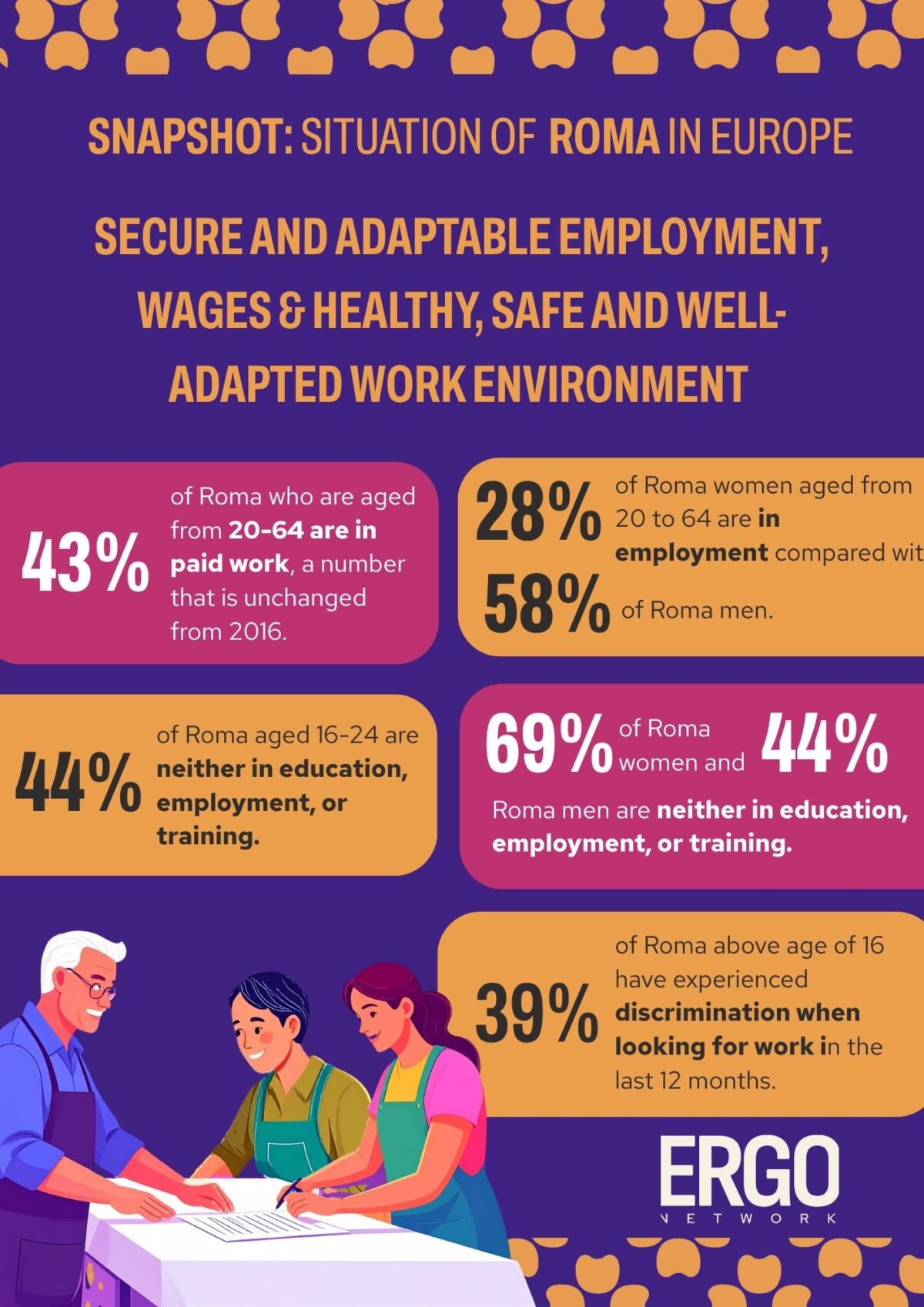
ERGO Network Snapshot Of Secure and Adaptable Employment, Wages and Work Environment

Snapshot on the Situation of Roma in Europe:  Secure and Adaptable Employment, Wages, and Healthy, Safe and Well-Adapted Work Environment 

Our Snapshots on the Situation of Roma in Europe are a series of reader-friendly, visually attractive handouts, linking each of the 20 policy principles of the European Pillar of Social Rights to Roma rights and inclusion. Each Snapshot includes key statistics, a brief problem statement, and extensive policy recommendations.  

Roma workers are often confined to precarious, unsafe, and low-paid jobs, with limited employment rights and social security. They also don’t benefit from almost any opportunities for training or career progression, while they face discrimination and exploitation in the workplace, such as the ethnic pay gap or being given unsafe and unsuitable tasks.   

  • Read the Snapshot here! 

For more information about our work on Secure and Adaptable Employment, Wages, and Working Conditions, please contact Amana Ferro (a.ferro@staging.ergonetwork.org), Senior Policy Adviser with the ERGO Network staff team. 

Digital deprivation should not become a new obstacle for Roma students

Digital deprivation should not become a new obstacle for Roma students
The Roma are left out as digital citizens and cannot benefit from the simple values of digital citizenship based on respect, education, and protection – Mustafa Jakupov
Find out more about digital divide and how it affects the Roma children and students in this article by Mustafa Jakupov on DigiGen – Research on the Digital Generation

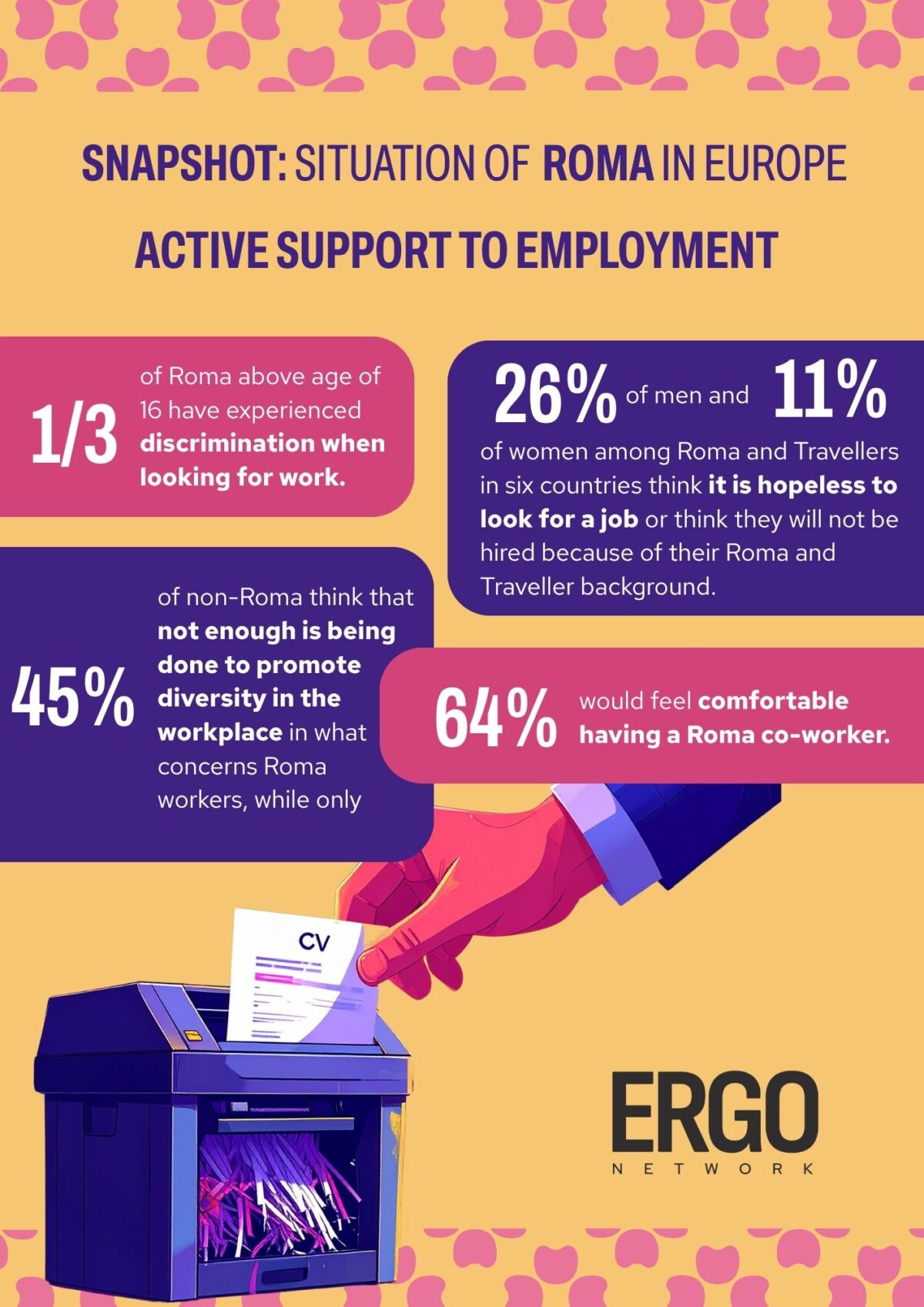
ERGO Network Snapshot Of Active Support to Employment

Snapshot on the Situation of Roma in Europe: Active Support to Employment 

Our Snapshots on the Situation of Roma in Europe are a series of reader-friendly, visually attractive handouts, linking each of the 20 policy principles of the European Pillar of Social Rights to Roma rights and inclusion. Each Snapshot includes key statistics, a brief problem statement, and extensive policy recommendations.  

Today, we look at active labour market policies and their usefulness when it comes to Roma jobseekers. While the Roma want to work, and they bring tremendous skills and commitment to the table, an employment-first approach is not always suitable, and they need the right mix of comprehensive measures to support them towards quality employment.  

  • Read the Snapshot here! 

For more information about our work on Active Support to Employment, please contact Amana Ferro (a.ferro@staging.ergonetwork.org), Senior Policy Adviser with the ERGO Network staff team. 

ERGO Network launches its research report on Roma access to adequate minimum income schemes

ERGO Network launches its research report on Roma access to adequate minimum income schemes

The European Roma Grassroots Organisations (ERGO) Network is holding today, 23 November, its annual Policy Conference, entitled “Implementing the EU Roma Strategic Framework. Roma access to adequate minimum income.”

Europe’s Roma experience some of the worst social inclusion indicators, with over 80% living in poverty, only 43% in paid employment, and 41% experiencing antigypsyism. This situation worsened significantly during the Covid-19 pandemic, with Roma communities being disproportionately hard hit. In a cash-based economy, providing people with adequate financial resources is a necessary pre-requisite for fighting poverty and social exclusion, as well as for enabling individuals to reach their full potential and to access rights and opportunities on the labour market and in society.

Access to adequate minimum income and social protection is the cornerstone of the European Social Model and our welfare states, and it needs to be guaranteed also for Europe’s Roma. The EU Council Recommendation of 24 June 1992 on Common criteria concerning sufficient resources and social assistance in social protection systems clearly urges Member States “to recognize the basic right of a person to sufficient resources and social assistance to live in a manner compatible with human dignity as part of a comprehensive and consistent drive to combat social exclusion.” This commitment is reaffirmed in the EU Active Inclusion Recommendation (2008) and the European Pillar of Social Rights (2017).

During 2021, ERGO Network conducted in-depth national case studies in five countries (Bulgaria, the Czech Republic, Hungary, Romania, and Slovakia), looking at existing minimum income schemes and assessing to what extent they are accessible to Roma applicants, and whether they are adequate for promoting Roma inclusion and dignity. The main findings and recommendations were brought together in an EU synthesis report, launched today in the framework of the above-mentioned event.

With this research, we aim to kick-start a debate with policy makers on how to improve the adequacy and take-up of minimum income and social protection by Roma in Europe, including in the framework of the European Pillar of Social Rights Action Plan, and the foreseen Council Recommendation on Minimum Income (2022). Access to sufficient financial resources is also a key element of reducing Roma poverty and social exclusion, which is one of the three horizontal objectives of the EU Roma Strategic Framework on Equality, Inclusion, and Participation.

For more information about ERGO Network’s work on adequate minimum income and social protection for Roma, as well as on Roma poverty and social exclusion (European Semester, European Pillar of Social Rights, etc), please contact Senior Policy Adviser Amana Ferro.

`
Publications – Page 7 – ERGO Network

By continuing to use the site, you agree to the use of cookies. more information

The cookie settings on this website are set to "allow cookies" to give you the best browsing experience possible. If you continue to use this website without changing your cookie settings or you click "Accept" below then you are consenting to this.

Close