ERGO Network Snapshot of Old Age Income and Pensions

Snapshot on the Situation of Roma in Europe: Old-Age Income and Pensions  

Our Snapshots on the Situation of Roma in Europe are a series of reader-friendly, visually attractive handouts, linking each of the 20 policy principles of the European Pillar of Social Rights to Roma rights and inclusion. Each Snapshot includes key statistics, a brief problem statement, and extensive policy recommendations.  

Most older Roma face stark health and income inequalities, due to a lifelong experience of poverty, poor housing, inadequate nutrition, and precarious work. At the same time, they are left with minimal pension entitlements, limited access to quality, inclusive, and proximity healthcare and long-term care services, and compounded discrimination based on both ethnicity and age, which, additionally, particularly impacts older Roma women. 

  • Read the Snapshot here! 

For more information about our work on older Roma, please contact Amana Ferro (a.ferro@staging.ergonetwork.org), Senior Policy Adviser with the ERGO Network staff team. 


European Commission releases Annual Sustainable Growth Survey (ASGS) 2022

European Commission releases Annual Sustainable Growth Survey (ASGS) 2022

What’s in it for Europe’s Roma?

On 24 November 2021, the European Commission published the Annual Sustainable Growth Survey 2022, accompanied by the draft Joint Employment Report 2022 (among other annexes), thus launching the European Semester 2022.

  • Read our full response to ASGS and the JER 2022 here!

The Annual Sustainable Growth Survey reaffirms that “the European Semester will remain the overall EU framework for the coordination of economic, employment and social policies”, while the Recovery and Resilience Facility remains “the key tool to implement the policy agenda” and is fully embedded in the European Semester. It also confirms the commitment to the four complementary dimensions of environmental sustainability, productivity, fairness, and macroeconomic stability.

For the second consecutive year, there is no mention of Europe’s Roma in this year’s Annual Sustainable Growth Survey and, unlike in previous years, there is equally no reference to ethnic or racial minority background. Similarly, the text contains no mention of antigypsyism or even discrimination anywhere in its content.

The main focus is on the green and digital transitions and, while social concerns are integrated as a component of these transitions and also have a dedicated section under the fairness objective, the prioritizing doesn’t seem to be at least on equal footing. The fairness section extensively covers education and training, as well as employment, however these are understood very narrowly from the perspective of their contribution to the twin transition. We appreciate the focus on combatting inequalities in education (including the digital divide) and the impetus to promote inclusion, diversity, and gender equality, as well as calls to stem energy poverty. However, we are missing references to ensuring access to fundamental services and rights, such as health or housing.

We are very pleased to see Europe’s Roma mentioned multiple times in the Joint Employment Report, concerning their heightened risk of experiencing poverty and social exclusion (including that of children), gaps in accessing education and training, school segregation, and the disproportionate impact of the Covid-19 pandemic (including on employment and income levels). Additionally, strong links are made to the EU Strategic Framework on Roma Equality, Inclusion, and Participation. However, disappointingly, while the document is quite extensive in covering Roma poverty and education, other thematic objective of the EU Roma Framework – employment, housing, health – are not covered at all in the Report. Equally, there is no mention of antigypsyism or racism.

Regarding civil dialogue, the Annual Sustainable Growth Survey only mentions civil society once, while the systematic involvement of social partners is much more consistently stressed. In the draft Joint Employment Report, civil society involvement is much better covered, with multiple references to its instrumental role as an important asset in implementing social and employment policies.

The ASGS also provides some clarity about the future of the European Semester, as well as what are the key steps and milestones to be expected for 2022. This year’s Semester will include the implementation of the Recovery and Resilience Facility, that of the European Pillar of Social Rights Action Plan, and – as a new element – that of the Sustainable Development Goals.

ERGO Network will continue to engage closely with the European Semester 2022, and strive to bring Roma rights and inclusion much more in focus in the delivery of these initiatives, and for better alignment of the priorities of the Semester and those of the EU Strategic Framework for Roma Equality, Participation, and Inclusion.

For more information about ERGO Network’s work on EU social inclusion and employment policy (European Semester, European Pillar of Social Rights, Sustainable Development Goals etc), please contact Senior Policy Adviser Amana Ferro.

ERGO Network Snapshot of Social Protection and Unemployment Benefits

Snapshot on the Situation of Roma in Europe: Social Protection, Unemployment Benefits, and Minimum Income  

Our Snapshots on the Situation of Roma in Europe are a series of reader-friendly, visually attractive handouts, linking each of the 20 policy principles of the European Pillar of Social Rights to Roma rights and inclusion. Each Snapshot includes key statistics, a brief problem statement, and extensive policy recommendations.  

The overwhelming majority of Roma in Europe, in fact over 80% of them, live in deep and persistent poverty, driven by limited access to adequate income and compounded by systemic discrimination. Many Roma are excluded from social protection entitlements due to strict eligibility requirements, inaccessible systems designed to discourage applicants, and widespread stigmatisation of beneficiaries.  

  • Read the Snapshot here! 

For more information about our work on Social Protection, Unemployment Benefits, and Minimum Income, please contact Amana Ferro (a.ferro@staging.ergonetwork.org), Senior Policy Adviser with the ERGO Network staff team. 


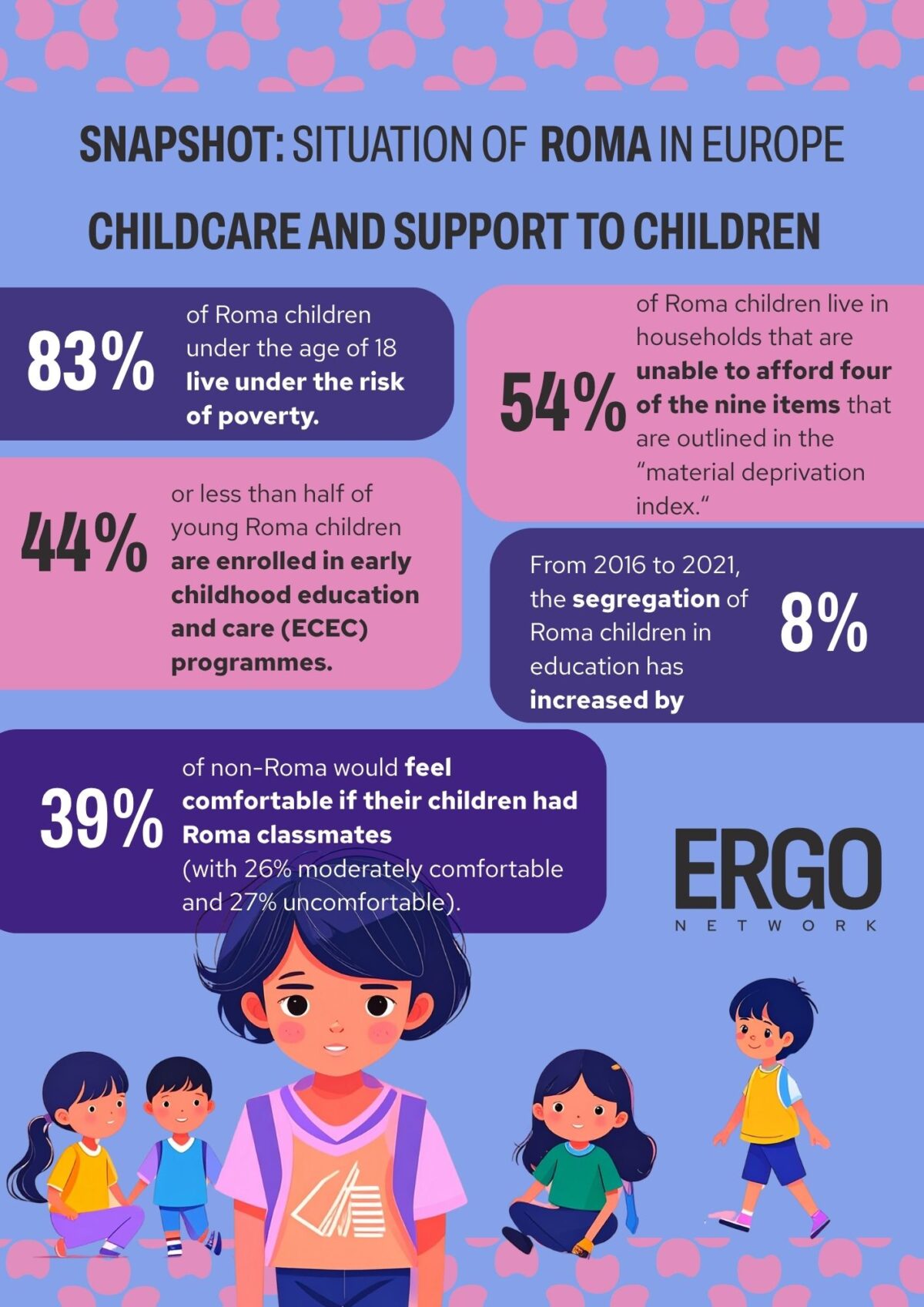
ERGO Network Snapshot of Childcare and Support to Children

Snapshot on the Situation of Roma in Europe: Childcare and Support to Children  

Our Snapshots on the Situation of Roma in Europe are a series of reader-friendly, visually attractive handouts, linking each of the 20 policy principles of the European Pillar of Social Rights to Roma rights and inclusion. Each Snapshot includes key statistics, a brief problem statement, and extensive policy recommendations.  

Across Europe, one in three Roma children faces deep-rooted poverty, exclusion, and antigypsyism, that undermine their development from the earliest years. This includes barriers to education, healthcare, housing, and essential services, combined with antigypsyism and harmful practices like family separation.  

  • Read the Snapshot here! 

For more information about our work on Childcare and Support to Children, please contact Amana Ferro (a.ferro@staging.ergonetwork.org), Senior Policy Adviser with the ERGO Network staff team. 

ERGO Network report on National Recovery and Resilience Plans – Bulgaria update

ERGO Network report on National Recovery and Resilience Plans – Bulgaria update

In September 2021, we published our comprehensive analysis report of the National Recovery and Resilience Plans (NRRPs), prepared by EU Member States in the framework of the European Semester. We are now releasing an update of this report, which now covers 12 countries and also includes Bulgaria, where the NRRP was only submitted by the Government on 15 October 2021.

Access the report here

`
Publications – Page 6 – ERGO Network

By continuing to use the site, you agree to the use of cookies. more information

The cookie settings on this website are set to "allow cookies" to give you the best browsing experience possible. If you continue to use this website without changing your cookie settings or you click "Accept" below then you are consenting to this.

Close