Thematic European Pillar of Social Rights Snapshots social media campaign

Roma inclusion and the European Pillar of Social Rights –

Thematic Snapshots social media campaign

In 2017, the European Union broke new ground by adopting the European Pillar of Social Rights (Social Pillar), the first set of social rights proclaimed by the EU institutions since the Charter of Fundamental Rights in the year 2000.

This comprehensive initiative of 20 social policy principles, complemented by a Social Scoreboard of 14 indicators, aims at supporting well-functioning and fair labour markets and welfare systems, with a focus on better integrating and delivering on social concerns.

The European Commission has pledged to make the Social Pillar “the compass of Europe’s recovery and our best tool to ensuring no one is left behind”, so that Europe’s future is socially fair and just.

Following up on this commitment, on 4 March 2021, the European Commission proposed the European Pillar of Social Rights Action Plan, aiming to turn its 20 policy principles into concrete policy actions.

To support this process, ERGO Network has prepared a comprehensive analysis of the 20 principles of the Social Pillar, to ensure that their implementation specifically includes Roma concerns, and that meaningful interplay is sought with the EU Strategic Framework for Roma Equality, Inclusion, and Participation.

This thematic analysis was released weekly as separate “Snapshots” on our social media channels (Facebook, Twitter, LinkedIn, and Instagram), as part of a campaign that ran from 9 November 2021 to 15 February 2022. Each Snapshot includes relevant European statistics, a brief problem statement, as well as concrete policy recommendations:

We hope that the implementation of the Action Plan of the European Pillar of Social Rights will be used as a true opportunity to ensure that Europe’s Roma are not left behind, particularly in the context of the Covid-19 pandemic and recovery.

Further reading:

For more information about ERGO Network’s work on the European Pillar of Social Rights, please contact Senior Policy Adviser Amana Ferro.
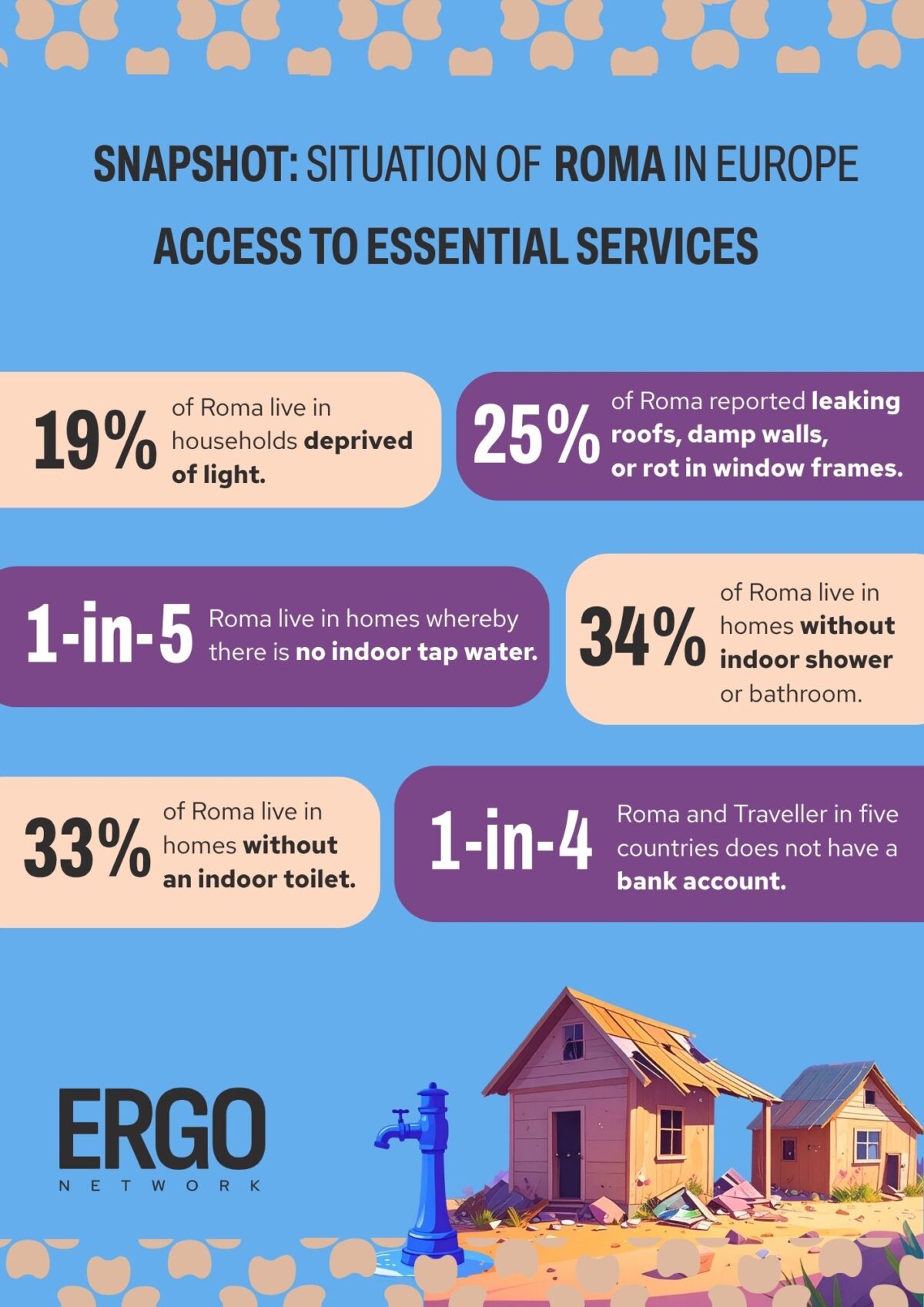
ERGO Network Snapshot of Access to Essential Services

Snapshot on the Situation of Roma in Europe: Access to Essential Services  

Our Snapshots on the Situation of Roma in Europe are a series of reader-friendly, visually attractive handouts, linking each of the 20 policy principles of the European Pillar of Social Rights to Roma rights and inclusion. Each Snapshot includes key statistics, a brief problem statement, and extensive policy recommendations.  

Roma communities across Europe continue to face multiple, complex obstacles in their efforts to access essential services, ranging from clean water and heating, to transport and digital inclusion. These obstacles revolve around extreme poverty, inadequate service infrastructure, administrative exclusion and undocumented status, antigypsyism, and – not least – the ongoing and increased privatisation of public services. 

  • Read the Snapshot here! 

 For more information about our work on Access to Essential Services, please contact Amana Ferro (a.ferro@staging.ergonetwork.org), Senior Policy Adviser with the ERGO Network staff team. 

European Commission’s Action Plan for Social Economy – What’s in it for Europe’s Roma?

European Commission unveils the EU Action Plan for Social Economy

– What’s in it for Europe’s Roma?

On 9 December 2021, the European Commission proposed an EU Social Economy Action Plan, aimed at putting forward concrete measures to help mobilise the full potential of social economy, including through improved visibility and recognition and access to finance and markets.

ERGO Network has closely engaged with the run-up to the Action Plan, with a view to raising awareness on the key role social economy can play in contributing to Roma inclusion and to delivering on the objectives of the EU Roma Strategic Framework. In 2020, we released a  comprehensive position paper, The role of Social Economy in supporting Roma social and economic inclusion. A close-up on the Covid-19 pandemic and the recovery strategies. With our members, we have reviewed the proposed EU Social Economy Action Plan in light of the key messages of our own position paper.

  • Read ERGO Network’s full response to the EU Social Economy Action Plan here!

Regrettably, there is only one mention of Europe’s Roma in the Action Plan, namely in the Introduction, with no other references to ethnic background, minorities, or racialised communities in the rest of the document. For social economy enterprises to actually support vulnerable groups such as the Roma, clear indicators that monitor Roma participation in social economy initiatives are needed. Additionally, social economy actors must be mindful of deeply rooted discrimination and antigypsyism and make conscious efforts to combat any such tendencies.

ERGO Network salutes proposals to better include social economy business models in entrepreneurship educational curricula, and the commitment to support the development of social impact measurement and management, including involving stakeholders in the development of assessment methodologies. However, we are disappointed to see that the contribution of social economy to reducing poverty and social exclusion is insufficiently mentioned, while failing to create fruitful synergies with the EU Roma Strategic Framework, as well as with the European Pillar of Social Rights in a comprehensive way.

While we welcome that developing policy and legal frameworks is one of the explicit objectives of the Action Plan, we would have liked to see the key aspect of the social and societal goals more strongly emphasised, as well as an explicit commitment to embed a partnership approach involving key stakeholders, including Roma communities and their civil society representatives.

ERGO Network appreciates that the Action Plan highlights the added value that social economy enterprises bring to local communities, stressing their strong local roots and the impetus to serve the communities where they are based. However, the role and potential of these communities is insufficiently taken into account in the document. Social economy initiatives must enshrine a broad bottom-up approach, based on real community needs and grassroot input, giving the Roma a voice in the process.

While the Action Plan clearly spells out the need for business development support for social enterprises, disappointingly nothing is said about supporting Roma social entrepreneurs. This is a glaring missed opportunity to tap into the enormous potential and competences that the Roma bring to the table. More targeted support is needed to build the capacity of the Roma, and the existence and potential of social enterprises need to be better promoted in Roma communities.

We equally welcome that the Action Plan acknowledges the key role of public financial support for social enterprises, as well as the commitment to increase the level of support in the next programming period. However, the document doesn’t take into account the fact that marginalised and racialised communities face additional barriers in accessing funding, nor does it put forward proposals to address them.

Social economy offers great potential to address Roma poverty, employment, health, education, accommodation, nutrition, and to keep alive Roma culture and crafts. ERGO Network expresses its hope that the gaps identified above will be remedied through implementation and stands ready to support these efforts, at both the EU and the national level.

For more information about our work on Social Economy, please contact Amana Ferro (a.ferro@staging.ergonetwork.org), Senior Policy Adviser with the ERGO Network staff team.

ERGO Network Snapshot of Housing and assistance for the homeless

Snapshot on the Situation of Roma in Europe: Housing and Assistance for the Homeless  

Our Snapshots on the Situation of Roma in Europe are a series of reader-friendly, visually attractive handouts, linking each of the 20 policy principles of the European Pillar of Social Rights to Roma rights and inclusion. Each Snapshot includes key statistics, a brief problem statement, and extensive policy recommendations.  

Many Roma across Europe live in de facto homelessness, or in insecure or substandard housing, in segregated informal settlements that lack access to services and pose environmental hazards. Widespread antigypsyism from all housing actors (landlords, sellers, banks, neighbours etc), ever-rising housing and utility costs, insufficient access to social housing, and forced evictions prevent them from accessing an adequate standard of living.  

  • Read the Snapshot here! 

For more information about our work on Housing and Assistance for the Homeless, please contact Amana Ferro (a.ferro@staging.ergonetwork.org), Senior Policy Adviser with the ERGO Network staff team. 

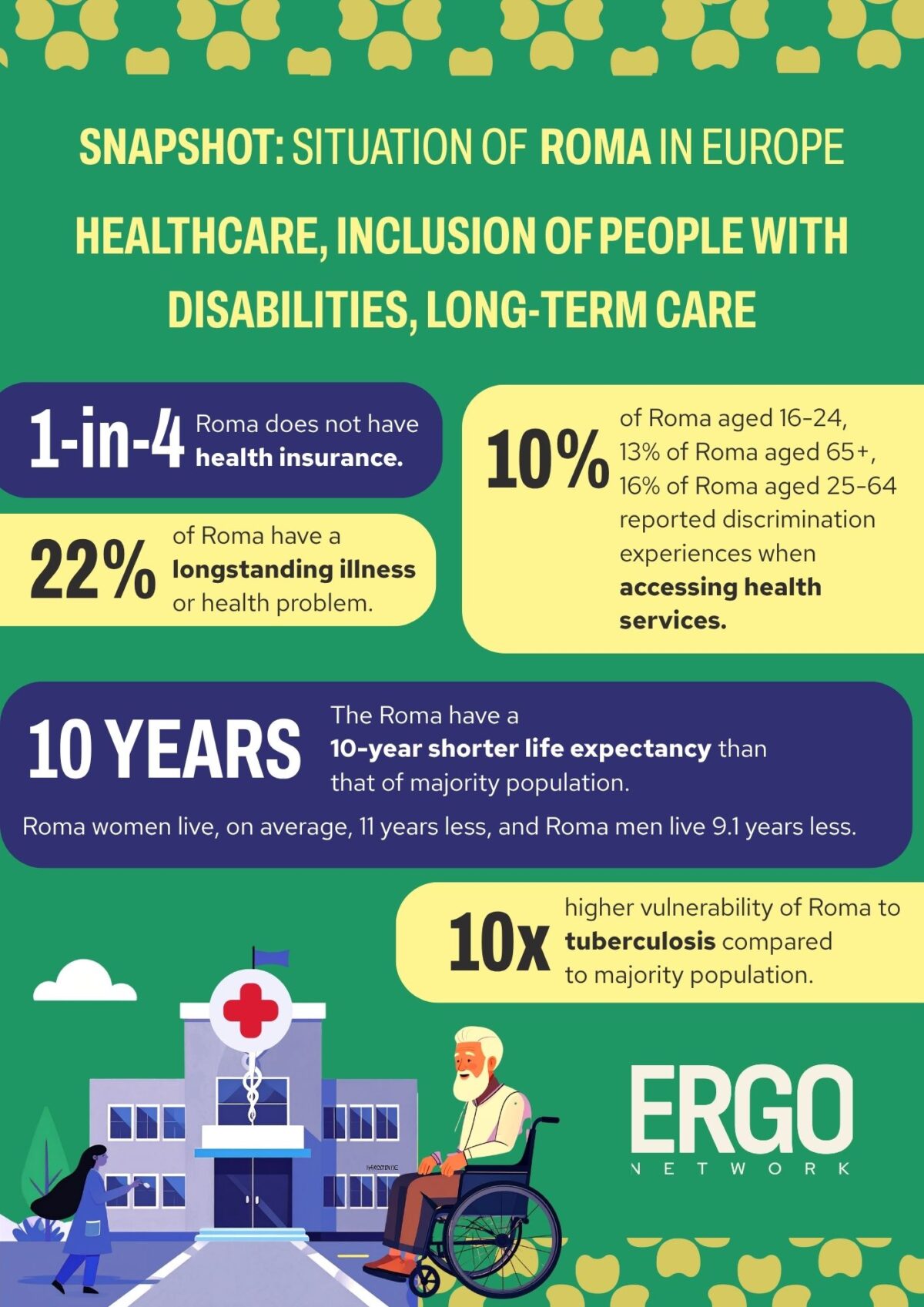
ERGO Network Snapshot of Health care, Inclusion of people with disabilities, Long-term care

Snapshot on the Situation of Roma in Europe: Healthcare, Inclusion of People with Disabilities, Long-Term Care  

Our Snapshots on the Situation of Roma in Europe are a series of reader-friendly, visually attractive handouts, linking each of the 20 policy principles of the European Pillar of Social Rights to Roma rights and inclusion. Each Snapshot includes key statistics, a brief problem statement, and extensive policy recommendations.  

Systemic health inequalities and entrenched unmet care needs are a daily reality for most of Europe’s Roma, entrenching disparities that range from life expectancy to prevalence of disabilities, across the medical spectrum, from mental health to sexual and reproductive health and rights. These are driven by social determinants such as poverty, antigypsyism, exclusion from services and insurance, and under-utilisation of Roma health mediators. 

  • Read the Snapshot here! 

For more information about our work on Healthcare, Inclusion of People with Disabilities, Long-Term Care, please contact Amana Ferro (a.ferro@staging.ergonetwork.org), Senior Policy Adviser with the ERGO Network staff team. 

`
Publications – Page 5 – ERGO Network

By continuing to use the site, you agree to the use of cookies. more information

The cookie settings on this website are set to "allow cookies" to give you the best browsing experience possible. If you continue to use this website without changing your cookie settings or you click "Accept" below then you are consenting to this.

Close