ERGO NETWORK SNAPSHOT OF Equal Opportunities

Snapshot on the Situation of Roma in Europe: Equal Opportunities 

Our Snapshots on the Situation of Roma in Europe are a series of reader-friendly, visually attractive handouts, linking each of the 20 policy principles of the European Pillar of Social Rights to Roma rights and inclusion. Each Snapshot includes key statistics, a brief problem statement, and extensive policy recommendations.   

Providing equal opportunities for all and combatting antigypsyism and all forms of intersectional discrimination are not a Roma issue, but a European imperative. Ending centuries of racism and exclusion of the Roma requires urgent political will, legal reform, and full recognition of Roma history, culture, identity, and rights.  

  • Read the Snapshot here! 

For more information about our work on Antigypsyism, Anti-Racism, and Equal Opportunities, please contact Isabela Mihalache (i.mihalache@staging.ergonetwork.org), Senior Advocacy Officer with the ERGO Network staff team. 


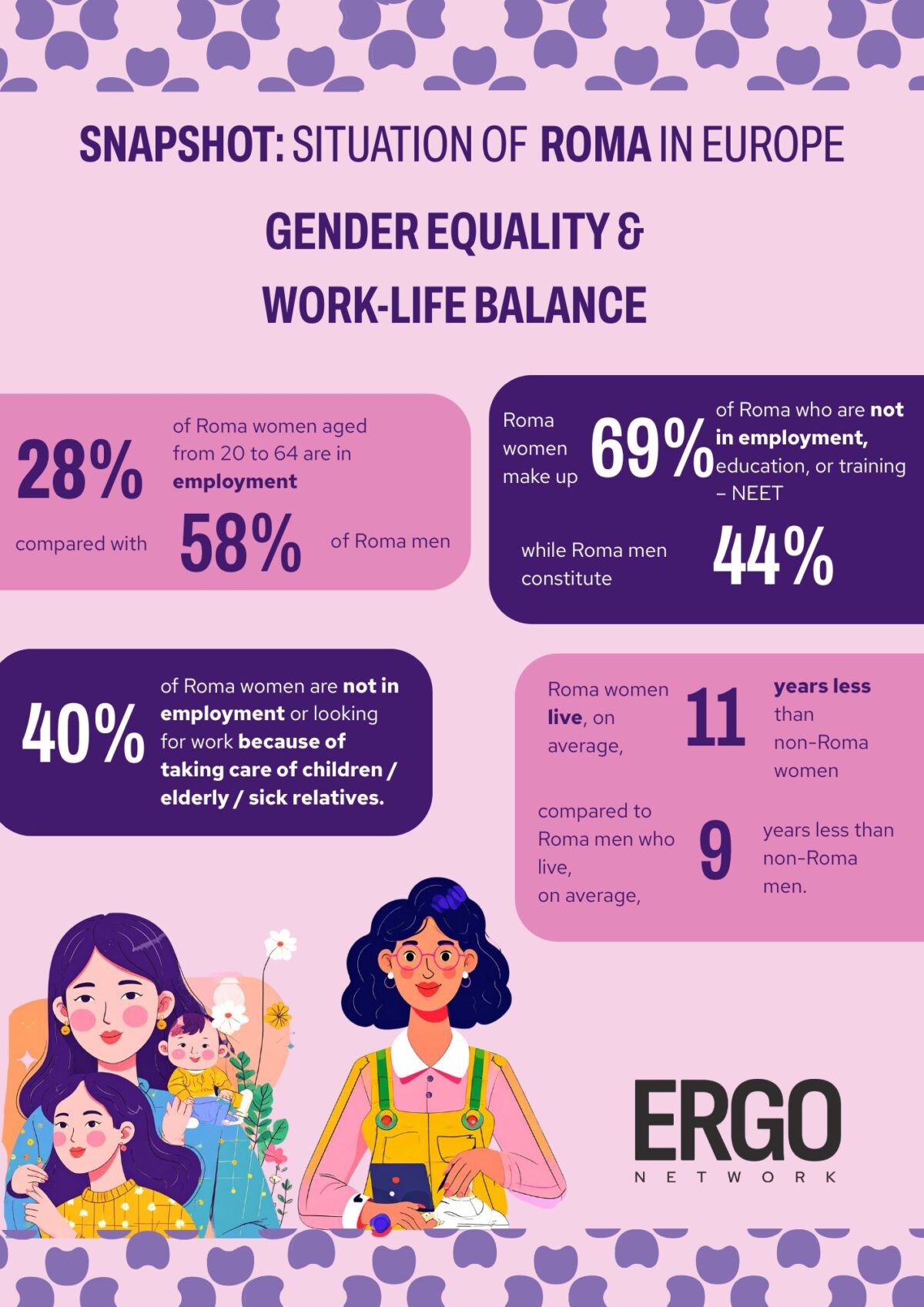
ERGO NETWORK SNAPSHOT OF GENDER EQUALITY AND WORK-LIFE BALANCE

Snapshot on the Situation of Roma in Europe: Gender Equality & Work-Life Balance 

Our Snapshots on the Situation of Roma in Europe are a series of reader-friendly, visually attractive handouts, linking each of the 20 policy principles of the European Pillar of Social Rights to Roma rights and inclusion. Each Snapshot includes key statistics, a brief problem statement, and extensive policy recommendations.  

Roma women across Europe face systemic and compounded discrimination, shaped by the intersection of ethnicity, gender, and class. From unpaid care to exploitative frontline jobs and exclusion from decision-making, their rights remain overlooked. It’s time to hear and celebrate their voices! 

For more information about our work on Roma women and gender equality, please contact Isabela Mihalache (i.mihalache@staging.ergonetwork.org) and Amana Ferro (a.ferro@staging.ergonetwork.org), senior policy staff with the ERGO Network staff team. 

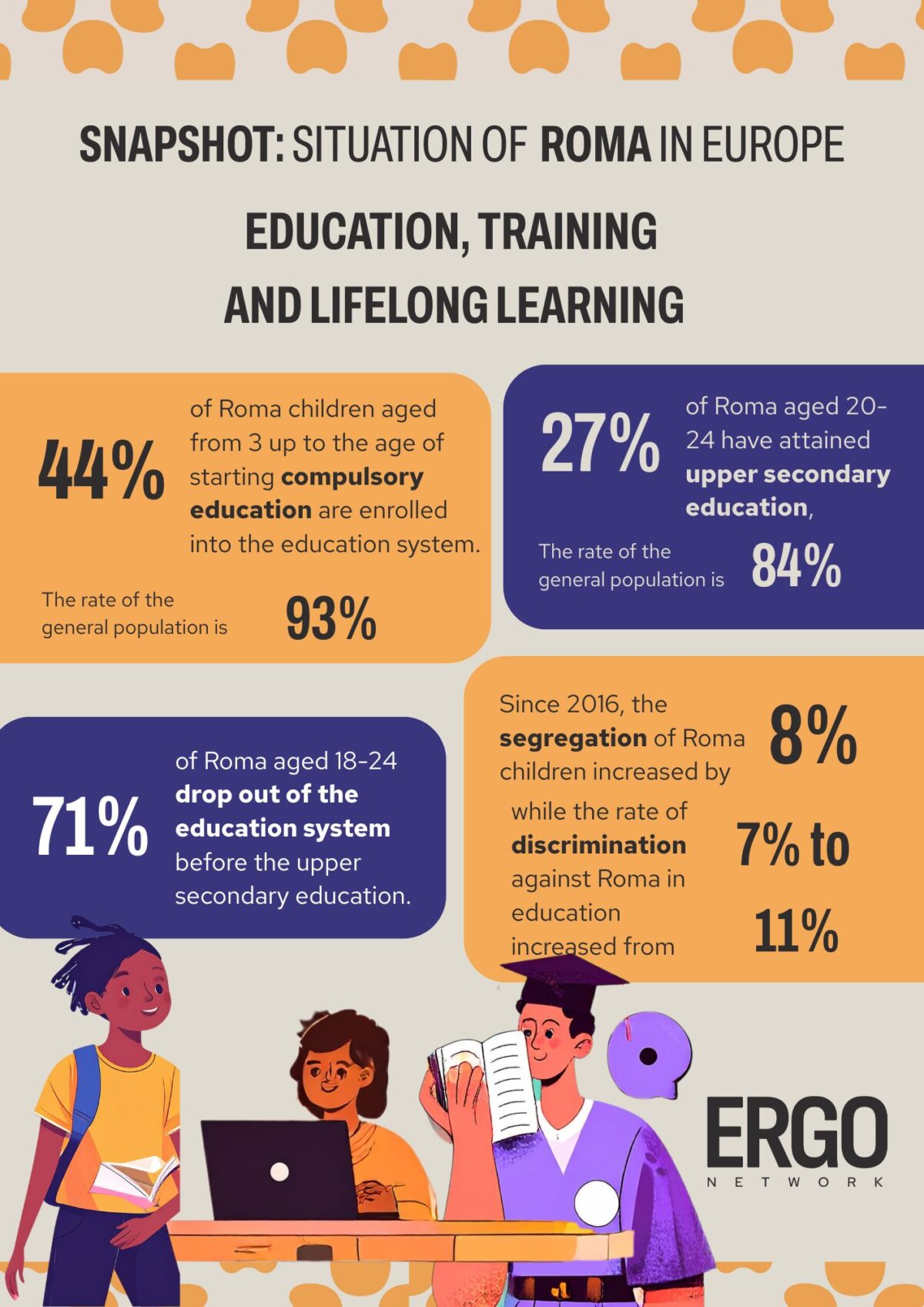
ERGO Network Snapshot of: Education, Training and Lifelong Learning

Snapshot on the Situation of Roma in Europe: Education, Training, and Lifelong Learning 

Our Snapshots on the Situation of Roma in Europe are a series of reader-friendly, visually attractive handouts, linking each of the 20 policy principles of the European Pillar of Social Rights to Roma rights and inclusion. Each Snapshot includes key statistics, a brief problem statement, and extensive policy recommendations.  

Roma children and students continue to encounter deep-seated discrimination and exclusion in educational settings, facing barriers such as poverty, segregation, language gaps, and hidden costs. These challenges persist across all levels of education and are compounded by a lack of culturally sensitive support, under-utilisation of Roma mediators, and the continued absence of Roma history and culture in national curricula. 

  • Read the Snapshot here! 

For more information about our work on Education, Training, and Lifelong Learning, please contact Amana Ferro (a.ferro@staging.ergonetwork.org), Senior Policy Adviser with the ERGO Network staff team. 

Member States submit National Recovery and Resilience Plans (NRRPs) – What’s in it for Europe’s Roma?

Member States submit National Recovery and Resilience Plans (NRRPs) – What’s in it for Europe’s Roma?

Over the past few months (April-July 2021), most Member States have submitted their National Recovery and Resilience Plans (NRRPs), in the framework of the 2021 European Semester.

The European Roma Grassroots Organisations (ERGO) Network and its national members have engaged closely with this process, with a view to ensure that Roma rights and inclusion were prioritised in the recovery efforts, following the Covid-19 pandemic. Roma people in Europe face poverty and social exclusion at rates of over 80% in most Member States, while their employment, education, health, housing, and other indicators are extremely low compared to the majority of the population, and antigypsyism and discrimination continue to be rampant. The coronavirus crisis only exacerbated this pre-existing situation.

ERGO Network conducted its own in-depth research, in the second part of 2020, on the impact of Covid-19 and associated measures on Roma communities in Europe. 1352 respondents from seven EU Member States (BE, BG, CZ, HU, IE, RO, SK), five Western Balkan countries (AL, B&H, NM, KO, RS) and Turkey provided evidence on how, despite some positive responses regarding immediate measures taken by some governments to assist vulnerable groups, including Roma and Travellers, the pandemic disproportionately hit these communities. You can access the full study here, and/or watch a short animated video of the key findings here.

Against this baseline, ERGO Network’s national members in 11 Member States have performed a detailed review of their countries’ National Recovery and Resilience Plans (AT, BE, CZ, FR, DE, HU, IE, LT, RO, SK, ES), to assess to what extent the Roma were being explicitly included in national reforms and investments to be supported through the EU Recovery and Resilience Facility. Read below a synthesis of this review, which also informed the Key Messages of this analysis:

1.  Only 5 of the 11 reviewed NRRPs (CZ, HU, RO, SK ES) explicitly refer to the Roma, despite the dire situation most of them were facing even before the pandemic, now much worsened. Our members deem most measures welcome, but insufficient to tackle root causes of exclusion.

2. None of the 11 reviewed NRRPs includes any references to antigypsyism, while more than half (7/11) also do not mention discrimination or racism. Those that do refer to discrimination only take into account gender equality, disability, sexual orientation, or migrant background.

3. The EU and National Roma Frameworks are absent from most (8/11) of the NRRPs reviewed (AT, BE, CZ, FR, DE, IE, LT, ES). When they are mentioned (HU, RO, SK), these are general references or problem statements, rather than concrete measures to bring about change.

4. None of the 11 Plans reviewed appears to prioritise the social inclusion of vulnerable groups, which is highly disappointing, but not surprising in a context where there was no earmarked minimum amount for social spending in the European Commission Guidance on the NRRPs.

5. All of our 11 national respondents indicated that the engagement of civil society in the drafting of the NRRPs was of poor quality, citing as main criticisms lack of information, unclear process, tight deadlines, lack of resources, and non take-up of submitted input.

ACCESS THE FULL SYNTHESIS REPORT HERE.

For more information about ERGO Network’s work on Roma poverty and social exclusion (European Semester, European Pillar of Social Rights, etc), please contact Senior Policy Adviser Amana Ferro.

`
Publications – Page 8 – ERGO Network

By continuing to use the site, you agree to the use of cookies. more information

The cookie settings on this website are set to "allow cookies" to give you the best browsing experience possible. If you continue to use this website without changing your cookie settings or you click "Accept" below then you are consenting to this.

Close