ERGO Network launches its research report on Roma access to quality and inclusive education
The European Roma Grassroots Organisations (ERGO) Network held its annual Policy Conference on 20 November, entitled “Implementing the EU Roma Strategic Framework. Roma access to quality and inclusive education.”
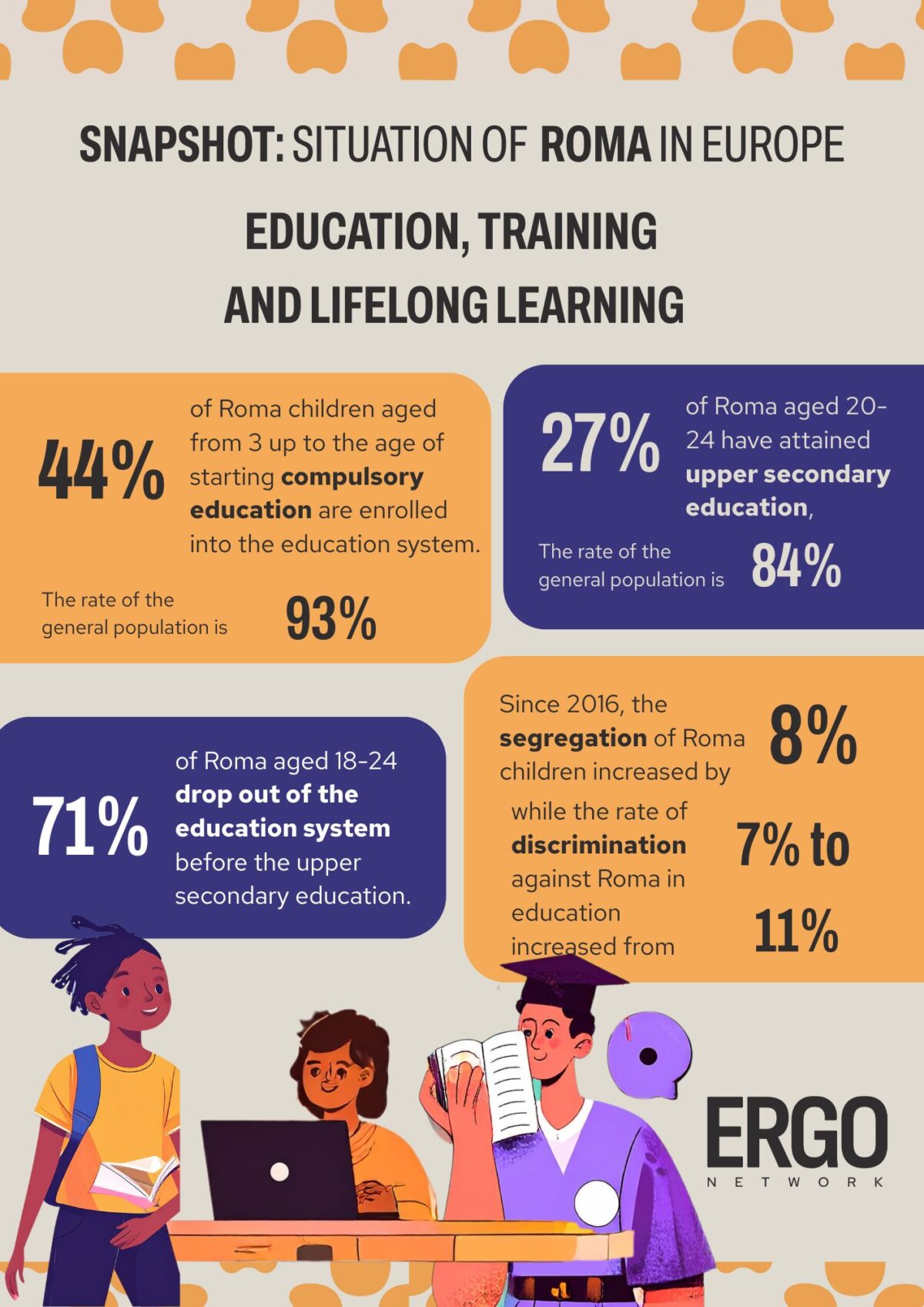
From a very young age, Roma children are unable to access the same learning opportunities as their peers. Poverty and discrimination lead to significantly lower attendance and completion rates for the Roma throughout the lifecycle. Pervasive antigypsyism, civil and institutional, results in segregated educational facilities and the misplacement of Roma children in special needs establishments. In the absence of sufficient and accessible second-chance schools and training opportunities, lifelong learning and upskilling are further impeded, and the Roma find themselves trapped in a constant state of poverty and low skills.The EU Roma Strategic Framework for Equality, Inclusion, and Participation 2020 – 2030includes, as one of its four sectoral objectives, “Increase effective equal access to quality inclusive mainstream education” by 2030, whilethe Council Recommendation on Roma Equality, Inclusion and Participation features a comprehensive section calling on Member States to “ensure that all Roma have effective equal access to and are able to participate in all forms and stages of education, from early childhood education and childcare to tertiary education, including second chance education, adult education, and lifelong learning”. Access to education, training, and lifelong learning is also covered by the European Pillar of Social Rights (Social Pillar), chiefly in its Principle 1, while quality education is Goal 4 of the UN Sustainable Development Goals (SDGs).
During 2025, ERGO Network conducted in-depth national case studies in six countries (Bulgaria, the Czech Republic, Hungary, Romania, Slovakia, and Spain), looking at the realities of Roma education, training, and lifelong learning, as well as at the key barriers the Roma face when trying to access quality and inclusive learning opportunities in these countries. Additional benchmarking evidence was provided by our members in Ireland and Sweden. The main findings and recommendations were brought together in an EU synthesis report, launched in the framework of the event mentioned above.
Key messages of the synthesis report:
1. In all six countries, the Roma continue to face persistently low educational attainment and learning outcomes throughout the lifecycle
- Comprehensive investment in Roma education is urgently needed, ensuring wrap-around support policies from early childhood to adult learning, combined with adequate, predictable funding, and disaggregated monitoring and indicators by ethnicity.
2. Financial and non-financial barriers to education continue to drive dropout and high NEET rates among Roma learners
- Governments should provide adequate income support and access to services to learners and their families, while tackling the shortage of good-quality, culturally competent educational establishments located where the Roma live.
3. Support for Roma learners and their families remains inconsistent, while educational mediators are underutilised
- Establish stable, state-funded systems of Roma educational mediators and assistants, ensuring proper accreditation, fair pay, and coordination with teachers and social services, alongside providing bilingual, after-school, and parental outreach programmes.
4. Antigypsyism and segregation remain pervasive, while Roma language and culture are invisible in curricula
- School segregation must be eradicated, alongside strong enforcement of anti-discrimination laws in education, mandatory anti-bias and intercultural training for all education staff, and the integration of Roma language, history, and culture in schools.
5. Educational disadvantage lasts a lifetime, locking the Roma out of lifelong learning, quality employment, and social mobility
- Supportive lifelong learning opportunities are needed through well-designed second-chance schools and relevant skills training that account for the needs of adult learners, such as childcare, income, and transport, as well as different starting points.
6. Roma communities and their civil society organisations must be involved to co-create sustainable ways forward.
- Policy makers and all educational actors must closely cooperate with Roma stakeholders and their civil society representatives to ensure evidence-based solutions, support disaggregated data collection, foster a common understanding, and bridge cultural gaps.
With this research, we aim to kick-start a debate with policy makers on how to improve the availability, accessibility, quality, and inclusiveness of education, training, and lifelong learning Europe’s Roma.
- Read the EU synthesis report here!
- Read the national case studies: Bulgaria – Czech Republic – Hungary – Romania – Slovakia – Spain.
- Read the additional benchmarking evidence: Ireland – Sweden
For more information about ERGO Network’s work on Roma access to quality and inclusive education, please contact Senior Policy Adviser Amana Ferro.