Research report on Roma access to decent and sustainable employment

ERGO Network launches its research report on Roma access to decent and sustainable employment

The European Roma Grassroots Organisations (ERGO) Network held its annual Policy Conference on 25 November, entitled “Implementing the EU Roma Strategic Framework. Roma access to decent and sustainable employment.” 

The Roma are more likely to experience discrimination in recruitment and in the workplace, to be paid less, to be offered precarious contracts, to be overlooked for promotions or learning opportunities, or to be given dangerous or unsuitable tasks. While overrepresented in unsustainable and exploitative forms of employment, the Roma are also underrepresented in trade union structures. Additionally, many Roma earn their livelihood from atypical or seasonal forms of work, which are not covered by adequate labour protection legislation and do not provide for employment rights and social security. Job creation efforts are not enough to provide the Roma with quality and secure jobs, and the great potential of social entrepreneurship is insufficiently supported.

The EU Roma Strategic Framework for Equality, Inclusion, and Participation 2020 – 2030 includes, as one of its four sectoral objectives, “Increase effective equal access to quality and sustainable employment” by 2030, while the Council Recommendation on Roma Equality, Inclusion and Participation features a comprehensive section calling on Member States to “promote effective equal access for Roma, in particular young Roma, to quality and sustainable employment”. Access to quality and sustainable employment is extensively covered by the European Pillar of Social Rights (Social Pillar), chiefly in its Principles 4, 5, 6, 7, 8, 9, 10, 13, while decent work is Goal 8 of the UN Sustainable Development Goals (SDGs).

During 2024, ERGO Network conducted in-depth national case studies in six countries (Bulgaria, the Czech Republic, Hungary, Romania, Slovakia, and Spain), looking at the realities of Roma employment and access to the labour market and the key barriers the Roma face when trying to access quality and sustainable jobs in these countries. Our members in Ireland provided additional benchmarking evidence. The main findings and recommendations were brought together in an EU synthesis report launched in the framework of the above-mentioned event.

Key messages of the synthesis report:

  1. A majority of Roma are not in paid work, at least not in the formal economy, nor are they adequately supported to enter the labour market. Urgent and significant investment is needed into integrated, personalised Active Inclusion approaches, combining income support with enabling services and Public Employment Services to have the necessary resources, staff, and training.
  2. The Roma who work are in poor-quality jobs with low pay, insecure contracts, unsafe working conditions, no access to training, and almost no trade union coverage. Countries need to develop and implement a comprehensive definition of job quality, covering all the aspects mentioned above, and ensure that it applies to all jobs, all sectors, and all workers. They also need to support and strengthen trade unions and collective bargaining.
  3. Antigypsyism is pervasive in recruitment as well as in the workplace. Much stronger anti-discrimination legislation is needed, coupled with effective implementation mechanisms and monitoring, anti-bias training for employers and recruiters, and broad campaigns to combat antigypsyism in society at large.
  4. Pushed to the margins of the labour market, the Roma make ends meet through the informal economy, pursuing traditional crafts, or seeking work abroad.Combating undeclared work needs to be done by regularising sectors and penalising rogue employers instead of poor workers; broader support schemes for self-employment and more protection for mobile workers are needed to prevent exploitation.
  5. Job creation efforts that would benefit the Roma are scarce – and while the social economy holds great potential for Roma employment, it is currently underutilised. More public investment is needed in locally accessible, community-rooted quality jobs, as well as supportive legislation and improved access to funding for social enterprises as a key tool for Roma employment, including the promotion of Roma social entrepreneurship.
  6. Participation of Roma communities and their civil society organisations is paramount in co-creating sustainable ways forward. Policymakers and labour market actors must cooperate closely with Roma stakeholders and their civil society representatives to ensure evidence-based solutions, support disaggregated data collection, foster common understanding, and bridge cultural gaps.

With this research, we aim to kick-start a debate with policy makers on improving the availability, accessibility, quality, sustainability, and inclusiveness of employment for Europe’s Roma.

For more information about ERGO Network’s work on Roma access to decent and sustainable employment, please contact Senior Policy Adviser Amana Ferro.
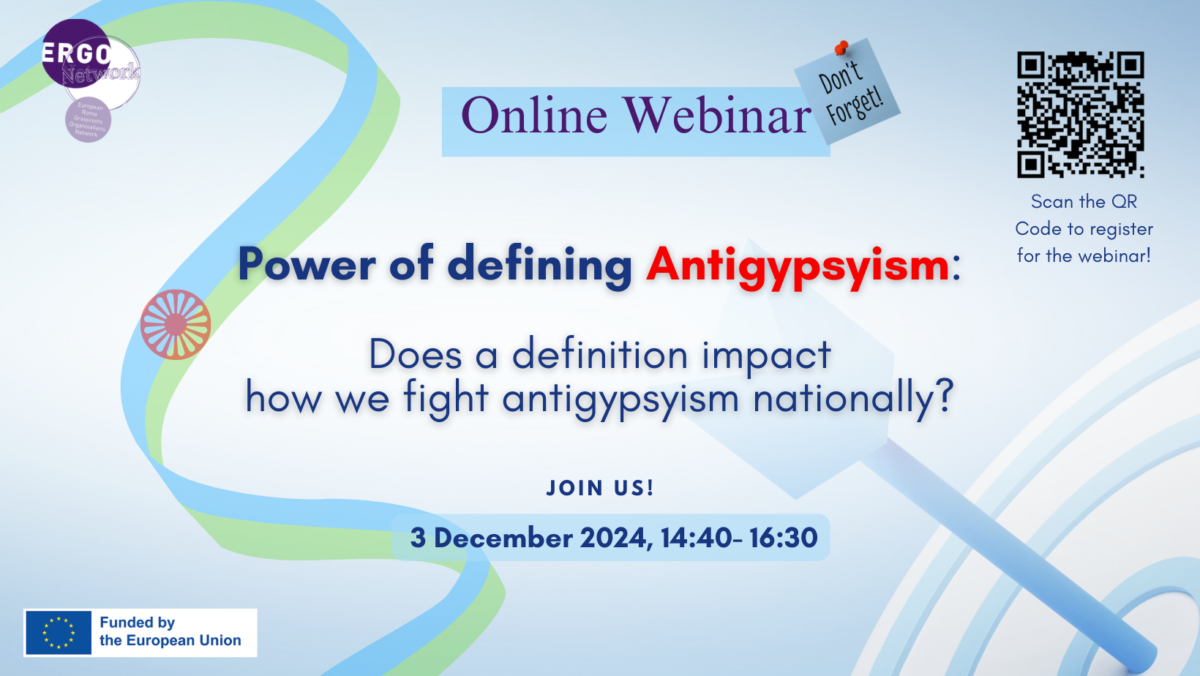
Register for Webinar on Antigypsyism

Register for the Webinar on Antigypsyism:

Power of defining antigypsyism: Does a definition impact how we fight antigypsyism nationally?

Date: 3rd December, 2024
Time: 14h40 – 16h30
Format: Online

Background and Context

Antigypsyism remains a significant and deeply rooted issue across Europe, affecting the lives of millions within the Roma communities. Despite various legal frameworks, policies, and commitments from national and European institutions, implementing impactful, coordinated actions is still lacking. The challenge lies in the sustained, institutional commitment to address and eliminate antigypsyism in all its forms effectively.

This webinar aims to bring together key actors – from European and national institutions to civil society organisations – to explore actionable strategies that institutionalise the fight against antigypsyism. With contributions from prominent organisations like ECRI (European Commission against Racism and Intolerance), IHRA (International Holocaust Remembrance Alliance), the Czech Governmental Commissioner for Roma Affairs or MIA agency, and Equinet, the webinar will spotlight how institutional actions can meaningfully impact Roma communities. The event will empower civil society actors to engage actively through a participatory approach, fostering dialogue and promoting actionable outcomes.

Objectives

The primary objective of the webinar is to facilitate meaningful dialogue on the institutional and societal roles necessary to tackle antigypsyism in Europe. Key objectives include:

Key Points for Emphasis

Strengthen Policy Frameworks for Member States

This session will explore how member states can utilise European frameworks, such as the EU Roma Strategic Framework, to institutionalise antigypsyism responses. By showcasing effective policies, tools, and legal frameworks, the webinar aims to create a blueprint to support policymakers and advocate for harmonising efforts. Speakers will examine gaps in current policies and share actionable recommendations to strengthen implementation across various European contexts, including the actions for civil society at the national and local levels.

Encourage National Advocacy Efforts

For meaningful change, it is crucial to empower civil society organisations at the national level, enabling them to advocate effectively within their local contexts. This session will focus on how organisations can engage with national policymakers and push for institutional support to fight antigypsyism. Practical advocacy techniques, successful case studies, and resources for collaboration with governmental and institutional bodies will be shared, inspiring civil society actors to pursue sustained, evidence-based advocacy.

Agenda

14:40    Welcoming participants and introduction

14:45    Keynote Address: Setting the Scene on approaches to define Antigypsyism in Europe

  • Gabriela Hrabanova, Director ERGO Network
  • Stelina Dungaj, ERGO Network

14:50   Panel Discussion 1: Institutional Roles and Responsibilities

  • Lucie Horvathova, The Czech Governmental Commissioner for Roma Affairs
  • Robert Rustem, European Commission against Racism and Intolerance (ECRI), Council of Europe
  • Mustafa Jakupov, Melde- und Informationsstelle Antiziganismus (MIA)
  • Daris José Lewis Recio, European Network of Equality Bodies (EQUINET)

15:30 Panel Discussion 2: Reflection of effective advocacy approaches at the national level

  • Senada Sali, European Roma Rights Centre
  • Zuzana Havirová, Roma Advocacy and Research Centre, Slovakia

16:00    Interactive Session: Q&A with Civil Society

16:15     Closing

Expected outcomes:

  • Increased understanding of institutional roles in combating antigypsyism.
  • Identification of gaps in policy frameworks and suggestions for strengthening them.
  • Practical strategies for civil society to advocate for institutionalised responses to antigypsyism at the national level.
  • A collaborative framework for ongoing engagement among European institutions, national bodies, and civil society.

Annual Policy Conference 2024 – Employment

IMPLEMENTING THE EU ROMA STRATEGIC FRAMEWORK. ROMA ACCESS TO DECENT AND SUSTAINABLE EMPLOYMENT

This past 25 November, ERGO Network organised its annual Policy Conference in Brussels. The conference was dedicated to exploring how to improve Roma access to quality, sustainable, and inclusive employment and taking stock of the implementation of the EU and National Roma Frameworks, with a particular focus on combatting antigypsyism.

The Opening session featured welcome words by Annabel Carballo Mesa of the ERGO Network Board, remarks by Erika Koller from the European Economic and Social Commitee (Workers’ Group and the Permanent Group on the Inclusion of Roma), as well as a video message from Hon. Mélissa Camara MEP (France, Greens/EFA).  

The Roma are more likely to experience discrimination in recruitment and in the workplace, to be paid less, to be offered precarious contracts, to be overlooked for promotions or training. Pushed at the margins of the labour market and underrepresented in trade unions, many Roma earn their livelihood from atypical, seasonal, or informal work. Job creation efforts are not enough, and the potential of social entrepreneurship is insufficiently supported. Increasing effective equal access to quality and sustainable employment is an objective of the EU Roma Strategic Framework, while it is also extensively covered by the European Pillar of Social Rights, and decent work is Goal 8 of the UN Sustainable Development Goals (SDGs).

The event launched ERGO Network’s research report on “Roma access to decent and sustainable employment”, based on six national case studies carried out in Bulgaria, the Czech Republic, Hungary, Romania, Slovakia, and Spain. ERGO Network members in Ireland provided additional benchmarking evidence. The main findings and recommendations aim to kick-start a dialogue with key decision-makers and stakeholders to identify positive solutions to support better labour market inclusion for Roma and to inform the delivery of the EU Roma Strategic Framework and the Social Pillar, as well as of other relevant policy initiatives.

The Key Messages of the report are:

  1. The majority of Roma are not in paid work, at least not in the formal economy, and they are not adequately supported to enter the labour market.
  2. The Roma who work are in poor-quality jobs with low pay, insecure contracts, unsafe working conditions, no access to training, and almost no trade union coverage.
  3. Antigypsyism is pervasive in recruitment as well as in the workplace.
  4. Pushed to the margins of the labour market, the Roma make ends meet through the informal economy, pursuing traditional crafts, or seeking work abroad.
  5. Job creation efforts that would benefit Roma are scarce, and while the social economy holds great potential for Roma employment, it is currently underutilised.
  6. Participation of Roma communities and their civil society organisations is paramount to co-create sustainable ways forward.

With the adoption of the EU Roma Strategic Framework up to 2030, governments were asked to develop National Roma Strategic Frameworks both in EU Member States and Western Balkan countries. In addition, civil society in EU Member States received funding from the European Commission to monitor the elaboration and adoption of these national strategic frameworks. To ensure an effective implementation, robust and continued monitoring of the entire policy process should be ensured.

The second part of the event assessed the state of play of the National Roma Frameworks in both the EU and Enlargement countries and their alignment with the EU Roma Strategic Framework on Equality, Inclusion, and Participation. It linked Council Recommendation in the context of a new European Parliament and European Commission. The session included a keen focus on the fight against antigypsyism, launching a new ERGO Network survey report on the topic. It also looked at digital inclusion and the role of cities in this respect.

Closing remarks were provided by Irena Moozová, Deputy Director General in the European Commission, DG Justice and Consumers, and the event was closed by Gabriela Hrabaňová, ERGO Network Director. The conference was very well attended with over 75 on-site and online participants, and it brought together ERGO Network national members from the grassroots level in many European countries, as well as other national practitioners, European civil society organisations, policy-makers from the EU and national levels, and other stakeholders.

If you attended this event or watched the recording, please let us know what you thought about it by filling out this brief Evaluation Form (project reference: 101140452; event title: ERGO Network Annual Policy Conference).

See more:

Visual summary by Ale listens and draws www.alelistens.com

For more information about this event, please don’t hesitate to contact us: info@staging.ergonetwork.org

This conference is kindly supported by the European Union Programme for Citizens, Equality, Rights and Values (CERV)  and by the German Federal Foreign Office. 

Register now for the upcoming Conference on Ukrainian Roma Refugees

Register now for the upcoming Conference on Ukrainian Roma Refugees

Venue: Hotel Chambord, 82 Rue de Namur, 1000 Brussels, Belgium & Online

Date: Wednesday, November 13 2024 

The ERGO Network, with the support of the European Philanthropic Initiative for Migration (EPIM), is organising a conference focused on advocacy and coordination for Ukrainian Roma refugees. As the situation continues to evolve, we must come together and discuss practical ways to address the needs of this vulnerable community. 

This event will serve as a platform to address the issues of Ukrainian Roma refugees and discuss strategies for effective advocacy and coordination efforts to support them during this challenging time. 

The ERGO Network, alongside its members, is committed to creating an inclusive environment where the voices of Ukrainian Roma refugees can be heard and their specific needs addressed. The conference will bring representatives from various sectors, including EU institutions, civil society organisations, government agencies, and international organisations. The goal is to foster collaboration and develop comprehensive plans for supporting Ukrainian Roma refugees. 

Attendees will engage in discussions aimed at identifying best practices for advocacy and resource mobilisation, ensuring that the unique challenges faced by Ukrainian Roma are adequately recognised and addressed in policy frameworks. 

In addition to organising the conference, the ERGO Network is actively supporting Ukrainian Roma refugees through various initiatives, particularly in countries such as Poland, Czechia, Hungary, and Moldova. This includes providing humanitarian assistance, facilitating access to social services, and promoting awareness of their rights. By collaborating with local organisations, community leaders, international organisations, and institutions, the ERGO Network is working to ensure that Ukrainian Roma refugees receive the necessary support for their integration and well-being. 

The conference will serve as a pivotal moment to amplify these efforts and strengthen the network of advocates committed to empowering Roma communities in the face of adversity. 

Agenda

Wednesday, November 13

9:00 – 9:30: Opening Remarks and Introduction to the event

  • Gabriela Hrabaňová, Director, ERGO Network
  • Sheena  Elaine Keller, Senior Sector Officer- EEA grants
  • Martin Mühleck, Directorate-General for Neighbourhood and Enlargement Negotiations (DG NEAR)
  • Csilla Volgyi, Policy Officer at the Directorate-General for Migration and Home Affairs, European Commission

9:30 – 10:15: Panel Discussion – Challenges Faced by Ukrainian Roma Refugees in Moldova

Moderator: Dejan Markovic, ERGO Network

  • Elena Sirbu – Roma Women’s Platform Moldova
  • Natalia Kropivka – UNHCR Moldova

10:15 – 11:00: Panel Discussion – Challenges Faced by Ukrainian Roma Refugees in Poland

Moderator: Dejan Markovic, ERGO Network

  • Elżbieta Mirga-Wójtowicz – Fundacija Jaw Dikh Poland
  • Mateusz Płoskonka – Municipality of Krakow, Department of Social Policy and Health

11:00 – 11:30: Coffee Break

11:30 – 12:15: Panel Discussion – Challenges Faced by Ukrainian Roma Refugees in Hungary

Moderator: Stephan Mueller, Central Council of the German Sinti and Roma

  • Fanni Székely-Trendl – Romaversitas Foundation
  • Eszter Benkő – Hungarian Helsinki Committee

12:15 – 13:00: Panel Discussion – Challenges Faced by Ukrainian Roma in the Ukraine

Moderator: Gabriela Hrabanová , ERGO Network

  • Igor Lossovsky – State Service of Ukraine for Ethnopolitics and Freedom of Conscience
  • Yulian Kondur – International Charitable Organisation Roma Women Fund Chiricli
  • Natalia Tomenko – YNGO ARCA

13:00 – 14:00: Networking Lunch

14:00 – 14:45: Panel Discussion – Challenges Faced by Ukrainian Roma Refugees in the Czech Republic

Moderator:  Gabriela Hrabanová, ERGO Network

  • Lidija Grebo – Slovo 21
  • Jan Husak – Romodrom o.p.s.

14:45 – 15:30: Panel Discussion – Challenges Faced by Ukrainian Roma Refugees in the West Europe

Moderator: Isabela Mihalache, ERGO Network

  • Stephan Mueller- Zentralrat Deutscher Sinti und Roma
  • Guillermo Ruiz – Melde- und Informationsstelle Antiziganismus (MIA), Germany

15:30 – 16:15: Panel Discussion – Sharing Best Practices from of the International organisations in support of Roma refugees 

Moderator: Dejan Markovic, ERGO Network

  • Valeria Morica – World Bank
  • Gyorgy Sumeghy – Habitat for Humanity International
  • Ulrike Pusch – Solidaritätsdienst International e.V.

16:15 – 16:45: Coffee Break

16:45 – 17:30: Closing Session: Recommendations and Future Steps

For more information about the event, please contact our coordinator for Ukraine, Dejan Markovic d.markovic@staging.ergonetwork.org.

This conference is supported by the European Philanthropic Initiative for Migration, EPIM.

Call for Branding Agency Proposals for ERGO Network

Call for Branding Agency Proposals for ERGO Network

Introduction
ERGO Network (European Roma Grassroots Organisations) is a European advocacy network that champions the rights of Roma communities across Europe. With members and partners in over 20 countries, ERGO Network works to combat antigypsyism, promote social inclusion, and ensure the active participation of Roma people in European society. To further strengthen our mission and elevate our voice, we seek a creative branding agency to help us redefine and enhance our brand identity.

Objective
ERGO Network is looking to develop a strong and cohesive brand identity that reflects our inclusivity, empowerment, and advocacy values for Roma communities. The chosen agency will work closely with us to design a fresh visual identity that will resonate with our stakeholders, partners, and the communities we serve.

Scope of Work
The selected agency will be responsible for the following deliverables:

  • Logo Design: A new or refined logo that reflects our mission and values. Multiple formats should be provided for use across various platforms.
  • Visual Identity: Design a comprehensive visual identity system, including a colour palette, typography, and design elements.
  • Brand Templates: Create templates for presentations, letters, reports, social media posts, and official documents to ensure a consistent brand image.
  • Brand Guidelines: Develop a detailed brand manual outlining the correct logo usage, colours, typography, and other visual elements.
  • Optional: Discuss website design enhancements in line with the new branding

Target Audience
ERGO Network’s primary audience includes policymakers, Roma grassroots organisations, international NGOs, EU institutions, and the general public. Our brand identity must resonate with these diverse groups while reflecting the values of inclusivity, dignity, and justice.

Tone and Style
We seek a brand identity that communicates empowerment, professionalism, and trust. It should be modern, engaging, and adaptable across different media (digital, print, social media).

Submission Requirements
Interested agencies should provide:

  • A portfolio showcasing relevant work, especially for NGOs or social impact organisations.
  • A brief description of your approach to the project, including creative concepts and strategies.
  • A list of deliverables, along with a timeline for the project.
  • A cost estimate or detailed pricing breakdown.
  • References from previous clients in the NGO or advocacy sector (if applicable).

Timeline

  • Call Opens: 17/10/2024
  • Submission Deadline: 23/10/2024 Midnight
  • Selection of Agency: 25/10/2024

Budget
Please include a cost estimate for the project based on the scope outlined above. We are open to discussing adjustments based on the agency’s proposal and expertise.

Evaluation Criteria
Submissions will be evaluated based on the following:

  • Creativity and originality in previous work
  • Experience with NGOs or advocacy organisations
  • Alignment with ERGO Network’s values and mission
  • Affordability and transparency in pricing
  • Ability to deliver within the timeline

How to Apply
Please submit your proposal via email to info@staging.ergonetwork.org by 23/10/2024. For any questions or further details, feel free to reach out before the deadline.

We look forward to collaborating with a talented and passionate agency to create a brand identity that supports our mission and amplifies the voices of Roma communities across Europe.

`
Ana Rozanova – Page 5 – ERGO Network

By continuing to use the site, you agree to the use of cookies. more information

The cookie settings on this website are set to "allow cookies" to give you the best browsing experience possible. If you continue to use this website without changing your cookie settings or you click "Accept" below then you are consenting to this.

Close