Digital deprivation should not become a new obstacle for Roma students
The Roma are left out as digital citizens and cannot benefit from the simple values of digital citizenship based on respect, education, and protection – Mustafa Jakupov
This past 23 November, ERGO Network organised its Annual Policy Conference, once again online. This year’s was dedicated to exploring how to improve Roma access and take-up of adequate minimum income schemes, as well as taking stock of the implementation of the EU and National Roma Frameworks.

Access to adequate minimum income and social protection is the cornerstone of the European Social Model, and it needs to be guaranteed also for Europe’s Roma. In a cash-based economy, providing people with sufficient financial resources is a necessary pre-requisite for fighting poverty and social exclusion, as well as for enabling individuals to reach their full potential and to access rights and opportunities on the labour market and in society. During the recovery from the devastating economic crisis due to the pandemic, this is today more important than ever.

The event launched ERGO Network’s research report on “Roma access to adequate minimum income”, based on five national case studies carried out in Bulgaria, the Czech Republic, Hungary, Romania, and Slovakia. The main findings and recommendations aim to kick-start a debate on how to improve the adequacy and take-up on minimum income and social protection by Roma in Europe, including in the framework of the European Pillar of Social Rights Action Plan, and the foreseen Council Recommendation on Minimum Income (2022).
The Key Messages of the report are:

After advocating effectively for the adoption of a strong EU Roma Strategic Framework up to 2030, it is essential to now continue to monitor its implementation and the adoption of corresponding National Frameworks in EU Member States and Western Balkan countries. Unfortunately, the targets set out in the framework are often too low or non-ambitious, and while participation is made more visible than in the previous period, there are very few commitments made in this area, and the implementation of the EU framework remains entirely up to national governments.

The second part of the event took stock of the status of adoption of the National Roma Strategic Frameworks and the engagement and participation of (pro-)Roma civil society in the drafting of the National Roma Frameworks. In the absence of a binding character of the EU Framework, the event assessed how serious is the commitment of governments to tackle antigypsyism and improve living conditions of Roma, while it also emphasised the role of the Roma civil society and the Roma Civil Monitor in monitoring the National Roma Frameworks, and that of Equality Bodies in enforcing the fight against discrimination and antigypsyism.
The event ended with concluding remarks on the need to increase complementarity between the EU Roma Strategic Framework and the EU Action Plan Against Racism in tackling antigypsyism and racism against Roma by Member States, as well as ensure better synergies between different relevant EU frameworks, and increase the emphasis on social rights as more effective means to tackle antigypsyism, poverty and social exclusion of Roma.

The conference was very well attended with over 60 participants, and it brought together ERGO Network national members from the grassroots level in many European countries, as well as other national practitioners, European civil society organisations, EU policy-makers from the European Parliament and the European Commission, and other stakeholders.
If you attended this event, or watched the recording, don’t forget to let us know what you thought about it by filling in this Evaluation Form. Thank you!
See more:
– Full recording of the Facebook livestream
– ERGO Network minimum income research report
Visuals provided by 500 markers.
For more information about this event, please don’t hesitate to contact us: info@staging.ergonetwork.org
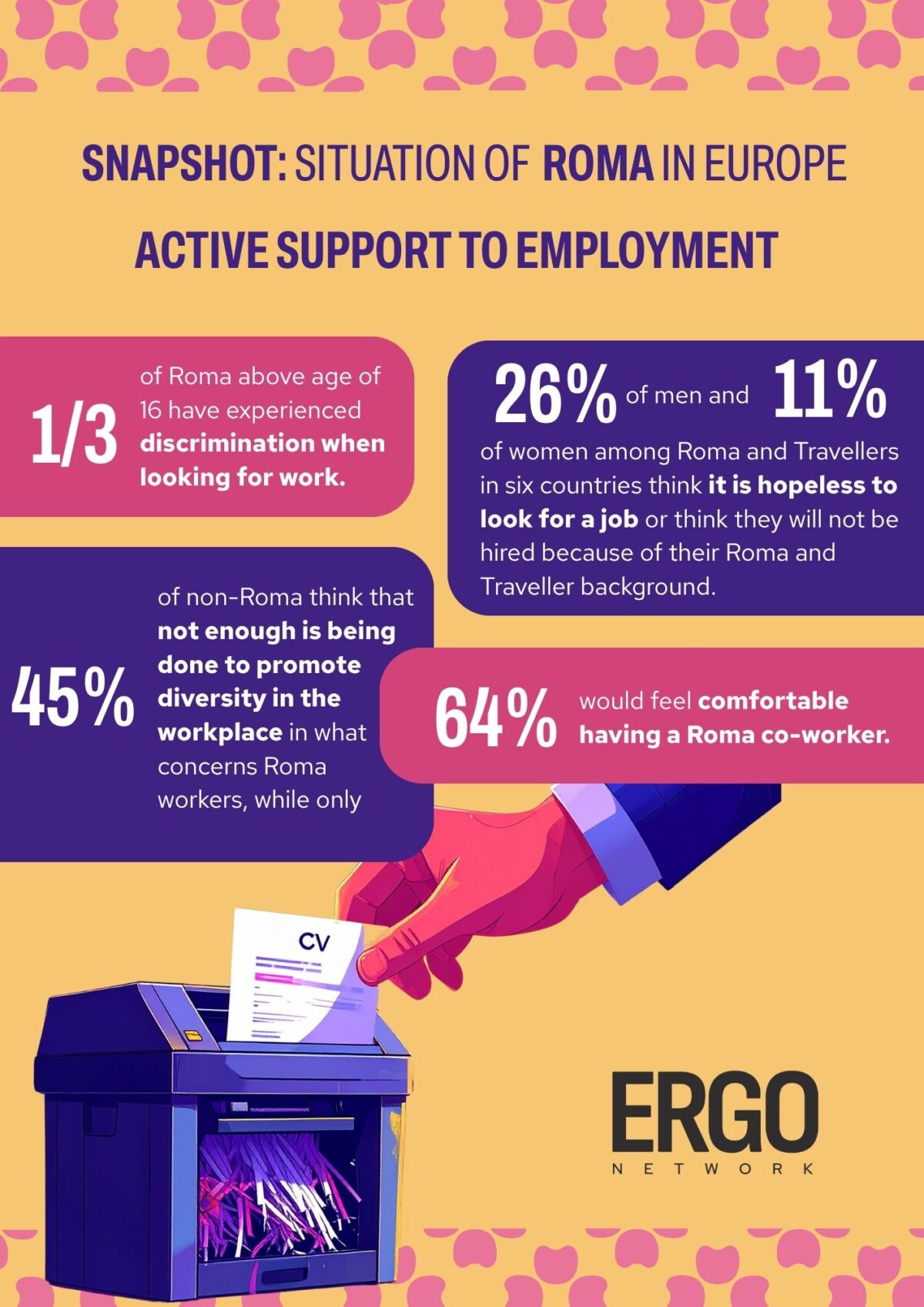
Snapshot on the Situation of Roma in Europe: Active Support to Employment
Our Snapshots on the Situation of Roma in Europe are a series of reader-friendly, visually attractive handouts, linking each of the 20 policy principles of the European Pillar of Social Rights to Roma rights and inclusion. Each Snapshot includes key statistics, a brief problem statement, and extensive policy recommendations.
Today, we look at active labour market policies and their usefulness when it comes to Roma jobseekers. While the Roma want to work, and they bring tremendous skills and commitment to the table, an employment-first approach is not always suitable, and they need the right mix of comprehensive measures to support them towards quality employment.
For more information about our work on Active Support to Employment, please contact Amana Ferro (a.ferro@staging.ergonetwork.org), Senior Policy Adviser with the ERGO Network staff team.
Bi-Annual RIISE Coordination Meeting
Several ERGO Network members and also new partners met on 22-23 November for our annual ‘Roma Included in Social Europe’ (RIISE) coordination meeting.
ERGO Network is implementing a four-year work programme funded by the EaSI Programme of the European Commission’s DG Employment in order to support the social inclusion and poverty reduction of Roma in EU member states and provide a bridge between the grassroots and the EU level concerning Roma-related policies and funding programmes.
An important part of the work programme is implemented on national level in the so-called ‘Big 5’ countries – the EU member states with the highest Roma population. With the financial support of the European Commission through the RIISE work programme, ERGO Network members coordinate national Roma civil society coalitions, support Roma activists to engage in and benefit from Community-Led Local Development (CLLD), conduct research and inform Roma activists about relevant EU developments.
During the online coordination meeting, representatives of Integro Association (Bulgaria), Nevo Parudimos (Romania), Policy Centre for Roma and Minorities (Romania), Life Together (Czech Republic), Slovo 21 (Czech Republic), Autonomia Foundation (Hungary), Socfactor (Hungary), RomanoNet (Czech Republic), Roma Advocacy and Research Centre (Slovakia) came together to discuss their work.
Among other things they shared updates on the EU Roma Framework & Anti-racism policy, the work of the civil society with the Fundamental Rights Agency, the Alliance Against Antigypsyism and the EU Roma Week.
The members were asked to join and contribute within the campaign “Decade to combat Antigypsyism” – an umbrella campaign to address and raise awareness about the phenomenon.
The meeting provided the space for the members to give updates on national coalitions and advocacy activities 2021. The afternoon was dedicated to the updates on the work in 2021 and next steps for 2022:
During the second day of the meeting the capacity building was discussed with the special focus on monitoring.
The next meeting will take place at the beginning of 2022, when the new application and activities under the new grant from DG Justice will be presented.
ERGO Network launches its research report on Roma access to adequate minimum income schemes
The European Roma Grassroots Organisations (ERGO) Network is holding today, 23 November, its annual Policy Conference, entitled “Implementing the EU Roma Strategic Framework. Roma access to adequate minimum income.”
Europe’s Roma experience some of the worst social inclusion indicators, with over 80% living in poverty, only 43% in paid employment, and 41% experiencing antigypsyism. This situation worsened significantly during the Covid-19 pandemic, with Roma communities being disproportionately hard hit. In a cash-based economy, providing people with adequate financial resources is a necessary pre-requisite for fighting poverty and social exclusion, as well as for enabling individuals to reach their full potential and to access rights and opportunities on the labour market and in society.
Access to adequate minimum income and social protection is the cornerstone of the European Social Model and our welfare states, and it needs to be guaranteed also for Europe’s Roma. The EU Council Recommendation of 24 June 1992 on Common criteria concerning sufficient resources and social assistance in social protection systems clearly urges Member States “to recognize the basic right of a person to sufficient resources and social assistance to live in a manner compatible with human dignity as part of a comprehensive and consistent drive to combat social exclusion.” This commitment is reaffirmed in the EU Active Inclusion Recommendation (2008) and the European Pillar of Social Rights (2017).
During 2021, ERGO Network conducted in-depth national case studies in five countries (Bulgaria, the Czech Republic, Hungary, Romania, and Slovakia), looking at existing minimum income schemes and assessing to what extent they are accessible to Roma applicants, and whether they are adequate for promoting Roma inclusion and dignity. The main findings and recommendations were brought together in an EU synthesis report, launched today in the framework of the above-mentioned event.
With this research, we aim to kick-start a debate with policy makers on how to improve the adequacy and take-up of minimum income and social protection by Roma in Europe, including in the framework of the European Pillar of Social Rights Action Plan, and the foreseen Council Recommendation on Minimum Income (2022). Access to sufficient financial resources is also a key element of reducing Roma poverty and social exclusion, which is one of the three horizontal objectives of the EU Roma Strategic Framework on Equality, Inclusion, and Participation.
For more information about ERGO Network’s work on adequate minimum income and social protection for Roma, as well as on Roma poverty and social exclusion (European Semester, European Pillar of Social Rights, etc), please contact Senior Policy Adviser Amana Ferro.