ERGO NETWORK SNAPSHOT OF Equal Opportunities

Snapshot on the Situation of Roma in Europe: Equal Opportunities 

Our Snapshots on the Situation of Roma in Europe are a series of reader-friendly, visually attractive handouts, linking each of the 20 policy principles of the European Pillar of Social Rights to Roma rights and inclusion. Each Snapshot includes key statistics, a brief problem statement, and extensive policy recommendations.   

Providing equal opportunities for all and combatting antigypsyism and all forms of intersectional discrimination are not a Roma issue, but a European imperative. Ending centuries of racism and exclusion of the Roma requires urgent political will, legal reform, and full recognition of Roma history, culture, identity, and rights.  

  • Read the Snapshot here! 

For more information about our work on Antigypsyism, Anti-Racism, and Equal Opportunities, please contact Isabela Mihalache (i.mihalache@staging.ergonetwork.org), Senior Advocacy Officer with the ERGO Network staff team. 


Our member organisation Pavee Point receives the 2020 Max van der Stoel Award

We congratulate our member Pavee Point Traveller and Roma Centre. The organisation has received the Max van der Stoel Award in recognition of its achievements in advocating and protecting the rights of Traveller and Roma communities in Ireland.

The 2020 Award Ceremony was postponed to 2021 due to COVID-19 restrictions, but on 19 November 2021 Chairperson Anastasia Crickley and Co-Director Martin Collins could attend the award ceremony in the Hague.

For more information visit the OSCE HCNM website.

ERGO Network’s Event on Funding of Bottom-up Approaches

Funding of bottom-up approaches:

Ways forward to support Roma inclusion

9 December 2021, 10am – 12pm, Online

Join us in our discussion on bottom-up approaches to funding for Roma Inclusion!

Background

In the past 20 years, Roma communities across Europe have seen very few improvements to their living situation, even though many public and private, international, and national funding programmes were aimed at Roma inclusion and empowerment.

One of the reasons for the lack of success of such funding programmes is the application of a top-down approach that does not consider the realities and voices of Roma at the grassroots level and comes with a heavy administrative burden.

All evaluations of the last EU Framework for National Roma Integration acknowledged that Roma communities needed to be involved in project design, implementation, and evaluation to bring about change.

This now needs to be translated into better funding programmes and regulations of public and private donors, including using more national resources for smaller projects, a prioritization of bottom-up approaches, and more support for Community-Led Local Development (CLLD).

With this event, we aim to raise donors’ awareness of the importance to give more support to bottom-up approaches, to finally improve the living situation of Roma communities on local level.

Objectives

The event will serve to launch ERGO Network’s new Analysis of funding for bottom-up approaches to Roma inclusion, shedding light on the importance of bottom-up approaches and assessing funding programmes targeted at Roma inclusion.

The main findings and recommendations aim to kick-start a debate with policy makers, donors, and civil society on how to design more effective funding programmes that can lead to a real change for local Roma communities.

Participants

The conference will bring together EU policymakers from across the institutional spectrum, donors, ERGO Network members, civil society from the grassroots level, as well as other relevant EU and national stakeholders.

We’re looking forward to counting you among the participants, so that together we can build positive, sustainable, evidence-based policy solutions that work!


This event is kindly supported by Iceland, Liechtenstein and Norway through the EEA and Norway Grants Fund for Regional Cooperation.

The project “New solutions to old problems – exchange of new type of approaches in the field of Roma integration” is funded by Iceland, Liechtenstein and Norway through the EEA and Norway Grants Fund for Regional Cooperation.

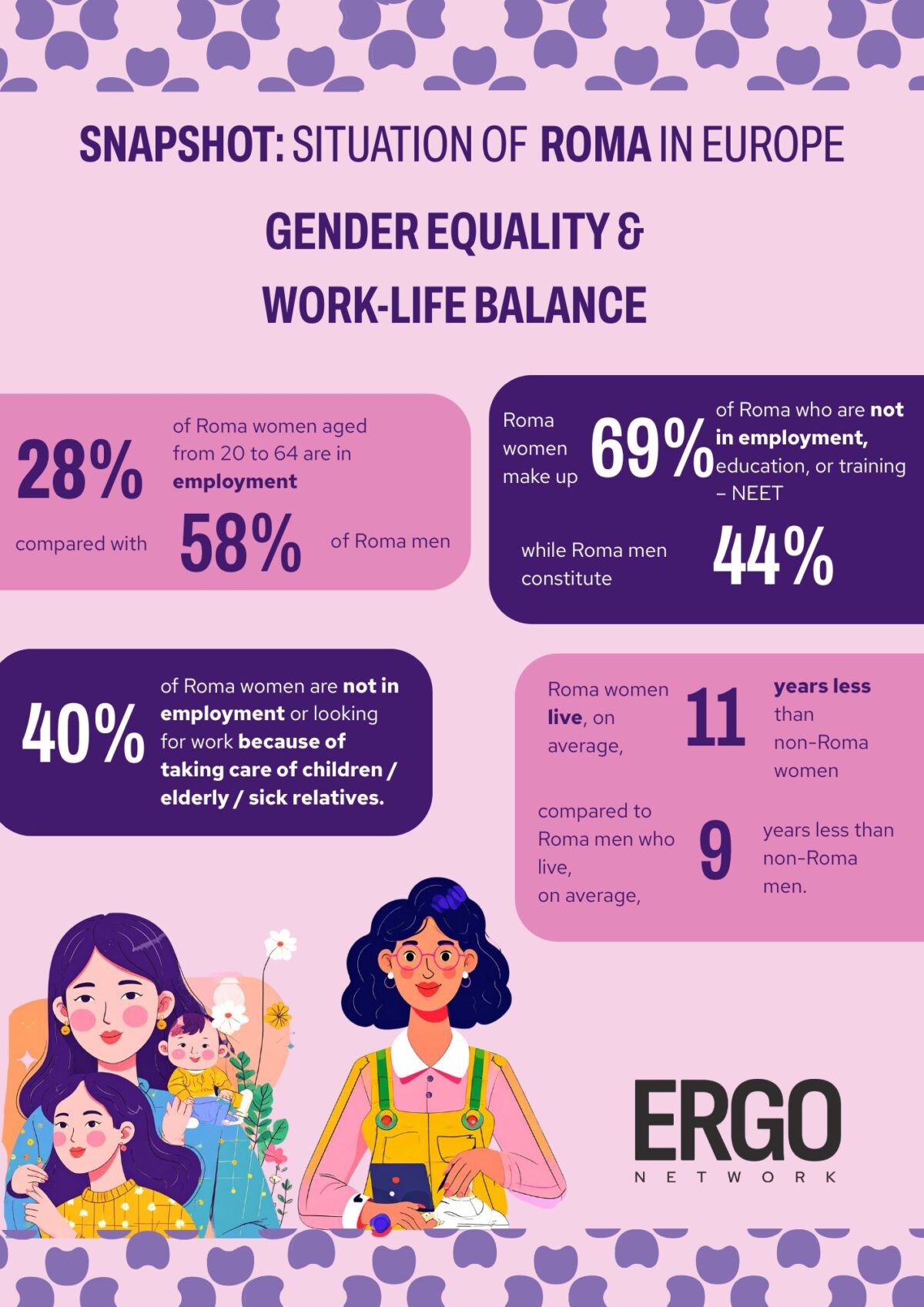
ERGO NETWORK SNAPSHOT OF GENDER EQUALITY AND WORK-LIFE BALANCE

Snapshot on the Situation of Roma in Europe: Gender Equality & Work-Life Balance 

Our Snapshots on the Situation of Roma in Europe are a series of reader-friendly, visually attractive handouts, linking each of the 20 policy principles of the European Pillar of Social Rights to Roma rights and inclusion. Each Snapshot includes key statistics, a brief problem statement, and extensive policy recommendations.  

Roma women across Europe face systemic and compounded discrimination, shaped by the intersection of ethnicity, gender, and class. From unpaid care to exploitative frontline jobs and exclusion from decision-making, their rights remain overlooked. It’s time to hear and celebrate their voices! 

For more information about our work on Roma women and gender equality, please contact Isabela Mihalache (i.mihalache@staging.ergonetwork.org) and Amana Ferro (a.ferro@staging.ergonetwork.org), senior policy staff with the ERGO Network staff team. 

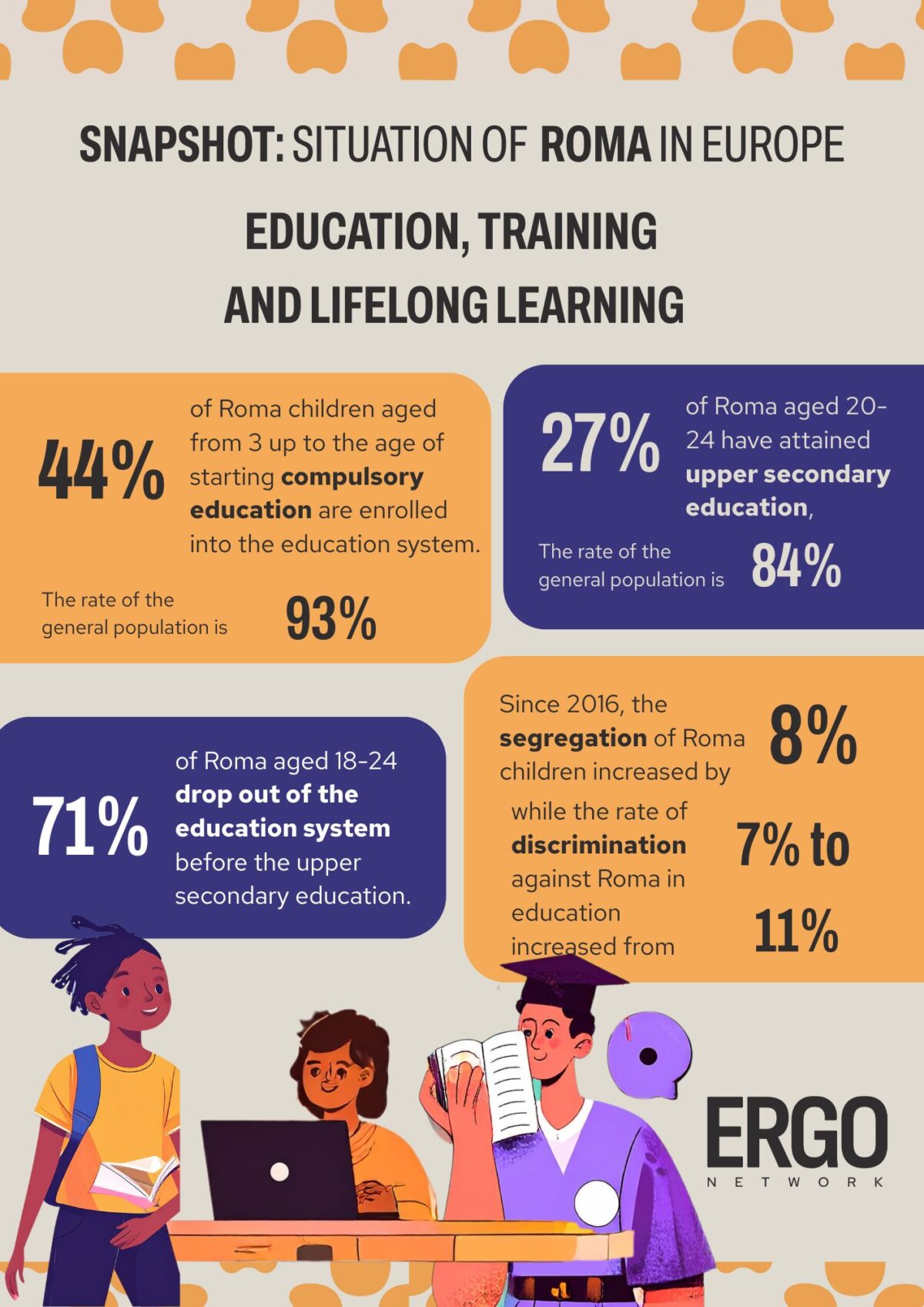
ERGO Network Snapshot of: Education, Training and Lifelong Learning

Snapshot on the Situation of Roma in Europe: Education, Training, and Lifelong Learning 

Our Snapshots on the Situation of Roma in Europe are a series of reader-friendly, visually attractive handouts, linking each of the 20 policy principles of the European Pillar of Social Rights to Roma rights and inclusion. Each Snapshot includes key statistics, a brief problem statement, and extensive policy recommendations.  

Roma children and students continue to encounter deep-seated discrimination and exclusion in educational settings, facing barriers such as poverty, segregation, language gaps, and hidden costs. These challenges persist across all levels of education and are compounded by a lack of culturally sensitive support, under-utilisation of Roma mediators, and the continued absence of Roma history and culture in national curricula. 

  • Read the Snapshot here! 

For more information about our work on Education, Training, and Lifelong Learning, please contact Amana Ferro (a.ferro@staging.ergonetwork.org), Senior Policy Adviser with the ERGO Network staff team. 

`
Ana Rozanova – Page 37 – ERGO Network

By continuing to use the site, you agree to the use of cookies. more information

The cookie settings on this website are set to "allow cookies" to give you the best browsing experience possible. If you continue to use this website without changing your cookie settings or you click "Accept" below then you are consenting to this.

Close