Adoption of the National Roma Strategic Frameworks 2021-2030

Adoption of the National Roma Strategic Frameworks 2021-2030

By December 2021, 26 Member States and 7 Enlargement Countries were expected to submit their newly adopted national Roma strategic frameworks in line with the EU Strategic Framework for Roma Equality, Inclusion and Participation and linked Council recommendation.

In October 2021, the ERGO Network conducted a public survey in these countries on the engagement of Roma and pro-Roma civil society organisations in the drafting of the strategic frameworks by the national governments and Contact Points for Roma.

The survey answered by 85 respondents in 22 EU Member States and 7 Enlargement Countries revealed that in 29% of cases there were more than 4 consultations with civil society organised at national level on average, while in 8% of cases only 1 consultation and in 13% of cases no consultation. On average, 41% of respondents answered that they did not know how many consultations have taken place with civil society organisations.

The respondents themselves of their organisations attended 1 consultation in 13% cases, 2 consultations in 12% cases, 3 consultations in 3,5% cases, 4 in 1% cases and more than 4 in 36% of cases. By contrast, in mid-December, the European Commission announced that only 9 countries submitted their new Roma strategic frameworks (AT, BG, CR, CZ, HU, NL, PL, SK and ES), while three countries have ongoing Roma strategies (FI, PT, SE).

The rest of the EU countries, except for Malta, are expected to submit their new Roma policies at the beginning of 2022. In the case of the Enlargement countries, Montenegro was the first one to submit its newly drafted strategy, while the rest are expected to submit by the beginning of 2022, as well.

For more information about this, please don’t hesitate to contact our Senior Policy Officer Isabela Mihalache at i.mihalache@staging.ergonetwork.org

ERGO Network’s Event on Funding of Bottom-up Approaches-NEWS

Funding of bottom-up approaches:

Ways forward to support Roma inclusion

9 December 2021

On the 9th of December, ERGO Network organized its online round table Funding of bottom-up approaches: Ways forward to support Roma inclusion, in the framework of the project “New solutions to old problems – exchange of new type of approaches in the field of Roma integration”

Over the past 20 years, Roma communities across Europe have seen very few improvements to their living situation, even though many public, private, international, and national funding programmes were aimed at Roma inclusion and empowerment. One of the reasons for the lack of success of such funding programmes is the application of a top-down approach that does not consider the realities and voices of Roma at the grassroots level and comes with a heavy administrative burden.  All evaluations of the last EU Framework for National Roma Integration Strategies acknowledged that Roma communities needed to be involved in project design, implementation, and evaluation to bring changes at local level.

The round table served to launch ERGO Network’s new Analysis of funding for bottom-up approaches to Roma inclusion, shedding light on the importance of bottom-up approaches and assessing funding programmes targeted at Roma inclusion. The event reflected on the challenges identified and provided input on how to improve existing funding programmes.

The main recommendations of study are:

General

  • All strategic and planning documents on Roma inclusion need to be public
  • Donors need to consider weak local governance
  • Beyond consultations. Implement participatory research methods for needs and strategic development
  • Detailed approaches with implementation plans, not general guidance, and concepts
  • More resources, funding, and human capacity, for community-led approaches

European Union

  • Any ESIF funds being managed by local municipalities should use a community-led and participatory approach
  • Good governance support should be highly recommended with any funding managed by local municipalities
  • Desk Officers, Managing Authorities, and NRCPs need specific guidance on what is CLLD and how to implement them
  • EU needs a detailed plan that defines the concepts of participation, empowerment, and bottom-up approaches and how to ensure they will be implemented
  • Monitoring Committees should be more independent, transparent, have representative from Roma community

National Governments

  • There should be a defined Roma inclusion budget with corresponding implementation plans, indicators, and monitoring system
  • Go beyond Monitoring Committee requirements
  • Develop a strong cooperation with RCM
  • Mainstream project need specific Roma inclusion targets
  • Conduct campaigns with local governments and community members on the importance of Roma inclusion to reduce the barrier of bias and antigygpsism

State Development Agencies

  • Develop approaches and priorities outside of the EU agenda
  • Should have public and detailed documents on their approach to Roma inclusion
  • Mainstream social inclusion strategies need details on how they ensure the impact on Roma inclusion 
  • Longer-term investments that use community-led and participatory approaches
  • Shift the priority of their investment from bilateral cooperation to more focus on setting inclusion agendas

Intergovernmental Organizations

  • A new long-term and collaborative initiative to be develop with a focus on community-led, participatory, antidiscrimination, and empowerment approaches
  • Develop agendas based on their organizational values not EU or other institutional agendas

Private Foundations

  • Increase transparency in their funding approaches and strategies for Roma inclusion
  • Implement measures with the goal to test alternative approaches that can be shared and scaled
  • Larger portion of funding should go to supporting community organization’s operational and human capacities. Especially, core funding.

The full research report will be officially launched at the beginning of 2022.

The conference was very well attended with over 70 participants, and it brought together ERGO Network national members from the grassroots level in many European countries, as well as other national practitioners, private donors, European civil society organisations, EU policymakers from the European Parliament and the European Commission, and other stakeholders.

If you attended this event, or watched the recording, don’t forget to let us know what you thought about it by filling in this evaluation form. Thank you!

See more:

For more information about this event, please don’t hesitate to contact us: info@staging.ergonetwork.org


This event is kindly supported by Iceland, Liechtenstein and Norway through the EEA and Norway Grants Fund for Regional Cooperation.

The project “New solutions to old problems – exchange of new type of approaches in the field of Roma integration” is funded by Iceland, Liechtenstein and Norway through the EEA and Norway Grants Fund for Regional Cooperation.

ERGO Network Snapshot Of Social Dialogue And Involvement Of Workers

Snapshot on the Situation of Roma in Europe: Social Dialogue and Involvement of Workers 

Our Snapshots on the Situation of Roma in Europe are a series of reader-friendly, visually attractive handouts, linking each of the 20 policy principles of the European Pillar of Social Rights to Roma rights and inclusion. Each Snapshot includes key statistics, a brief problem statement, and extensive policy recommendations.  

Roma workers are over-represented in precarious forms of employment, while they are under-represented in trade union structures. This means that they have limited access to information and support, as well as that their specific concerns – such as the ethnic pay gap and antigypsyism – are often not addressed in collective bargaining.  

For more information about our work on Social Dialogue and Involvement of Workers, please contact Amana Ferro (a.ferro@staging.ergonetwork.org), Senior Policy Adviser with the ERGO Network staff team. 

ERGO Network’s Learning Academy

ERGO Network’s Learning Academy

What are the key challenges in organising Roma communities? How do you identify a successful local leader?

These were two of many questions discussed during ERGO Network’s Learning Academy in Varna, Bulgaria in September 2021. The Academy gave the partners of the project “New solutions to old problems – exchange of new types of approaches in the field of Roma integration” a chance to finally come together face to face after 18 months of online meetings.

The participants of the Academy shared their knowledge on leadership, community organising and building trust. The discussions were documented by the team of visual recorders 500 Markers, who have put the outcomes into these two videos.

What are the challenges in organising Roma communities?

Is it the lack of trust?
Antigypsyism?
Or maybe the people who use the community for self-interest?

These are the challenges. But what are the solutions to them?

What is a leader? How do you recognize one? And even more important – how can we develop local leadership qualities?

This video is based on the workshop on community organizing delivered by Marina Tota from the European Community Organizing Network.

The videos were created as a part of ERGO Network’s Learning Academy. The Academy is funded by the European Commission through the EaSI programme of DG EMPL and is part of the project New Solutions To Old Problems – exchange of new type of approaches in the field of Roma integration”, funded by Iceland, Liechtenstein and Norway through the EEA and Norway Grants Fund for Regional Cooperation.


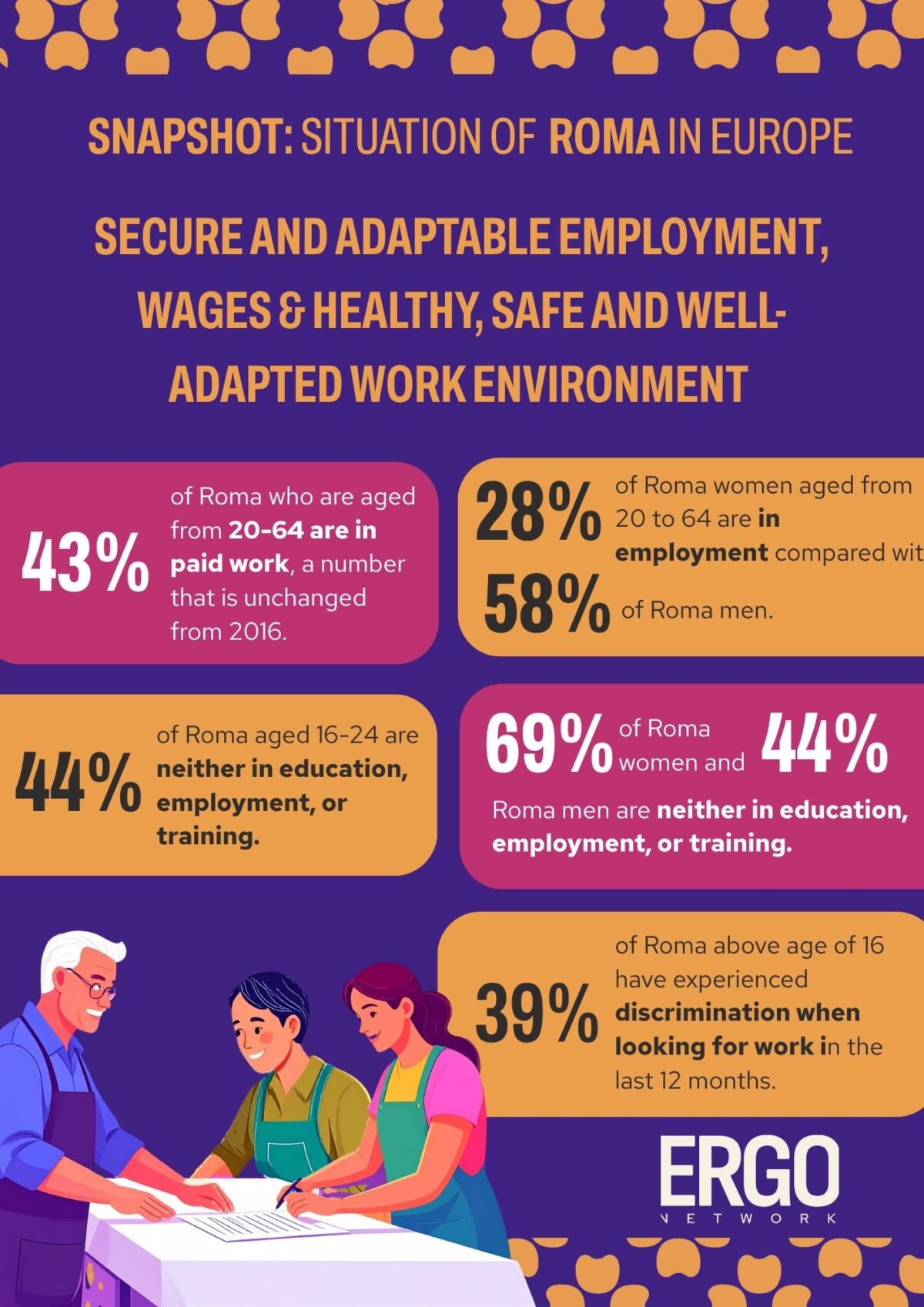
ERGO Network Snapshot Of Secure and Adaptable Employment, Wages and Work Environment

Snapshot on the Situation of Roma in Europe:  Secure and Adaptable Employment, Wages, and Healthy, Safe and Well-Adapted Work Environment 

Our Snapshots on the Situation of Roma in Europe are a series of reader-friendly, visually attractive handouts, linking each of the 20 policy principles of the European Pillar of Social Rights to Roma rights and inclusion. Each Snapshot includes key statistics, a brief problem statement, and extensive policy recommendations.  

Roma workers are often confined to precarious, unsafe, and low-paid jobs, with limited employment rights and social security. They also don’t benefit from almost any opportunities for training or career progression, while they face discrimination and exploitation in the workplace, such as the ethnic pay gap or being given unsafe and unsuitable tasks.   

  • Read the Snapshot here! 

For more information about our work on Secure and Adaptable Employment, Wages, and Working Conditions, please contact Amana Ferro (a.ferro@staging.ergonetwork.org), Senior Policy Adviser with the ERGO Network staff team. 

`
Ana Rozanova – Page 35 – ERGO Network

By continuing to use the site, you agree to the use of cookies. more information

The cookie settings on this website are set to "allow cookies" to give you the best browsing experience possible. If you continue to use this website without changing your cookie settings or you click "Accept" below then you are consenting to this.

Close