ERGO Network Annual Policy Conference 2022

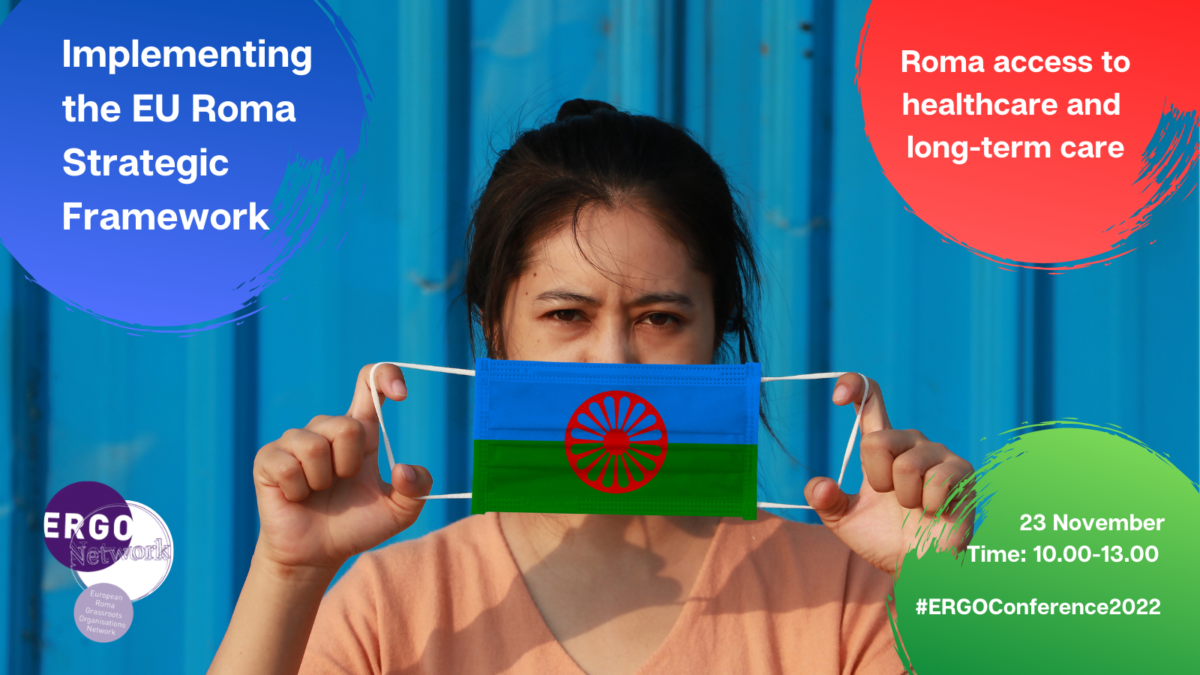
ERGO Network Annual Policy Conference: Implementing the EU Roma Strategic Framework

Roma access to healthcare and long-term care

23 November, 10h – 13h, Mundo B Conference Room

Join us for our Annual Policy Conference 2022!

At a time where Europe is facing multiple crises such as the ongoing pandemic, the war in Ukraine, and the spike in inflation and energy prices, many Roma find themselves facing worsening poverty and exclusion, dire living conditions, and widespread antigypsyism.

The event will serve to launch ERGO Network’s research report on “Roma access to adequate healthcare and long-term care”, based on six national case studies carried out in Bulgaria, the Czech Republic, Hungary, Romania, Slovakia, and Spain. A significant health inequality gap exists between the Roma and the majority population, across every area of physical and mental health and wellbeing, including rates of suicide, disability, life expectancy, and infant mortality.

The conference will also assess the stay of play of the newly adopted National Roma Frameworks and their alignment with the EU Roma Strategic Framework on Equality, Inclusion, and Participation and linked Council Recommendation, as well as Roma involvement in the drafting process and next steps for implementation. A robust and continued monitoring of the entire policy process should be ensured in both EU Member States and Enlargement countries.

The conference will bring together ERGO Network members from the grassroots level, EU policy-makers from across the institutional spectrum, as well as other relevant EU and national stakeholders. If you attend in person, please feel free to wear a mask. The event will be followed by a networking lunch outside the conference room. If you attend online, you will still need to register below.

We’re looking forward to counting you among the participants, so that together we can build positive, sustainable, evidence-based policy solutions that work!

#ERGOConference2022

This conference is kindly supported by the European Union Programme for Citizens, Equality, Rights and Values (CERV) and by the German Federal Foreign Office.

Call for Applications for Local Experts supporting Ukrainian Roma

Supporting Ukrainian Roma impacted by war in the Czech Republic and Romania:

Call for Applications for Local Experts for the Czech Republic and Romania is extended until 15 December 2022

ERGO Network is contracting local experts to draft a monitoring report on the situation of Ukrainian Roma refugees in the Czech Republic and Romania. Each expert will draft a monitoring report for the country of assignment. Besides, local experts will support ERGO Network in advocacy efforts to address the antigypsyism the Ukrainian Roma refugees face by monitoring the experiences of Ukrainian Roma refugees on the ground.

ERGO Network

ERGO Network (www.ergonetwork.org) brings together around 30 members from across Europe and supports organisations with a common perspective on Roma grassroots empowerment and equal citizenship to challenge stereotypes and combat stigmatization. We mobilize and connect organisations and individuals that share and express our values – active citizenship, shared responsibility, and passion – to strengthen and empower Roma civil society involvement in decision-making at local, national, and European levels and to address existing shortcomings of policies targeted at Roma.

Context and objectives for the project

The approximately 400,000 Roma living in Ukraine have faced antigypsyism for centuries, manifested for example in statelessness, extreme poverty and hate crimes. Today, Roma refugees and IDPs experience differentiated, sub-standard treatment in the Ukrainian humanitarian response inside Ukraine and in all countries receiving refugees. Besides antigypsyism in the provision of aid, the Roma are also neither involved nor receives special consideration in the development of programmes for refugees and IDPs and the planning of post-war programmes in Ukraine.

For the estimated 100,000 Ukrainian Roma who have fled the country. Roma civil society organizations are currently their main – and often only – point of support. Both state services and mainstream humanitarian NGOs largely ignore the Roma or treat them differently.

With this project, we aim to:

  • Support the work of national and local Roma CSOs in countries receiving refugees in improving access to quality services for Roma refugees;
  • Advocate for equal access to timely and quality services for Ukrainian Roma refugees on national and European levels, based on evidence from the ground;
  • Raise awareness of antigypsyism faced by Ukrainian Roma and contribute to changing the narrative about Roma.

Role of the local monitoring expert

We are looking for local experts with experience in the context of monitoring the delivery of humanitarian aid to Ukrainian Roma refugees takes place – the Czech Republic and Romania.

Specifically, each expert is expected the following:

  • Develop and write the monitoring report on the situation of Ukrainian Roma refugees for the country they are assigned to work based on a common methodology.
  • Conduct interviews and focus groups, with a special focus on vulnerable sub-groups of Roma refugees
  • Collect and analyse data on the existing situation regarding Ukrainian Roma refugees as a part of the work on drafting the report
  • The Report shall provide relevant data to ERGO Network on Ukrainian Roma refugees, including a detailed scope of work and target locations produced (i.e. number of Ukrainian Roma refugees in certain regions, or the number of Ukrainian Roma refugees in certain reception centres).
  • Develop recommendations on possible sustainable solutions to be part of the legal framework in this area and in the specific country produced as a part of the Report

Please see the full call and the conditions HERE

Profile of the expert:

  • Sound background in the field of Roma inclusion in countries of assignment
  • Experience in conducting monitoring and research within the topic of this Call for Application
  • Experience in drafting monitoring and research reports in the field of Roma inclusion

Conditions:

  • This Call for Applications will be open until 15 December 2022. The deadline for submission of applications is 15 December 2022, 24.00 (CET).
  • Anticipated starting date of the local expert engagement is the 27 of December 2022, while the anticipated contract term is from the 27 of December 2022 to the 27th of February 2023.

Contract and budget:

  • Expert shall be paid 2000 EUR expert costs per the report in each country all taxes and VAT included.
  • The total number of days for the assignment is 10.

Application procedure:

Those who wish to apply to this Call for Applications should submit the following documents:

  • CV, highlighting background and expertise regarding research on Roma and with particular focus on Roma population vulnerable sub-groups
  • Document/statement explaining why this topic is interesting and relevant, and how it can improve the lives of Ukrainian Roma refugees in a particular country encompassed by this project
  • Brief description of the methods and tools to be used to carry out the monitoring of delivery of humanitarian aid to Ukrainian Roma refugees

We will select the experts for each country defined by the project in which monitoring of the delivery of humanitarian aid to Ukrainian Roma refugees should take place. The selection of the experts will be performed according to the “Value for money” principle.

Please submit your application to d.markovic@staging.ergonetwork.org by the 15 of December 2022, 24:00 (CET).

For further questions, please contact d.markovic@staging.ergonetwork.org

Council Recommendation on Minimum Income – What’s in it for Europe’s Roma?

Council Recommendation on Minimum Income – What’s in it for Europe’s Roma?

On 28 September 2022, the European Commission proposed a Council Recommendation on Adequate Minimum Income, aimed at making minimum income schemes more effective at lifting people out of poverty, while promoting the labour market integration of those who can work. It is accompanied by a Communication on better assessing the distributional impact of Member States’ policies and providing guidance on how these can be better targeted to address existing inequalities.

ERGO Network has closely engaged with the run-up to these initiatives. In 2021, we prepared a comprehensive research report on Roma access to adequate minimum income schemes in five countries. In 2022, we responded to the European Commission call for evidence on this Council Recommendation. We equally provided input to the similar call for evidence on distributional impact assessments. We have subsequently reviewed the proposed Council Recommendation on Minimum Income and accompanying Communication on distributional impact in light of the key messages of our own positions.

  • Read our full response here!

Overall, we welcome the Council Recommendation as a significant step forward in strengthening the adequacy, availability, coverage, and take-up of minimum income schemes in the European Union. Thirty years after the previous Council Recommendation of 1992 on sufficient resources for a life in dignity for all EU citizens (which the current proposal replaces), it was high-time that the coordinated access was undertaken by Member States to address existing gaps in provision and access inequalities and to ensure dignified lives and wellbeing for all.

We equally welcome the accompanying Communication and efforts to conduct more and better impact assessments of distributional policies, both by Member States and the European Commission, in order to capture the impact of reforms and investments on the income levels of the population, particularly the most disadvantaged. The document acknowledges that income inequalities undermine European values as well as endanger economic growth, echoing concerns expressed by over 80% Europeans even before the pandemic.

We further appreciate that the Council Recommendation includes explicit references to Europe’s Roma and the multiple disadvantages they face when trying to access their minimum income entitlements, as well as puts forward positive proposals to combat them. Additionally, the document makes the link to the EU Roma Framework on Equality, Inclusion and Participation and the related Council Recommendation. Disappointingly, the same does not hold true for the accompanying Communication.

ERGO Network had called for an explicit end to the culture of blaming benefit claimants as abusers of the welfare state, as well as for widespread antigypsyism to be combatted in all aspects of daily life. Sadly, this call was insufficiently heeded by the Council Recommendation, and we find it a missed opportunity that discrimination (on all and any grounds) is not listed as one of the main challenges described. There is nothing about discrimination in the Communication, and no mentions of racism or antigypsyism or the EU Anti-Racism Action Plan in either of the two documents.

ERGO Network expresses its hope that these gaps will be remedied through implementation, lest Europe’s Roma be left behind once more, and stands ready to support these efforts at both EU and national level.

For more information about our work on minimum income, please contact Amana Ferro (a.ferro@staging.ergonetwork.org), Senior Policy Adviser with the ERGO Network staff team.

GFoD invites Roma candidates to apply for Rights Experts position

GFoD invites Roma women and men to apply for Rights Experts positions

Call for applications for “Rights Experts” from Communities Discriminated on Work and Descent*[1]

We are looking for 2 Roma Rights Experts to work closely with ERGO Network and Global Forum on Communities Discriminated on Work and Descent (GFoD). We particularly encourage Roma women to apply for the Rights Experts due to low representation in this position.

The Roma human rights defenders will be working together with others, coming from the Communities Discriminated on Work and Descent (CDWD), including Dalits, Quilombola, Burakumin, Haratin, Oru, and countless others, who experience discrimination based on their ancestral occupation. Such discrimination is one of the common practices, yet also one of the least understood form of discrimination in the world.

Context

Global Forum on Communities Discriminated on Work and Descent is the global advocacy mechanism of Communities Discriminated on Work and Descent. More than 260 million people across the world are discriminated on the basis of work and descent and are more commonly known as Dalits, Roma-Sinti, Quilombola, Burakumin, Hartin amongst many other names.

Discrimination on Work and Decent (DWD) is a global phenomenon which lacks public recognition and acknowledgement and affected communities are among the most marginalised and excluded people. The ERGO Network is a member organization of the GFoD ensuring the voice of Romani people from Europe.

Position Overview

GFoD has started the CDWD Rights Experts program in 2021 and is currently seeking applications for the next cohort of Rights Experts from Communities Discriminated on Work and Descent to support global advocacy and data collection processes at the national, regional and global level. Candidates will be recruited on the basis of requirements and qualifications listed below.

Two CDWD Roma Rights Experts will be recruited and work in close cooperation with the ERGO Network and will be recruited on the basis of requirements and qualifications listed below ensuring the knowledge about the Romani communities and related legal and policy backgrounds in European countries.

The position requires a high level of autonomy and responsiveness to engage in advocacy processes and a high interest and willingness to engage in national, regional and global advocacy processes. Elevating the national level advocacy of the Roma community towards collective global advocacy engagement for all Communities Discriminated on Work and Descent (CDWD) at the United Nations and other levels.

The positions require approximately 20-24 hours per month for the duration of 12 months with a 3-month trial period with potential international travel.

Duties and responsibilities of the Rights Experts (REs)

  • Dedicate at least 3 full working days per month to this role.
  • Participate and organise capacity building, mutual learning and general advocacy activities.
  • Contribute to the development and implementation of the GFoD global advocacy strategy adopted in 2022 in New York.
  • Author statements, critical interventions and articles or contribute to specific ideas and concept notes on the concerns of CDWD as per the requirement of HLPF and other UN and human rights instruments, mechanisms or initiatives.
  • Communicate regularly with the GFoD Secretariat and the ERGO Network and undertake national, regional and take part in global consultation processes within the local, regional and national CDWD community.

Requirements and qualifications

In order of preference, characteristics and qualifications are listed below. Please note that given our preference for candidates, applicants are not required to have English as a working language.

  1. Anchored and rooted in Communities Discriminated by Work and Descent (CDWD): Persons from Romani origin are highly encouraged to apply to this position. Women, youth, LGBTQ+ and other underrepresented and marginalized groups from CDWD are highly desired for this position.
  2. Experience: Are social leaders within their own community with considerable experience in advocacy actions and processes at national, regional and international level. It is highly desirable that candidates are established human rights defender in their country/region/community and are experts in one particular field area related to the UN Sustainable Development Goals (SDGs). For example, (Access to water and sanitation – SDG 6, decent work – SDG 8, Inequalities – SDG10 etc.). Please mention in your application which SDGs you are most interested in/have worked on.
  3. Commitment: Candidates who have shown ongoing commitment and leadership to the cause of CDWD and Roma, Sinti and Travellers in particular are encouraged to apply.
  4. Academic qualifications: Academic qualifications such as University qualifications, publications of book, articles or other journalistic work will be considered in the application process.

Recruitment and timeline

Please submit your applications to info@staging.ergonetwork.org until Sunday, 20th of November 2022 midnight CET with a subject line “GFoD Rights Expert – application”.

Please submit your CV together with a one page over letter referencing relevant experience mentioned under Requirements and Qualifications. Interviews will start in late November 2022. We prefer applications in English.

Successful candidates will be appointed for a 12-month period with an initial 3 moth trial period.

Due to the high volume expected applications only shortlisted candidates will be contacted.

[1] *Communities Discriminated on Work and Descent (CDWD) are oppressed through caste like discrimination, often forced into conditions of traditional and or modern slavery/bonded labour.

Monitoring Mission on the situation of Ukrainian Roma refugees in the Czech Republic

Monitoring Mission on the situation of Ukrainian Roma refugees in the Czech Republic

On 26 October ERGO Network Secretariat together with our partners and members from Jaw Dikh Poland and Roma Women Platform ROMNI from Moldova held the first monitoring mission to investigate the situation of Ukrainian Roma refugees in the Czech Republic. This is the first mission of our one-year-long project supported by the European Programme for Integration and Migration (EPIM).

The organisations met with the Czech organisation Romodrom, which is active in the field of Roma refugee support since the onset of the war, currently working with more than 1500 people from Ukraine in the Czech Republic as well as also providing social services to the Roma in Western Ukraine.


The partners have discussed the work of Romodrom and other recipient countries. The partners from Jaw Dikh and ROMNI shared the practices from their work with mediators and service provision as well as advocacy and lobbying.

The meeting was followed by a visit to a refugee centre in Prague 5, where 90 people are accommodated, most of them Roma from Western Ukraine. Several organisations are contributing to the smooth functioning of the centre: Romodrom by covering the rent and taking care of the logistics, RomPraha provides social services, our members from Slovo 21 are offering cooking facilities and other classes, UNICEF runs after-school classes for children to help them adapt to the new environment.

A report will be prepared after more information is collected, which will provide ERGO Network and the partners with the necessary data to strengthen our advocacy and cooperation with possible allies. Similar visits will also take place in the coming months to Moldova, Poland, Romania and possibly Ukraine.

`
Ana Rozanova – Page 23 – ERGO Network

By continuing to use the site, you agree to the use of cookies. more information

The cookie settings on this website are set to "allow cookies" to give you the best browsing experience possible. If you continue to use this website without changing your cookie settings or you click "Accept" below then you are consenting to this.

Close