
We are hiring Project Coordinator Jekhipe

Position: Project Coordinator Jekhipe

ERGO Network is hiring a Project Coordinator on a 100% basis to join its
team in Brussels (80% on Jekhipen and 20% on other ERGO advocacy activities)

ERGO Network

ERGO Network (www.ergonetwork.org) brings together 30 members from across Europe and supports organisations with a common perspective on Roma grassroots empowerment and equal citizenship to challenge stereotypes and combat stigmatization. We mobilize and connect organisations and individuals that share and express our values – active citizenship, shared responsibility, and passion to strengthen Roma civil society involvement in decision-making at local, national and European levels and to address existing shortcomings of policies targeted at Roma.

Jekhipe Project

Under the Jekhipe project, ERGO Network, together with its partners from Czechia, Germany, Italy, Romania, Spain and Sweden, undertook to address some of the key structural and institutional obstacles in achieving justice and equality for Roma in practice by tackling the lack of acknowledgement of Roma as victims of historical injustices such as slavery or the Holocaust and the set-up or adequate compensations and reconciliation processes; or the lack of access to services and rights; the lack of Roma museums and institutional representation of Roma in arts and culture; the lack of Roma history teaching etc.

The project is built on the assumption that to achieve Roma equality, inclusion and participation, priority needs to be given to restore the humanity and dignity of Roma and give value to Roma identity in ways that Roma was never granted since the moment they entered today’s Europe. Roma annihilation policies and practices, including portraying Roma in dehumanising ways have solidified negative perceptions and treatment and targeted actions by both state and non-state actors against Roma that have been justified and perpetuated since the beginning, feeding into a perpetual cycle of marginalisation and victimisation of Roma in society.

This is why JEKHIPE focuses on multiple and complementing levels of policy making, including research and evidence-building, monitoring and advocacy, networking and alliances building, awareness raising and capacity building and empowerment to address what we view as core obstacles and concerns hindering Roma equality. It attempts to engage with national and European institutions and relevant stakeholders, including academia, politicians, justice mechanisms, state authorities, civil society and Roma communities themselves and challenge the status quo on approaching Roma issues, particularly antigypsyism and propose mechanisms that can create increased accountability by national governments.

More specifically, the project aims to achieve the following objectives:

  • Build transitional justice processes and mechanisms at the EU, national, regional/local levels, including by setting up expert and/or truth commissions on antigypsyism.
  • Develop policy recommendations for EU and national policymakers on transitional justice approaches to address antigypsyism.
  • Raise awareness of the manifestations of institutional antigypsyism and policy and legislative developments in the fight against antigypsyism.
  • Promote Roma identity, history and culture as a tool to prevent and fight antigypsyism, and include Roma history and culture in school curricula.
  • Empower Roma communities and NGOs to recognise and fight antigypsyism.
  • Capacitate local Roma civil society and key stakeholders in countering antigypsyism.

Task description

The project coordinator will be hired under the Jekhipe Project and will report directly to ERGO Network Senior Advocacy Officer on Anti-racism and Antigypsyism. The project coordinator will have the following responsibilities:

Project management Jekhipe:

  • To ensure that project tasks are implemented timely and correctly
  • To ensure regular open coordination between all consortium partners
  • To develop and maintain strong relationships with project partners and stakeholders, fostering a culture of partnership and collaboration
  • To provide regular project updates to senior management and project partners, as advised by the senior management.
  • To ensure financial management of the project, including budget tracking and reporting together with the Senior Programme Manager of ERGO Network.
  • To identify and manage project risks, implement appropriate mitigation strategies where necessary, and ensure compliance with EU regulations and reporting requirements.
  • To ensure timely and correct reporting of all partners.
  • To regularly monitor progress and conduct internal interim evaluations.
  • To prepare online, hybrid and on-site events and meetings (venues, catering, billing, planning, contact with suppliers).

Contribute to the implementation of activities under the project and beyond:

  • To raise awareness of the manifestations of institutional and structural antigypsyism and policy and legislative developments in the fight against antigypsyism.
  • To promote the development of national data and indicators on antigypsyism under the EU Roma framework.
  • To develop policy recommendations for EU and national policymakers in areas focusing on but not limited to transitional justice, environmental racism and the fight against antigypsyism and racism more broadly.
  • To organise events, including drafting agendas and organising logistical aspects of events.
  • To organise and/or contribute to training events on capacity building of CSOs on issues of non-discrimination, racism and antigypsyism.
  • To represent ERGO in public events and in multi-stakeholder platforms; prepare public presentations and defend ERGO’s positions.

Requirements

Experience:

  • University degree – preferably in a relevant field such as public social sciences or law.
  • At least 3 years working on Roma policy issues at national or European level, particularly on human rights aspects, including non-discrimination.
  • Previous specific policy experience targeting racism and discrimination is desirable.
  • At least three years of demonstrated professional experience in project management (EU project management is desirable).

Skills:

  • Excellent project management skills, including planning, budgeting, risk management and stakeholder management.
  • Good knowledge of discrimination or antigypsyism issues related to Roma in Europe.
  • Good understanding of the functioning of EU institutions.
  • Legal background and knowledge of transitional justice processes are an added value.
  • A good understanding of EU project rules and financial regulations is desirable.
  • Fluency in English (written and spoken) is essential; proficiency in Romanes and other European languages is an advantage.
  • Strong experience with Microsoft Office (Teams, Word, Excel, PowerPoint).
  • Excellent communication and interpersonal skills, with the ability to build strong relationships with project partners and stakeholders;
  • Strong analytical and problem-solving skills
  • Strong organisational skills with attention to detail
  • Ability to work independently and responsibly in an international team
  • Ability to organise work assignments, set priorities and meet deadlines
  • Creative, forward-thinking and proactive attitude
  • Gender awareness
  • Ability to work effectively in a team environment and manage multiple tasks simultaneously
  • Genuine interest in the values and mission of the ERGO Network

Conditions

  • The job location is Brussels. This is a full-time position (37,5 hours/week)
  • The successful candidate will start as soon as possible.
  • Salary: gross monthly salary starting from € 3,200 gross depending on the level of experience, coupled with various legal and extra-legal benefits: 13th-month salary, holiday bonus, luncheon vouchers (8€ per working day), transport allowance (49€ per month)), hospitalisation insurance, additional 7 days of holidays per year.
  • A 2-year full-time work contract with an intention to extend, subject to funding;
  • An organisation committed to values of democracy, fairness, integrity and sustainability;
  • A friendly and respectful work environment.

Location

We offer Belgian contracts under Belgian law. The candidate must commit to officially registering in Belgium and working partially from our office in Brussels. This currently entails a structural teleworking scheme (with at least 2 days in the office per week, depending on the position) and will work under the supervision of the ERGO Senior Advocacy Officer on Anti-Racism and Antigypsyism.

Application procedure

Interested and qualified candidates should complete the application form and submit it to info@staging.ergonetwork.org by 6 February 2024, 23:59 CET, indicating in the subject of the email “Application Project Coordinator Jekhipe”. This email address can also be used for further information and questions.

Successful candidates will be invited for interviews online or in Brussels on February 12th.

ERGO is an equal opportunities employer. We respect our employees’ private lives, including where they take care roles. We strive to be an inclusive organisation and encourage applications from a diverse range of candidates.
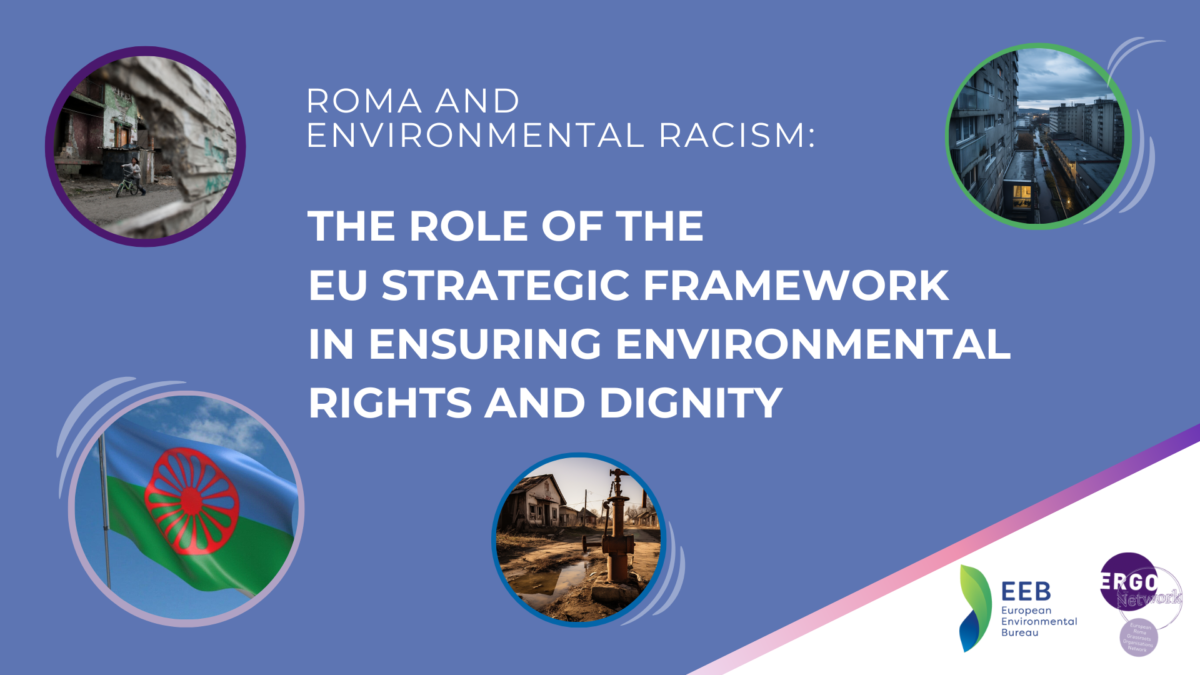
Roma and Environmental Racism: The Role of the EU Strategic Framework in Ensuring Environmental Rights and Dignity

Roma and Environmental Racism: The Role of the EU Strategic Framework in Ensuring Environmental Rights and Dignity

Under International Holocaust Remembrance Day, the ERGO Network and the European Environmental Bureau (EEB) organised an online joint policy launching event on Environmental Justice in Roma Communities and the EU Roma Strategic Framework on 29 January 2024 from 14:00 to 16:30.

🗓️Date: 29.01.2024

🕒 Time: 14:00-16:30 CET

🌐 Location: Online

Last autumn, the EEB and the ERGO Network collaborated to host the inaugural Environmental Justice Conference for Roma communities in Cluj-Napoca, Romania. The event arose as a natural response to the EU’s recognition of environmental justice in October 2020, signified by the adoption of the EU Strategic Framework for Roma Equality, Inclusion, and Participation – a pioneering policy document which notably highlights the imperative for environmental justice within the EU. 

This collaboration was now followed up on the framework of the Roma Holocaust Remembrance Day on January 27th by a joint EEB/ERGO event on environmental justice in Roma communities and the EU Roma Strategic Framework.

The event aimed to launch several policy products developed by the European Environmental Bureau and the ERGO Network, including the joint report on Environmental Justice in National Roma Strategic Frameworks, the EEB Case studies on Environmental Racism and the Basic Principles of Environmental Justice and Roma communities as a main outcome of our October Environmental Justice Conference in Cluj, Romania.

The event heightened awareness about the imperative to monitor the repercussions of environmental racism on Roma communities. This monitoring spans the National Roma Strategic Frameworks and wider EU Environmental policies and programs, emphasizing a commitment to a human rights baseline— a fundamental principle of environmental justice.

Lastly, the event endeavoured to actively involve stakeholders in this crucial dialogue to continue to work ahead in 2024.

We thank all the participants of the event. For those who were not able to attend, please note that you can still view the recorded event on the ERGO Facebook page:

Agenda of the event

13:30 – 14:00 Registration and online connection

Moderator: Stephanie Richani, Advocacy Lead, Equinox Racial Justice Initiative  -Equinox

14:00 – 14:15 Opening remarks and purpose of the meeting

  •  Gabriela Hrabanova, Director ERGO Network
  •  Patrizia Heidegger, Director EEB
  •  MEP Romeo Franz, Greens/EFA, Germany

14:15 – 15:10 ERGO & EEB report on Environmental Justice in NRSFs  

  • Isabela Mihalache, ERGO Network
  • Dan Doghi, European Commission, DG JUST
  • Magda Boulabiza, Policy and Advocacy Advisor, ENAR
  • Discussion

15:10 – 16:10 EEB case studies and Basic principles on Roma and Environmental justice

  • Diego Marin, Policy Officer for Raw Materials and Resource Justice, EEB
  • William Acker, National Association of Citizen Travellers (ANGVC) – Case
    study in France
  • Francesc Cots, Energy & Climate Manager, Eco-union, Spain – Case study in
    Spain
  • Discussion

16:10 – 16:30 Conclusions and follow-up

  • MEP Patricia Caro Maya, The Left group in the European Parliament
    GUE/NGL, Member LIBE Committee, Spain (video message)
  • Patrizia Heidegger, Director EEB

Background

The European Commission and EU Member States have set guidelines to combat antigypsyism through the EU Roma Strategic Framework, adopted in 2020, and the Council Recommendation on Roma equality, inclusion, and participation. This strategic framework focuses on three pillars: equality with the broader society, social and economic inclusion, and active participation in various aspects of life.

A significant development within this framework is the inclusion of environmental justice guidelines for Member States. It calls for recognition and action against environmental discrimination affecting marginalized Roma communities in segregated areas, representing a groundbreaking acknowledgement of the connection between racial discrimination and environmental challenges faced by the Roma, such as the lack of access to essential services – including tap water, safe and clean drinking water, adequate sanitation, waste collection and management services, and other environmental services.

As of January 2023, the European Commission’s assessment of National Roma Strategic Frameworks reveals that several Member States address improving access to essential services, notably running water. However, there is a limited inclusion of both mainstream and targeted measures for social housing access. Some strategies focus on official procedures for urban development, residential upgrading, home ownership encouragement, and infrastructure investment in areas like electricity, gas, water, sewage, waste management, roads, and transport access. 

Furthermore, a report organised by the EEB as a follow-up to our 2020 “Pushed to the Wastelands” focusing on Eastern Europe provides detailed case studies of environmental racism in Western Europe. Both reports collectively assert that environmental racism is a pan-European issue, underscoring that countries are ill-prepared to address contemporary issues leading to environmental injustices, let alone that member states are inadequately responding to future ecological challenges for Roma communities.

The most recent report on the topic, produced jointly by ERGO Network and EEB will be presented at the event on 29 January, titled “Environmental Justice in National Strategic Frameworks.” It delves into the critical intersection of environmental justice and the inclusion of Roma communities in Europe. The comprehensive analysis begins by outlining the policy context, emphasising the significance of environmental justice concerning Roma inclusion. Recognising the historical oversight, the report highlights the adverse environmental conditions faced by Roma and Traveller communities, from living near pollution sources to discriminatory housing practices. The introduction stresses the impact of the COVID-19 pandemic, underscoring the vulnerability of marginalised communities due to limited access to essential environmental services.

The report then focuses on the EU Strategic Framework for Roma Equality, Inclusion, and Participation, adopted in October 2020, marking a crucial milestone in addressing environmental justice within EU policy. The subsequent development of National Roma Strategic Frameworks by Member States is examined, focusing on social inclusion areas such as education, employment, healthcare, and housing. The analysis aims to provide a comprehensive overview of how environmental justice is addressed within these frameworks, considering direct environmental aspects and related proxies like access to housing and utilities.

Additionally, the report identifies good practices at the national level and offers recommendations to Member States for enhancing their strategies, emphasising the need for collaborative discussions among stakeholders to address the risks and impacts of environmental racism and discrimination faced by Roma and Traveller communities.

The Common Basic Principles for Environmental Justice for Roma emerged through deliberations with community representatives, civil society members, practitioners, and academics engaged in Roma rights issues during the first Environmental Justice for Roma Conference held in Cluj-Napoca, Romania, on October 11th, 2023. Rooted in equity, inclusivity, and justice, the principles address historical and ongoing environmental injustices Roma populations face.

For more information about ERGO Network’s work on environmental justice, please contact Senior Advocacy Officer Isabela Mihalache.

Incorporating Roma in European Youth Policies: An Assessment of Inclusion Efforts

Incorporating Roma in European Youth Policies: An Assessment of Inclusion Efforts

The Roma community constitutes one of the largest European minorities. Simultaneously, it has continuously experienced structural and institutional marginalisation, resulting in its persistent exclusion from various spheres of society. This systemic exclusion is reflected in the hindered effectiveness of youth-focused measures within the EU policies that, based on the outcomes of this online survey, are insufficient in addressing the multifaceted needs and aspirations of Roma youth.

Many individuals of Roma youth face substantial barriers impeding their accessibility to essential resources, opportunities, and representation within wide-raging societal constellations. These impediments comprise disparities in education, restricted economic prospects, cultural biases, lack of access to healthcare, or inadequate housing. The identified situation is paradoxical, given that various dedicated efforts aim to foster Roma inclusion nationally and internationally. However, regardless of specific initiatives targeting Roma inclusion, the meaningful engagement and representation of Roma youth remains limited within broader youth-centric policies and related programs.

This survey illustrates an endeavour to underpin the challenges faced by Roma youth and proposes a possible orientation for a more holistic approach to including Roma youth. This survey aims to inform policy decision-makers who seek to address Roma exclusion through empowering Roma youth.

Objectives

To achieve the mentioned aim, this survey consists of four objectives:

  • To evaluate the inclusiveness of youth measures concerning the Roma community.
  • To identify potential barriers that hinder the effective participation of Roma youth in these measures.
  • To gather stakeholders’ perspectives on the importance of Roma inclusion in broader youth policies.
  • To provide recommendations for enhancing the representation and participation of Roma youth in youth-focused initiatives.

Recommendations from the Roma youth:

This survey presented the outcomes of an online survey. By analysing respondents’ insights on the general and specific youth policies, it assessed the effectiveness of existing youth measures for including the Roma youth in various policies regarding decision-making and participation within related youth initiatives. The findings of the survey affirm that Roma youth continue to be underrepresented in the European Union’s youth-focused policies despite numerous inclusion efforts.

Regarding that, this survey efforted not only to underpin the challenges faced by Roma youth but also to propose a possible avenue of a more holistic approach to including Roma youth.

Generally, the suggestions revolve around creating more inclusive policies that directly engage Roma youth in decision-making processes, empower them through various educational opportunities, and design workshops or trainings for Roma and non-Roma awareness raising about anti-Roma racism and means of combating them. This survey is expected to bear valuable insights for policy decision-makers aiming to empower Roma youth by reversing the long-lasting Roma exclusion.

Read the full survey assessment “Incorporating Roma in European Youth Policies: An Assessment of Inclusion Efforts“

Promoting Inclusivity: Roma and Non-Roma Youth Leading Social Change 

On December 7, in Brussels, ERGO Network had the dissemination event of the “Roma Youth Bring Change” project supported by Erasmus. 

The project brought together Autonomia Foundation (Hungary), RRoma (North Macedonia), and ERGO Network to showcase and disseminate the methodology of community detective and community campaign games and case studies in North Macedonia and Hungary focusing on social issues – planned and implemented by and targeting Roma and non-Roma young people. The project was a success and gave young Roma skills to be campaign promoters and game facilitators.

The event’s innovative outcome involves gamification and community campaigns for inclusivity and the fight against discrimination. 

See more:

For more information about this project and event, please don’t hesitate to contact: info@staging.ergonetwork.org

Human Rights Day: A Critical Look at Roma Housing and Human Rights in Europe

Human Rights Day: A Critical Look at Roma Housing and Human Rights in Europe

On this International Human Rights Day, we find ourselves reflecting on the persisting challenges faced by the Roma and Traveller communities across Europe, particularly in the realms of housing, discrimination, and social inclusion. This article provides ERGO Network’s position on the pressing issues surrounding access to one of the fundamental human rights – the quality and affordable housing for Roma.

As we delve into the discourse, the narrative reveals a stark reality exacerbated by the adverse effects of the COVID-19 pandemic, inflation, and escalating costs of living, all of which disproportionately affect these marginalised communities.

As we commemorate Human Rights Day, let this article serve as a call to action, urging governments, institutions, and civil society to collaborate in realising tangible progress and comprehensive solutions for the Roma across Europe.

According to ERGO Network’s most recent case studies on Roma and Traveller access to quality and affordable housing and accommodation in Bulgaria, Czechia, Hungary, Romania, Slovakia, and Spain, with additional benchmarking evidence from 6 other European countries – in Ireland and the Western Balkans and Turkyie, the impact of Covid-19 and increase in inflation and cost of living – hit Roma and Travellers’ communities in Europe the hardest on top of existing inequality and antigypsyism.

The vast majority of Roma and travellers experience vast amounts of poverty and homelessness. Their living conditions tend to be considerably poorer than those of non-Roma, including the lack of utilities and services, unsafe and unsound dwellings, exposure to environmental hazards and injustice more broadly, as well as chronic overcrowding, but not lastly segregation, which is flourishing also because of mass forced evictions without the provision of alternative housing and accommodation, and which entails among others insecurity of tenure and lack of identity papers.

In the face of the demonstrated picture of historical, widespread structural and institutional antigypsyism against Roma and Travellers across the EU and Enlargement countries, the EU has taken unprecedented action by proposing the EU Roma Framework in 2011 and mobilising Member States to commit to developing national strategies and local action plans, including a council recommendation on Roma in 2013. However, as the 2018 evaluation report of the implementation of the EU Framework showed, in the areas of housing and discrimination, the situation was reported as worsening while some progress was observed regarding the general objective of fighting poverty.

Fortunately, the new EU Strategic Framework for Roma Equality, Inclusion and Participation, supported by the Council Recommendation, has somehow tried to mitigate the situation by proposing specific targets in the area of housing. With the 2023 Commission assessment of the NRSFs, Several Member States included measures to improve access to essential services […] and, to some extent, prevent and eradicate spatial segregation. Few NRSFs have […] measures to facilitate access to social housing, while several NRSFs propose measures for urban and residential upgrading and to invest in infrastructure such as electricity, gas, running water, sewage and waste management, roads and access to transport. Combatting discrimination and antigypsyism as obstacles to accessing housing or addressing forced evictions are only mentioned by a few Member States.

The European Pillar of Social Rights also covers housing aspects and is applicable under the UN Sustainable Development Goals. Desegregation is also covered under the European Semester but not followed up on under the Resilience and Recovery; more needs to be done to ensure operational alignment and synergy throughout EU policies, including EU environmental policies. Some shortcomings are also evident with the newly adopted conclusions on Roma housing, where linked social determinants are not adequately addressed, including its proxies such as environmental justice.

But more needs to be done by the Member States to commit to improving desegregated housing and accommodation for Roma and travellers, combat poverty, social exclusion and antigypsyism, political will and know-how.

We salute the Spanish Presidency for continuing the work on Roma housing under the National Roma Platform. However, we need all MS and Enlargement countries to invest in improving the structural condition of the dwellings of Roma, including their connection to utilities and develop and implement comprehensive desegregation plans, tackling the legalisation of irregular housing situations and the environmental consequences stemming from the use of unsuitable locations; Roma housing and energy poverty must be addressed. Evictions should be the last resort and always accompanied by adequate alternative accommodation. Social housing allocation should follow a human rights-based approach, reducing conditionality and unaffordability and ensuring that vulnerable groups such as Roma are prioritised.

The new Roma Framework is aligned with all relevant EU and Enlargement countries funding for addressing Roma housing and linked social determinants, so governments need to make use of the ESF+, ERDF, Horizon 2020, Invest EU, Recovery and Resilience, IPA 2021-27, Neighbourhood, Development and International Cooperation Instrument – for the Enlargement countries. Perhaps even more relevant is the possibility for MS to use the Technical Support Instrument that provides tailor-made technical expertise to EU Member States to design and implement reforms, which is demand-driven and does not require co-financing from Member States. The same type of technical assistance is available for Enlargement countries under TAIEX and Twinning.

Western Balkan need to be an integral part of all policy processes under the EU Roma Framework and also benefit from the same attention and representation in the EU Platform agenda, mainly because the enlargement countries are those where political commitment can be leveraged easier through the enlargement criteria and where the situation of Roma whether in the area of housing or otherwise is even more dire.

As such, in July 2019, at the Poznan Summit, the Western Balkans Prime Ministers adopted the Declaration on Roma integration in the EU enlargement process. The Poznan commitments cover housing and inclusion of the Roma dimension in the green and digital agendas, and new Roma inclusion Strategies/Action Plans align with the EU Roma framework.

As we advance with the EU Roma Platform, we need to ensure that until the upcoming EU Presidency event, we have concrete and tangible progress and developments at the national level. We also allow civil society to attend even party meetings with national Roma Contacts Points. In these meetings, we need to see a higher and broader in-person political representation from the EU and National MS.

Ultimately, let us not forget about the principle of nothing for Roma without Roma – the shrinking space of Roma civil society is an undeniable reality, following the negative trend in Europe where we experience a human rights crisis both in our communities, including in the leadership of the EU and many of its Member States. In the context of antigypsyism, limiting the role and exercise of NGOs to participate and monitor human rights issues and policy implementation process on Roma inclusion and equality is not only undemocratic but also dangerous not only to protecting Roma lives but also to ensuring their wellbeing. Ensuring that Roma NGOs are inside the programmes and projects as partners and leaders is essential.

This article is an adaption of the speech held by ERGO Network’s Senior Advocacy Officer Isabela Mihalache as a part of the panel on the political conclusions of the 16th Roma Platform organised by the European Commission under the patronage of the Spanish Presidency in Madrid. If you have more questions about our work on the EU Roma Framework, please email i.mihalache@staging.ergonetwork.org.

For more information about our work on Roma access to quality and sustainable housing, please contact Amana Ferro (a.ferro@staging.ergonetwork.org)”

`
Ana Rozanova – Page 13 – ERGO Network

By continuing to use the site, you agree to the use of cookies. more information

The cookie settings on this website are set to "allow cookies" to give you the best browsing experience possible. If you continue to use this website without changing your cookie settings or you click "Accept" below then you are consenting to this.

Close