Inclusion or Exclusion? The Reality for Roma Refugees in Poland

Inclusion or Exclusion? The Reality for Roma Refugees in Poland

The ongoing conflict in Ukraine has led to a massive humanitarian crisis, forcing millions of people to seek refuge in neighbouring countries. Among these displaced individuals are the Roma, a discriminated-against ethnic group in both Ukraine and Poland. This article delves into the situation of Ukrainian Roma refugees in Poland, as outlined in the ERGO Network project’s report, “Supporting Ukrainian Roma impacted by war.” The report, prepared for ERGO Network by Elżbieta Mirga-Wójtowicz, Kamila Fiałkowska and Monika Szewczyk, sheds light on Roma refugees’ challenges and highlights the urgent need for comprehensive support and advocacy efforts.

The Scale of the Crisis and Legal Assistance

As of February 2023, nearly 1,563,000 people from Ukraine had sought refuge in Poland, with a significant part being Roma. Despite the staggering numbers, the plight of the Roma within the broader refugee crisis tends to be overlooked. The report suggests that tens of thousands of Roma have crossed the Polish border, and estimates by the European Commission put the figure at least 100,000 Roma fleeing Ukraine. The Roma face a complex set of challenges rooted in historical discrimination and exacerbated by the trauma of being refugees from a war-torn region.

The legal initiatives for Ukrainian refugees at both the European and Polish levels include the activation of the Temporary Protection Directive and the extension of legal stay for Ukrainian citizens in Poland until March 4, 2024, with various assistance measures. However, despite these efforts, the author notes a significant lack of adequate support for Ukrainian Roma refugees in Poland, highlighting systemic discrimination and challenges in accessing assistance due to antigypsyism.

Distinct Challenges of Ukrainian Roma Refugees

The discrimination faced by Ukrainian Roma refugees is profoundly ingrained and multifaceted. In both Ukraine and Poland, they encounter various forms of discrimination, both verbal and non-verbal. This discrimination extends beyond rhetoric, affecting crucial aspects of their lives, such as housing, employment, information access, transportation, and vital support services, including psychological, legal, and educational assistance.

Antigypsyism, or prejudice against Roma, compounds the challenges faced by this group. The report highlights that the Roma tend to form larger groups for security, yet this collective behaviour complicates voluntary efforts to assist them. The trauma of war, coupled with enduring discrimination, creates a paradoxical situation where Ukrainian Roma refugees experience both exclusion and inclusion simultaneously.

Role of Roma Activists and NGOs

In the absence of comprehensive government-led initiatives, the primary efforts to aid Ukrainian Roma refugees are spearheaded by Roma activists and organisations in Poland. While these organisations treat Roma as equals, their capacity is often stretched thin due to the unique challenges faced by the Roma refugees. The burden falls on activists and NGOs to independently provide support and assume responsibility for the well-being of the refugee community.

The report emphasises the necessity of establishing a precise mechanism for financial support for NGOs and activists working with Roma refugees. The support should extend to individual services, such as psychological and legal assistance for activists, recognising the additional pressures on them. At present, Roma activists and organisations, along with local authorities, share a similar attitude towards Roma refugees, creating a need for a more sustainable and collaborative approach.

Official Stance and Color-Blind Policies

While the report does not explicitly detail services being denied to Roma, it highlights an official stance of being ‘colour-blind.’ This approach, while seemingly neutral, inadvertently negates the existence of institutional antigypsyism and discrimination against Roma in Poland. By overlooking the specific challenges faced by Ukrainian Roma refugees, the colour-blind policy exacerbates the situation and impedes the development of targeted solutions.

Advocacy and Awareness

The report stresses the importance of advocacy to raise awareness of the social and economic challenges faced by Ukrainian Roma refugees. With Roma residing in reception centres, the dynamic situation calls for dialogue and cooperation between various stakeholders, including owners, coordinators, staff, volunteers, Roma NGOs, and local authorities. The involvement of the Ombudsman is suggested, and avenues such as meetings, trainings, workshops, and social campaigns are proposed to foster understanding and break down resentment against the Roma community.

Conclusion

The plight of Ukrainian Roma refugees in Poland underscores the need for a nuanced and targeted approach to address the unique challenges faced by this marginalised group. From systemic antigypsyism to the trauma of war, the Ukrainian Roma refugees navigate a complex web of discrimination and exclusion. The role of Roma activists and organisations is crucial, but sustainable solutions require broader collaboration, financial support, and a concerted effort to raise awareness and challenge colour-blind policies.

The recommendations outlined in the report aim to enhance human rights protection for Roma refugees from Ukraine in Poland. They include the development of a comprehensive migration policy, establishing intergovernmental collaborations, addressing discrimination issues at a national level, aligning governmental programs with the specific needs of Roma refugees, and providing support for NGOs and activists. Specific measures include creating monitoring systems, fostering integration through workshops, sensitising stakeholders, prioritising Roma issues within national structures, and initiating transnational advocacy efforts. 

This report was made through the ERGO Network project “Supporting Ukrainian Roma impacted by war”, financed by the European Program for Integration and Migration (EPIM) and the European Commission’s CERV programme.

Guidelines on Countering Antigypsyism

New ERGO Network Manual: Guidelines on Countering Antigypsyism

We are happy to present our latest ERGO Network Manual, also part of our Decade Against Antigypsyism Campaign – “Guidelines on Countering Antigypsyism”.

“Guidelines on Countering Antigypsyism” were written by Ana Rozanova and Martina Horvathova for ERGO Network with the idea of equipping non-governmental civil society organisations with practical knowledge and strategies to address one of the most persistent forms of discrimination in our society.

The Guidelines provide insights and practical strategies for CSOs and individuals committed to fighting against the deeply rooted prejudice and discrimination faced by Roma communities. Throughout them, we explored various dimensions of antigypsyism, both online and offline, and emphasised the significance of addressing
this issue.

By understanding the complexities of antigypsyism, both online and offline, we can devise effective strategies to challenge stereotypes, promote inclusivity, and advocate for the rights of Roma communities. Our collective efforts are necessary to dismantle systemic barriers and promote social justice.

Let us remember that the fight against antigypsyism is not isolated to a single organisation or individual. It is a collective responsibility that requires ongoing commitment, resilience, and solidarity. By working together, we can challenge prejudices, dismantle stereotypes, and build a society that embraces diversity, inclusivity, and equal opportunities.

Let these guidelines for countering antigypsyism serve as a call to action for us to take measurable, practical steps in this work.

For more information about ERGO Network’s Decade against Antigypsyism Campaign, please contact Communication and Campaign Officer Ana Rozanova.

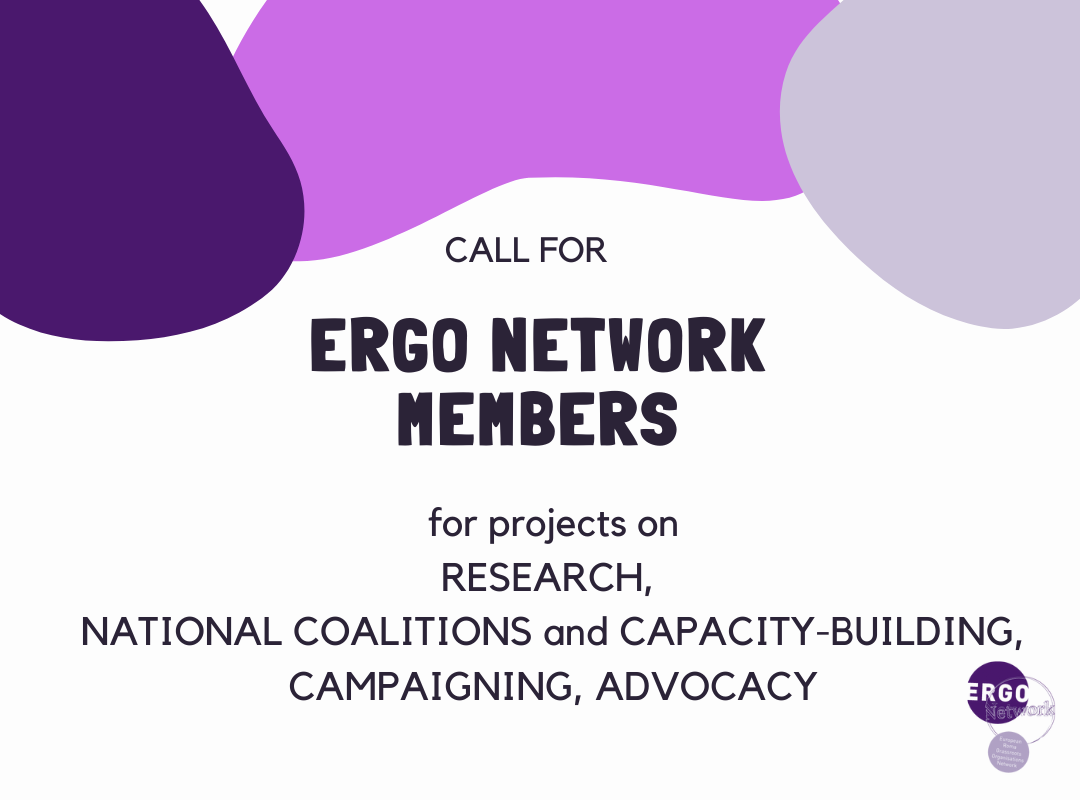
Call to ERGO Network Members for Applications for Re-Granting 2024

Roma equality, inclusion and participation (EQUIP) 2024: Re-granting to ERGO Network members

This year, the ERGO Network can give grants to its members in three categories. These grants are part of ERGO Network’s financial support to third parties through its Annual Work Programme ‘Roma Equality, Inclusion and Participation 2024, funded by the Citizens, Equality, Rights and Values Programme (CERV) of the European Commission.

RESEARCH:

Call for applications for small-scale research projects: To support local and national Roma civil society in gathering evidence of challenges Roma faces locally through research activities.

Three projects with budgets up to 4,000 €

NATIONAL COALITIONS: 

To support local and national Roma civil society in gathering evidence of challenges Roma face locally through research activities and strengthening the networks.

Six projects with budgets up to 5,000€

CAPACITY-BUILDING, CAMPAIGNING, ADVOCACY: 

Call for applications for capacity-building, campaigning, and advocacy projects.

Nine projects with budgets up to 10,000€

Eligibility criteria: 

– Be a member (full or associate) of the ERGO Network
– Be established as a Member State of the European Union
– Be a legal entity, a non-profit organisation
– Respect EU values as laid down in Art.2 of the Treaty on European Union and the EU Charter of Fundamental Rights.
– Not be a sub-contractor of ERGO Network
– Adhere to ERGO Network’s safeguarding policy, have their safeguarding policy or agree to start developing a safeguarding policy.

All ERGO Network full member and associate member organisations can apply to more than one of the calls.

The deadline for applications is 29 March 23:59 CET.

The selection will be done by a team of ERGO Network Secretariat, board members, and one external evaluator.

The implementation period is foreseen for May to November 2024.

This project is funded by the European Union.

European Commission releases Autumn Package 2024: What’s in it for Europe’s Roma?

European Commission releases Autumn Package 2024: What’s in it for Europe’s Roma?

On 21 November 2023, the European Commission published the Annual Sustainable Growth Survey, accompanied by the draft Joint Employment Report (among other annexes), launching the next European Semester 2024. The Annual Sustainable Growth Survey (ASGS) highlights the main policy priorities for the European Union for the year to come, and it outlines the main tools for implementing these objectives. The Communication also outlines the key aspects of the 2024 European Semester cycle and confirms the commitment to the four complementary dimensions of environmental sustainability, productivity, fairness, and macroeconomic stability.

ERGO Network warmly welcomes the explicit mention of the Roma in this year’s Annual Sustainable Growth Survey (page 9) in the context of supporting their access to employment. We further appreciate wording on the Union of Equality (page 7), which includes the EU Roma Strategic Framework for Equality, Inclusion and Participation and the EU Anti-Racism Action Plan, though they are sadly not mentioned explicitly. However, disappointingly, discrimination, racism, or antigypsyism are not mentioned at all.

As every year, the main focus of the document is on the green and digital transitions. Social concerns are dealt with under the Fairness section (one of the four dimensions of the European Semester), which is rather narrowly dedicated to employment and skills. Nevertheless, we appreciate calls to strengthen collective bargaining and to raise wage levels, support adequate social protection and social inclusion, and improve access to quality early childhood education and care (although this is clearly done from a labour market perspective rather than children’s rights).

We are very pleased to see Europe’s Roma mentioned multiple times in the Joint Employment Report, concerning issues such as their heightened risk of experiencing poverty and social exclusion (including that of children), low participation of Roma children in early childhood education and care, early school leaving, need for better access to desegregated housing, low employment rates, difficulties in accessing essential social services. Additionally, strong links are made to the EU Strategic Framework on Roma Equality, Inclusion, and Participation and its targets throughout the text, coupled with references to the Council Recommendation and recent Council Conclusions. Regrettably, though, there is no mention of antigypsyism or racism, and only 12 references to discrimination, however, one of them referring specifically to the plight of the Roma.

The ASGS explicitly urges Member States to “actively engage with stakeholders, including social partners, local and regional authorities, as well as relevant civil society organisations” throughout the European Semester and the implementation of the Recovery and Resilience Facility  (our bold). This is very positive, as are the several references to civil society in the draft Joint Employment Report.

The ASGS also provides some clarity about the future of the European Semester, as well as what are the key steps and milestones to be expected for 2024. As usual, this will include the implementation of the Recovery and Resilience Facility, that of the European Pillar of Social Rights Action Plan, and that of the Sustainable Development Goals. Additionally, the 2024 Semester will also look at the Cohesion Policy programmes, exploring how they complement the Recovery and Resilience Facility, with a view to feeding into the mid-term review of the current programming period (2021-2027).

ERGO Network will continue to advocate for a stronger focus on Roma rights and inclusion in the framework of these processes and for stronger synergies between the European Semester and the EU Roma Strategic Framework for Equality, Inclusion, and Participation, the EU Anti-Racism Action Plan, and other relevant policies.

For more information about ERGO Network’s work on EU social inclusion and employment policy (European Semester, European Pillar of Social Rights, Sustainable Development Goals etc), please contact Senior Policy Adviser Amana Ferro.

Honouring Holocaust Remembrance Day: Introducing the Jekhipe Project

Honouring Holocaust Remembrance Day: Introducing the Jekhipe Project

On 27th January, the international community comes together to commemorate Holocaust Remembrance Day, a solemn occasion that marks the liberation of the Nazi concentration camps, including Auschwitz, by the Red Army in 1945. This day serves as a poignant reminder of the millions of lives lost during the Holocaust, among them the Roma men, women, and children who perished in the shadows of history, subjected to the horrors of the “Forgotten Holocaust.”

Remembering the Roma Genocide

The Roma Genocide, overlooked for decades, saw its victims, particularly those in the “Gypsy Family Camp” at Auschwitz-Birkenau, facing a tragic end on 2nd August 1944. As we reflect on the past, it is crucial to acknowledge that the legacy of persecution endured by the Roma community did not conclude with the liberation of the camps. Antigypsyism persists, with its manifestations intensifying even in the face of global challenges, as noted by Gabriela Hrabanova, Director of ERGO Network.

Introducing the Jekhipe Project

In response to these persistent challenges, ERGO Network, in collaboration with partners from Czechia, Germany, Italy, Romania, Spain, and Sweden, proudly announces the Jekhipe Project. This initiative is a comprehensive effort to address structural and institutional obstacles hindering justice and equality for Roma communities. It seeks to rectify historical injustices, including slavery and the Holocaust while addressing contemporary issues such as limited access to services, inadequate representation, and the absence of Roma-focused cultural institutions.

Jekhipe’s Core Objectives

The Jekhipe Project operates on multiple levels, engaging in research, advocacy, networking, and capacity building to challenge existing paradigms and promote the inclusion and participation of Roma in society.

The project’s key objectives include:

  • Building transitional justice processes and mechanisms at the EU, national, regional/local levels, including expert and truth commissions on antigypsyism.
  • Developing policy recommendations for EU and national policymakers on transitional justice approaches to address antigypsyism.
  • Raising awareness of institutional antigypsyism and policy developments in the fight against antigypsyism.
  • Promoting Roma identity, history, and culture as tools to prevent and combat antigypsyism, including advocating for the inclusion of Roma history and culture in school curricula.
  • Empowering Roma communities and NGOs to recognise and combat antigypsyism.
  • Capacitating local Roma civil society and key stakeholders in countering antigypsyism.

Are you interested in working on this project?

Right now we have an open vacancy for the Jekhipe Project Coordinator, a crucial role in leading the project towards impactful change. Read more about it here.

Connecting the Dots: Romani Week Event

This 9-11 April, during Romani Week 2024, we will launch the Jekhipe Project officially. The event, titled “Reclaiming our past, rebuilding our future: New approaches to fighting antigypsyism against Roma,” will serve as a platform to initiate the project’s goals, bringing together experts, policymakers, activists, and the Roma community to foster dialogue and collaboration.

As we remember the Holocaust on this solemn day, let us also commit to challenging the persistence of antigypsyism and working towards a future where the dignity and humanity of the Roma community are fully recognised and respected. Together, we can build a more inclusive and just world.

`
Ana Rozanova – Page 12 – ERGO Network

By continuing to use the site, you agree to the use of cookies. more information

The cookie settings on this website are set to "allow cookies" to give you the best browsing experience possible. If you continue to use this website without changing your cookie settings or you click "Accept" below then you are consenting to this.

Close