Romani Week 2024 Announcement

Romani Week 2024: Shaping the Future for Roma, Sinti, and Travellers in Europe

As Europe grapples with a complex socio-political landscape characterised by both anti-racism movements and the resurgence of far-right ideologies, the need for inclusive discussions about marginalized communities becomes increasingly vital. In this context, the Roma, Sinti, and Travellers face numerous challenges related to equality, inclusion, and participation. The rise of xenophobic and nationalist sentiments at both national and EU levels poses a threat to their well-being and integration into society.

The Challenge

Despite efforts on paper, the struggle for effective inclusion of Roma, Sinti, and Travellers persists due to a disconnect between policies on Roma inclusion and mainstream initiatives. The political will to combat antigypsyism and social exclusion often falls short, with National Roma Strategic Frameworks remaining under implementation. As the political climate in Europe evolves, the urgency to address these challenges becomes even more apparent.

What is Romani Week?

Romani Week, an annual event held in Brussels serves as a platform to raise awareness about the realities faced by Roma, Sinti, and Travellers in Europe. It brings together civil society organizations, European institutions, and international entities during the Roma International Day. This year, the event is more pertinent than ever, coinciding with the upcoming European elections.

Objectives of Romani Week 2024

Romani Week 2024 aims to dissect the position of the Roma agenda within the broader European political discourse and priorities. The focus is to foster dialogue about the pressing issues affecting the Roma, Sinti, and Travellers communities and ensure their prominence in mainstream political discussions and EU policy priorities.

The primary objectives include:

  1. Platform for Discourse: Provide a platform for representatives and stakeholders of Roma, Sinti, and Travellers to engage in conversations about the contemporary political, economic, and human rights landscape in Europe.
  2. Political Accountability: Encourage stronger accountability and political will from governments, both within the EU and Enlargement countries, to deliver on the promises of equality, inclusion, and participation for Roma, Sinti, and Travellers.
  3. Concrete Topics: Address specific issues such as increased antigypsyism, structural discrimination, the implementation and monitoring of National Roma Strategic Frameworks, and discussions about Roma history, truth, and reconciliation processes.

Overview of the events

Please note that you have to register for each event separately using the special form. If you would like to see the draft agenda, check the regularly updated website of the Romani Week 2024 here.

Future of Roma, Sinti and Travellers in Europe

The event will discuss the ongoing political, economic and human rights changes Europe faces today and ways to ensure that Roma, Sinti and Travellers become a more prominent priority within the mainstream political discourse and policy priorities at the EU level to ensure a stronger accountability and political will by governments, both in the EU and Enlargement countries, to deliver on the equality, inclusion and participation of Roma, Sinti and Travellers.

The event will also discuss the future of Roma, Sinti and Travellers after the European elections, the change in EU leadership and the possible increase of far rights groups in the EU’s political spectrum.

Registration HERE

Most Roma Friendy Mayor Award

The ceremony will award positive examples of Roma integration by local authorities In the Western Balkans and Turkey.

Registration HERE

80 Years of the Roma Holocaust. Lessons to prevent future acts of genocide

More information on this event is coming soon

Registration HERE

Transitional justice to tackle antigypsyism, reclaim our past and rebuild our future

The Jekhipe project launch event focuses on establishing transitional justice processes, including expert commissions, at the EU and national levels to address antigypsyism. The project aims to provide policy recommendations, raise awareness about institutional antigypsyism, promote Roma identity and culture in education, and empower Roma communities and NGOs in the fight against antigypsyism.

Registration HERE

The Roma Civil Monitoring: the role of CSOs in the future of Roma equality, inclusion and participation

The event will discuss the effective participation of Roma civil society in national policy-making.

Registration HERE

Intersectional Perspectives of Romani Children’s Rights

The event addresses the pervasive systemic discrimination faced by Roma children from early childhood, spanning issues like inadequate healthcare, limited access to education, and discrimination in sports. It aims to discuss employing an effective intersectoral approach to challenge and change these practices. 

Registration HERE

Romani Week 2024 promises to be a crucible of ideas and actions, fostering a united front against discrimination and exclusion. By bringing together key stakeholders and decision-makers, the event strives to propel the Roma, Sinti, and Travellers into the forefront of political discourse and policy priorities. As we face the European elections, Romani Week 2024 marks a crucial milestone in pursuing a more inclusive and equitable future for all. Join us in this dialogue to shape a better tomorrow for the Roma, Sinti, and Travellers in Europe.
Ukrainian Roma Refugee Odyssey in Central and Eastern Europe

Challenges and Urgent Needs: Ukrainian Roma Refugee Odyssey in Central and Eastern Europe

Today marks two years since the beginning of the war in Ukraine on 24 February. Since the very beginning, ERGO Network has been supporting Ukrainian Roma both in Ukraine and abroad as they sought refuge in other countries in Europe. The war triggered a migration crisis of a proportion Europe was not prepared for: among the 5 million Ukrainian refugees, approximately 100,000 Roma individuals. From that very first day, through our work with our member organisation, Roma Women Fund Chiricli, we have followed the journeys of many Ukrainian Roma, setting up emergency funds and providing money for food, medicine or petrol to individuals and families.

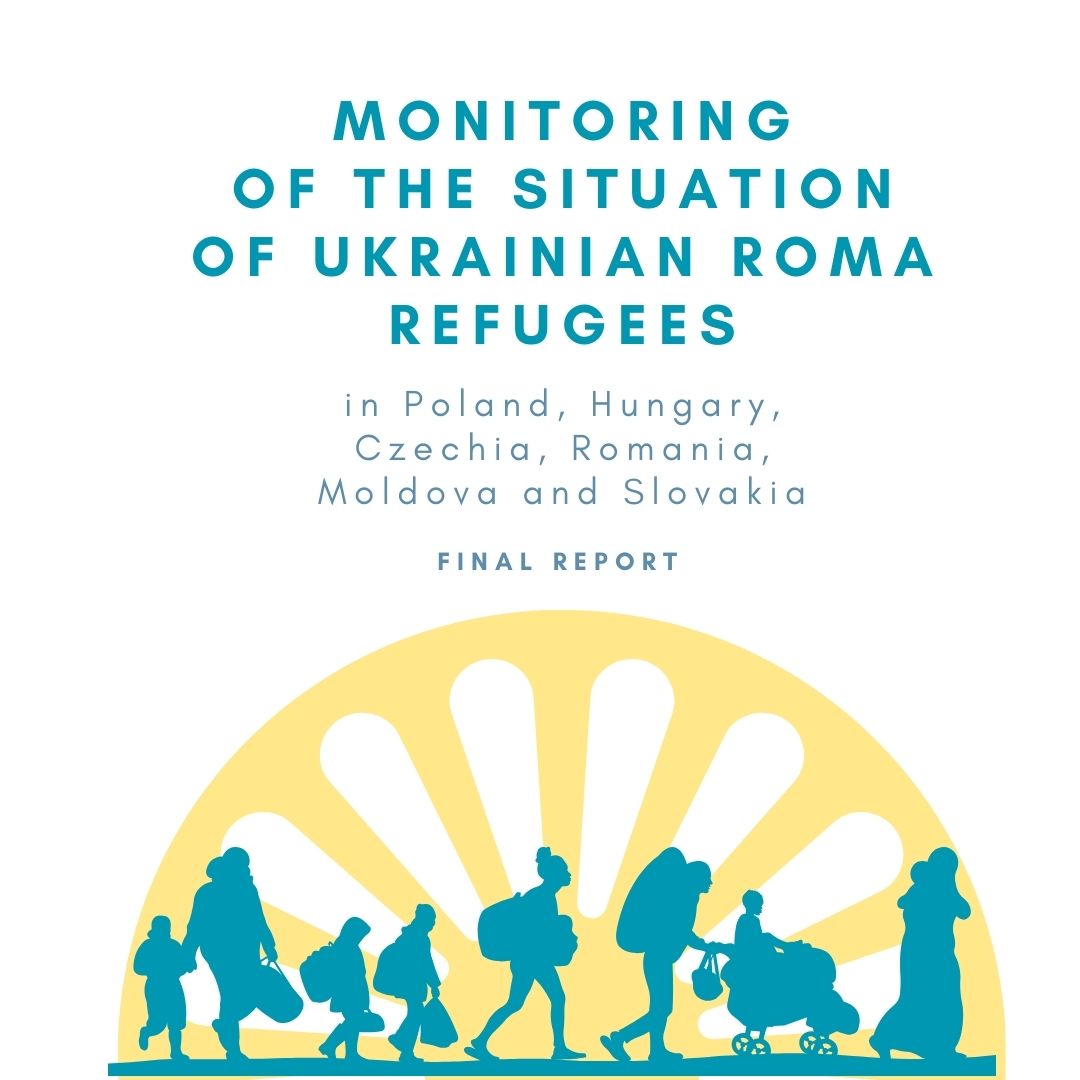
In the true spirit of ERGO Network, our work on Ukraine started from the very grassroots and scaled up in those two difficult years into a fully-fledged line of work, with the support of EPIM and other smaller grants. Today, on this sad anniversary, we would like to share with you one of the results of this work: the Monitoring Report of the Situation of Ukrainian Roma Refugees in Poland, Hungary, Czech Republic, Romania, Moldova and Slovakia. Our member organisations and associates brought it together, painting the big picture with the brushstrokes of individual interviews and research analysis.

The focus of this crisis goes beyond sheer numbers. In Poland, Hungary, the Czech Republic, Romania, Moldova, and Slovakia, Roma refugees from Ukraine face enduring discrimination rooted in cultural-historical issues, presenting challenges not commonly encountered by other refugees. Discrimination takes various forms, hindering access to crucial resources like housing, employment, information, and support services.

Despite the implementation of Temporary Protection (TP) and subsequent enhancements, the vulnerabilities of the Roma community within refugee populations persist. Cultural differences, discrimination, and limited education continue to shape their journey, resulting in subpar conditions and ongoing challenges.

The report, drawing from diverse data sources and covering the period until June 2023, provides a comprehensive understanding of the challenges faced by Roma refugees in these countries. It underscores the imperative for sustained attention and targeted interventions to address the unique challenges confronted by the Roma refugee community.

Major Findings: A Closer Look

The Roma refugee crisis unfolded in two distinct periods, with concrete measures taken by individual countries crucial for understanding and addressing challenges specific to the Roma community. Across Poland, Hungary, the Czech Republic, Romania, Moldova, and Slovakia, multifaceted challenges rooted in cultural-historical issues permeate crucial aspects like housing, employment, and support services.

In Poland, the collective approach of Roma refugees seeking security exacerbates challenges for activists facing substantial personal, financial, and societal pressures due to antigypsyism. Hungary grapples with historical racial marginalisation, necessitating a comprehensive strategy to address prolonged shelter stays and align with EU guidelines.

The Czech Republic views Roma refugees mainly as transient, demanding urgent attention for their long-term integration. Despite a robust legal framework, Romania confronts housing, education, employment, and healthcare challenges. Moldova contends with persistent disparities, emphasising the need for concerted efforts to bridge gaps in access to services, combat discrimination, and enhance advocacy initiatives.

The Slovak Republic, while actively assisting Ukrainian refugees, highlights instances of bias and challenges faced by Roma families. Slovakia’s legal framework and support measures reveal areas where targeted interventions are crucial to address discrimination and ensure equitable treatment for all refugees, including the Roma community.

Persisting Challenges Despite Efforts

While certain aspects, such as advancements in legal frameworks and increased awareness, offer positive aspects, socioeconomic problems, discrimination, and barriers to employment persist. ERGO Network Coordinator for Ukraine Dejan Markovic criticised the ‘colour-blind’ approach of service providers exacerbates the situation, overlooking institutional antigypsyism and challenges faced by the Roma refugee community:

“Ukrainian Roma refugees, forced to flee conflict and persecution, face not only the challenges of displacement but also the risks of discrimination and marginalisation in their quest for safety and stability.”

Increased awareness regarding the discrimination faced by Roma refugees has prompted advocacy and awareness campaigns, fostering improved understanding and collaboration among stakeholders. Yet, the prolonged armed conflict has intensified challenges within Roma communities, affecting socioeconomic indicators and hindering access to essential services.

Persistent barriers to employment, particularly for Roma women, highlight ongoing challenges. Limited educational access and language barriers remain formidable obstacles, indicating the need for targeted interventions.

Discrimination against Roma refugees, particularly in Central and Eastern European countries, remains pronounced. The report emphasises the imperative for targeted interventions, ongoing monitoring, and adaptive strategies to address the distinct challenges faced by the Roma refugee community.

Recommendations for International organisations

Recommendations put forth in the report include implementing comprehensive anti-discrimination legislation, streamlining asylum processes, providing free legal counselling, launching public awareness campaigns, ensuring equitable healthcare access, offering language and integration classes, developing job placement and vocational training programs, supporting NGOs, fostering collaboration, and establishing data collection and monitoring mechanisms.

The report recommends sustaining and evolving collaborative efforts for international organisations, emphasising the importance of ongoing engagement with the Roma Coordination Group and incorporating contributions from thematic meetings conducted by UN WOMEN.

For the European Union, the report urges heightened awareness, the universal application of the Temporary Protection Directive, and the adoption of promising initiatives observed in certain EU countries. A multifaceted approach at the EU and national levels is recommended, encompassing legal frameworks, streamlined asylum processes, culturally sensitive services, public awareness campaigns, and financial support for NGOs.

For the past two years, we have worked jointly with our member organisations and independent Roma researchers to create a comprehensive analysis of the so-called bigger picture by bringing the perspective of the grassroots and connecting and empowering them. It is not in our power to stop the war. Still, we hope this report serves as a compelling call to action, stressing the need for sustained efforts to ensure the inclusion and well-being of the Roma refugee community in the broader European context.

CALL FOR A CONSULTANT

CALL FOR A CONSULTANT TO SUPPORT US IN THE DEVELOPMENT OF OUR 2026-2030+ STRATEGIC PLAN

ERGO Network is contracting a consultant to support us in developing our 2026-2030+ strategic plan based on strategic objectives and strategies. We expect a participatory process, including ERGO Network’s board, staff and membership.

ERGO Network

ERGO Network (www.ergonetwork.org) brings together 30 members from across Europe and supports organisations with a common perspective on Roma grassroots empowerment and equal citizenship to combat antigypsyism. We mobilize and connect organisations and individuals that share and express our values – active citizenship, shared responsibility, and passion – to strengthen and empower Roma civil society involvement in decision-making at local, national and European levels and to address existing shortcomings of policies targeted at Roma.

Our office is based in Brussels.

ERGO Network is seeking the services of a consultant with strong experience and excellent organisational skills to develop and implement a participatory strategic planning process. Our network’s culture is based on participation and co-creation, which we also expect from this important planning process.

The objectives of the task are:

  • To conduct an in-depth context analysis in collaboration with members, Board and staff to help review the organisation’s strategic directions (vision, mission, strategic objectives, pathways of change…etc.) and the most suitable structure and resources needed to effectively achieve the outcomes and impact necessary for bringing about change;
  • To support ERGO Network’s strategic planning for 2026-2030 by effectively bringing the insights and views of ERGO Network members into the process in a participatory manner.
  • To support the creation of long-term strategic goals for the organisation to reach by 2035.

Final output:

  • Strategic Plan 2026-2030, including long-term strategic goals until 2035, to be adopted by the ERGO Network General Assembly in June 2025.  

ERGO Network staff will be able to support this process by being available for interviews, meetings and comments, providing internal documents, and setting up meetings with members and the board.

Timeframe and fees:

The contract starts on 1st April 2024, and the full process must be finalised within 12 months, with a first draft of the strategic plan ready by 15th December 2024.  The maximum budget, VAT included, is 10.000€.  

Interested consultants are required to send a full application to ERGO Network with a brief presentation of their qualifications and experience, the methodology, key activities and the process they plan to develop and implement with a proposed timeline. The application must include a price offer for the total project.

Profile:

  • Excellent strategic planning skills, including experience in participatory strategic planning processes;
  • Strong facilitation skills and proven ability to lead collaborative consultation processes;
  • Knowledge of civil society movements;
  • Fluency in English (speaking and writing) is essential;
  • Experience working with Roma civil society and with European networks is desirable.

Please send your application to info@staging.ergonetwork.org by 10th March 2024, 23:59 CET.

For further questions, please contact Christine Sudbrock at c.sudbrock@staging.ergonetwork.org

Call for Applications: Rights Experts for Communities Discriminated on Work and Descent in Europe

Call for applications for Rights Experts from Communities Discriminated on Work and Descent in Europe

We are looking for 3 Rights Experts to work closely with ERGO Network and the Global Forum on Communities Discriminated on Work and Descent (GFoD). We particularly encourage Roma women to apply for this position to achieve equal representation in the Rights Experts team.

Selected Roma Rights Experts will work closely with other Communities Discriminated on Work and Descent (CDWD), including Dalits and Burakumin in Asia, Quilombola and Palenque in Latin America, Haratin and the CDWD of various names amongst different groups of Africa, who experience discrimination based on their ancestral occupation. This specific type of discrimination, described by the UN as “discrimination based on work and descent”, is common practice in Asia, Africa, Latin America and Europe. Yet, it is also one of the least understood forms of discrimination worldwide.

Context

Global Forum on Communities Discriminated on Work and Descent (GFoD) is the global advocacy mechanism of Communities Discriminated on Work and Descent (CDWD). More than 270 million people across the world are discriminated against based on work and descent. They are more commonly known as Dalits, Roma, Quilombola, Burakumin, and Haratin, amongst many other names. Discrimination on Work and Decent (DWD) is a global phenomenon which lacks public recognition and acknowledgement, and affected communities are among the most marginalised and excluded people.

Position Overview

GFoD started the CDWD Rights Experts program in 2021 and is currently seeking applications for the next cohort of Rights Experts from Communities Discriminated on Work and Descent to support global advocacy and data collection processes at the national, regional and global levels. Candidates will be recruited based on the requirements and qualifications listed below.

The position requires a high level of autonomy and responsiveness to engage in advocacy processes and a high interest and willingness to engage in national, regional and global advocacy processes. At its core, the program elevates the national level advocacy of these communities towards collective advocacy engagement for all Communities Discriminated on Work and Descent (CDWD) on the global level, such as the United Nations (UN) and other regional and global human rights mechanisms.

The position requires 32 hours per month for the duration of 12 months with potential international travel, and with a 3-month trial period.

Duties and responsibilities of the Rights Experts (REs)

  • Dedicate at least 4 full working days per month to this role.
  • Participate and organise capacity building, mutual learning and general advocacy activities.
  • Contribute to developing and implementing the GFoD regional and global advocacy strategies.
  • Author statements, critical interventions and articles or contribute to specific ideas and concept notes on the concerns of CDWD as per the requirement of HLPF and other UN and human rights instruments, mechanisms or initiatives.   
  • Communicate regularly with the GFoD Secretariat and undertake national, regional and participate in global consultation processes within the local, regional and national CDWD community.

Requirements and qualifications

In order of preference, characteristics and qualifications are listed below. 

Please note that given our preference for candidates from respective communities, applicants are not required to have English as a working language. 

  1. Anchored and rooted in Communities Discriminated by Work and Descent (CDWD): Persons from Communities Discriminated on Work and Descent (CDWD) are highly encouraged to apply to this position. Women, youth and other underrepresented and marginalised groups from CDWD are highly desired for this position.
           
  2. Experience: Social/community leaders within their community with considerable experience in advocacy actions and processes at national, regional and international levels. Candidates should be established human rights defenders in their country/region/community and are experts in at least one particular field area related to the UN Sustainable Development Goals (SDGs). For example, (Access to water and sanitation – SDG 6, Decent work – SDG 8, Inequalities – SDG10 etc.). Please mention which SDGs you are most interested in/have worked on in your application.
  3. Commitment: Candidates who have shown ongoing commitment and leadership to the cause of CDWD are encouraged to apply.
  4. Academic qualifications: Academic qualifications such as University qualifications, publications of books, articles or other journalistic work will be considered in the application process.

Recruitment and timeline

Please submit your applications to RE2024@globalforumcdwd.global by 10 March 2024. Please submit your CV together with a one-page letter referencing the relevant experience mentioned above under Requirements and Qualifications. English as a working language is preferred but Spanish, Portuguese, French, Russian and Arabic are also accepted. Please mention all your working languages in your application. The program is dependent and conditional on donor support, which has yet to be released for this program. In case the donor withdraws funding, the program may not continue.

Successful candidates will be appointed for a 10-12 month period with an initial 3-month trial period.

Due to the high volume of expected applications, only shortlisted candidates will be contacted.

Most Roma Friendly Mayor Award, 2024

Launch of the award in the Western Balkans and Türkiye:
Most Roma Friendly Mayor Award 2024

This is the fourth edition of the “Most Roma Friendly Mayor” Award in the Western Balkans and Türkiye. The award recognises those local authorities who believe in their citizens and treat them equally. It aims to change attitudes towards Roma inclusion and features local authorities who give power to Roma communities and listen to their needs.

The winners will be selected through a competition open to municipalities willing to apply for the award “Most Roma Friendly Mayor”. The competition is being simultaneously implemented in the Western Balkans and Türkiye, with one winner for each country.

The awarded mayors from Albania, Serbia, Kosovo, Republic of North Macedonia, Bosnia and Herzegovina, Montenegro and Türkiye will participate in a special event from 9th to 11th of April 2024, in the frame of the Roma Week, organised in Brussels where they will meet a high representative from DG NEAR.

The award ceremony will emphasize positive examples of Roma inclusion, highlighting the philosophy of empowerment, mobilization and equal dialogue between local authorities and Roma communities, where the municipalities and the Roma community can come together and engage in a dialogue on an equal level.

The competition for this award will be open from February 8th until February 29th, 2024. An independent jury will be established in each country, and it will, based on the given questionnaire, select the winner of the contest “Most Roma Friendly Mayor”.

Application documents:

  • The application form completed
  • Articles/news/reports/documents/protocols that support your responses in the application form
  • Feedback / Roma Community assessment regarding the municipality
  • Pictures

The application form can be mailed to:

Roma Active Albania, Rr.Ylbere Bylykbashi; P. 25; Shk. 2; Ap 4; Tirane, Albania, or be sent via email to info@raa.al until February 29th 2024, local time 23:59.

This activity is implemented in the frame of the project “Romani Women POWER OF CHANGE in the Western Balkans and Turkey”, financed by the European Union, Europe Aid / 162473/DH/ACT/Multi, Project number CN 2019/413-758.

`
Ana Rozanova – Page 11 – ERGO Network

By continuing to use the site, you agree to the use of cookies. more information

The cookie settings on this website are set to "allow cookies" to give you the best browsing experience possible. If you continue to use this website without changing your cookie settings or you click "Accept" below then you are consenting to this.

Close