New reports about racism and inequality in the UK

New reports about racism and inequality in the UK

The “Report of the United Nations Special Rapporteur on contemporary forms of racism, racial discrimination, xenophobia and related intolerance on her visit to the United Kingdom of Great Britain and Northern Ireland” has been published and makes specific reference to Gypsies, Roma and Travellers.

The UN Special Rapporteur E. Tendayi Achiume stated in her report that the UK Government’s policies exacerbate discrimination, stoke xenophobic sentiment and further entrench racial inequality. It highlights persistent racial disparities in, among others, education, employment, housing, health, surveillance, interactions with police, prosecutions, and incarceration.

“The structural socio-economic exclusion of racial and ethnic minority communities in the United Kingdom is striking,” the Special Rapporteur said in her report, based on a fact-finding visit to the country in April and May 2018.

“Notwithstanding the existence of a legal framework devoted to combating racial discrimination, the harsh reality is that race, ethnicity, religion, gender, disability status and related categories all continue to determine the life chances and well-being of people in Britain in ways that are unacceptable and, in many cases, unlawful.”

During her fact finding visit to the country in April and May 2018 she held a special meeting with Gypsy, Roma and Traveller organisations.

The full report of the Women and Equalities Committee “Tackling inequalities faced by Gypsy, Roma and Traveller communities” was produced in April 2019:

The Government has now produced its response to this in which it states that “the Government agrees that an ambitious programme of work needs to be undertaken in order to tackle inequalities faced by Gypsy, Roma and Traveller communities.

The Ministry for Housing, Communities and Local Government will lead in co-ordinating a cross-Government strategy to improve outcomes for Gypsy, Roma and Traveller communities. The ministry will work closely with other Government departments including the Race Disparity Unit within the Cabinet Office, the Department for Education, the Department of Health and Social Care, the Government Equalities Office and the Home Office to develop the strategy.”

This follows years of pressure from NGOs, including the civil society monitoring reports and the “Experts by Experience” report of the National Federation of Gypsy Liaison Groups and will be a “Roma Integration Strategy” in all but name. The Strategy won’t be operational until 2020 to give time for community input into its formulation, but the commitment to produce it is a positive move and we will be working alongside other NGOs to ensure that the Strategy is “bottom up” rather than merely being imposed from above.

Save the Date

Before the summer break, we are announcing the dates for some important events in the second half of the year. Mark the dates in your calendar – more information will follow soon!

20-23 October: Annual Members Meeting in Skopje, North Macedonia

20 October: Meetings of the ERGO Network Board, Advisory Committee and Working Groups (Skopje, North Macedonia)

25-27 November: Coordination meeting of ‘Roma Included in Social Europe’ programme (Brussels)

25 November: ERGO Network conference on ‘Education: how to achieve policy change in hostile environments?’ (Brussels)

Towards a more holistic approach to Roma inclusion

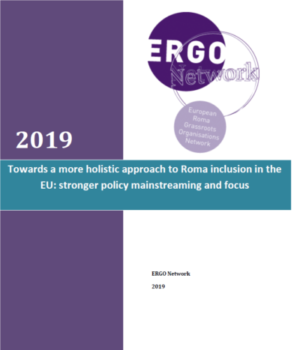
Towards a more holistic approach to Roma inclusion in the EU: stronger policy mainstreaming and focus

The long term perspective of the Roma inclusion process implies that, at this stage, expecting major socioeconomic impact of the Roma integration process is premature. Although the necessary policies, tools and structures linked with the inclusion of Roma were put in place in the Member States, the actual implementation is still at an initial phase without mainstreaming them in the EU general policy initiatives.

Existing assessments of implementation of the social inclusion policies and programmes at EU and national level revealed that the policies and programs did not reach marginalised groups, and did not manage to improve the situation of Roma. This is why ERGO Network, with contributions from its allies, published a policy paper that provides specific recommendations on possible ways of mainstreaming Roma inclusion in the next Multi-Annual Financial Framework and post 2020 EU Roma Framework, key recommendations for the mainstream policies, and finally, not only initiatives/actions that should be taken by the European Commission, but also those that should be taken by Member States.

Alliance against Antigypsyism: new recommendations

Alliance against Antigypsyism offers recommendations and concrete measures to combat antigypsyism for the future EU and national policies

The Alliance against Antigypsyism has recently published two new policy papers.  The first offers recommendations to combat antigypsyism for future EU and national policies to ensure they are comprehensive and no dimension or manifestation of antigypsyism is omitted. The Alliance also went one step further and proposes concrete measures to combat antigypsyism In their paper “Developing measures to combat antigypsyism after 2020: Guidance for European and national stakeholders”.

Both papers aim to inspire European and national stakeholders to contribute to combating exclusion of Roma. They could be used as guide for EU Member States and Candidate Countries to update their current national strategies or create new strategies that can respond to antigypsyism. With the papers we also want to enter the narratives and practice of the new European Parliament and the European Commission. There has been a tremendous work done by civil society and EU institutions in the last years and it is now the time for Roma rights advocates to make sure that the new parliamentarians and the new Commission follow-up and continue to create policies and legislations that reflect realities of Roma people in Europe.

Roma and pro-Roma activists are invited to adapt these recommendations and measures to their context, use the ideas the Alliance put forward to advocate on national and local levels. These papers are a result of the work led by the European Roma Grassroots Organisations (ERGO) Network, Central Council for German Sinti and Roma and European Network against Racism, with inputs of more than 25 other Roma and pro-Roma organisations and individual experts.

Report: Falling through the cracks

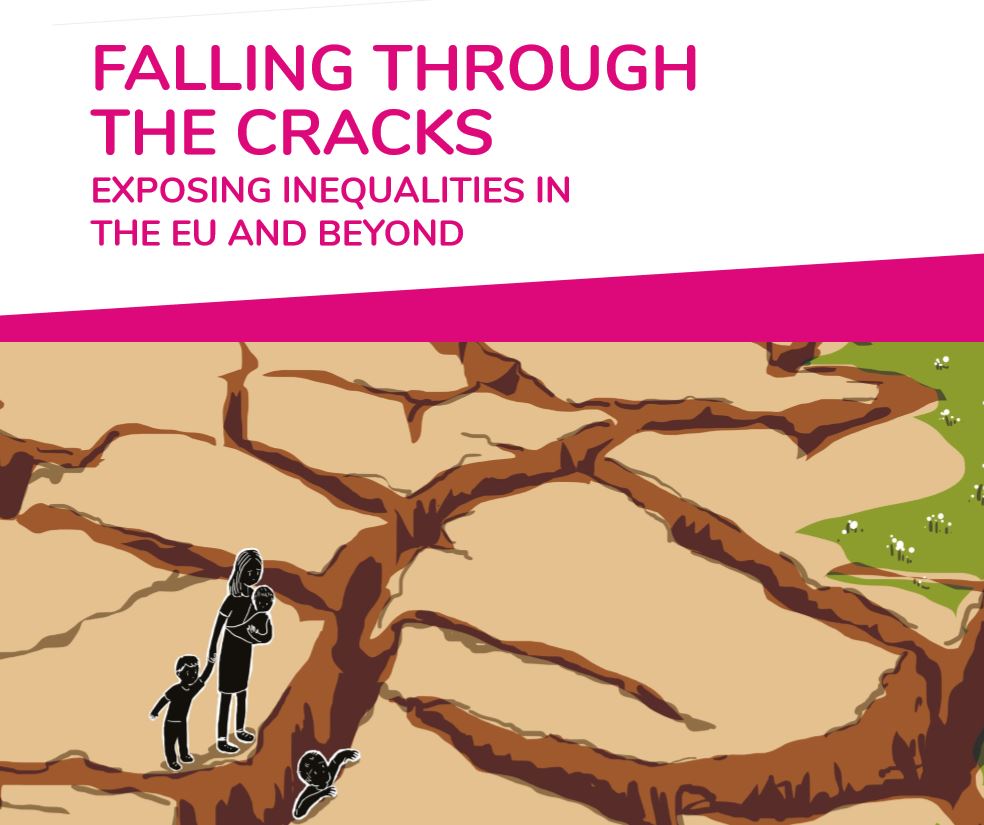
ERGO Network analyses SDG 10 for report ‘Falling through the cracks: exposing inequalities in the EU and beyond’

ERGO Network’s chapter “Reducing Inequalities between Roma and Non-Roma: EU, SDG 10 and Combating Exclusion of Roma”, is published as part of a bigger report “Falling through the Cracks – Exposing Inequalities in the EU and beyond”, published by SDG Watch Europe, Make Europe Sustainable for All and Faces of Inequality. Besides our chapter dedicated to Roma inclusion, issues such as environmental injustice towards Roma are addressed throguhout the whole report.

SDG 10 – ‘To reduce inequalities within and between countries’ – is highly relevant for Roma. The goal is being reviewed in 2019 in the UN-led process that monitors progress towards achieving the Sustainable Development Goals. SDG indicators could potentially be used in the future by the creators of new Roma related policies, as currently all analyses of Roma-related policies show that a lack of concrete and measurable indicators lead to the failure of national Roma-related policies. The SDG indicators .  The chapter written by ERGO Network looks at issues where there is a strong overlap between SDG Goal 10 and EU ‘Roma objectives’.

We as civil society have taken the opportunity to provide yet another analysis of inequality that affects Roma people across the European Union. We use this moment to present concrete policy recommendations to the EU and the UN agenda simultaneously. Our purpose is to provide information and proposals to address inequalities effectively.

Download the report here.

`
Christine Sudbrock – Page 24 – ERGO Network

By continuing to use the site, you agree to the use of cookies. more information

The cookie settings on this website are set to "allow cookies" to give you the best browsing experience possible. If you continue to use this website without changing your cookie settings or you click "Accept" below then you are consenting to this.

Close