Roma grassroots perspectives on poverty alleviation

New publication: Roma grassroots perspectives on poverty alleviation

In 2018 in the framework of ERGO’s Annual Work Programme ‘Roma Included in Social Europe’ (RIISE), ERGO Network members from Hungary, Romania, Bulgaria, Slovakia and the Czech Republic conducted seven comprehensive local case studies that contribute to a better understanding of the impact of National Roma Integration Strategies (NRISs) and relevant mainstream measures on local Roma communities. The topic of the case studies was how access to quality education and employment as well as antigypsyism affect Roma people’s economic situation.

We have now published a synthesis report that can serve as evidence concerning implementation of the EU Roma Framework and mainstream social policies on the grassroots level, which can support the EU institutions’ work on making the European Pillar of Social Rights a reality.

The main objective is to fill the gap and bring more perceptions of Roma into Roma-related discourses. Therefore ERGO members explored Roma people’s perspectives on the causes of poverty that can potentially say more about barriers to poverty reduction efforts and implementation of the National Roma Integration Strategies and social policies (if any). Fostering participation of Roma in voicing their needs and positions about what causes their economic situation is crucial for our work.

You can read the synthesis report here.

Sustainable Development Goals for Roma Inclusion

Have you ever heard of the Sustainable Development Goals? Don’t know what this has to do with Roma? Then check out our report ‘Roma Included: In the Sustainable Development Goals that ERGO Network published in 2019.

Just want to have a glimpse on what is inside? Then check out our short video summarising the report.


The objective of the report is to trigger debate among Roma activists on how to engage with the Sustainable Development Goals (SDGs). More than three years after the proclamation of the United Nation’s 2030 Agenda for Sustainable Development, the SDGs can provide opportunities for advancing the inclusion of Roma and for countering antigypsyism. Almost all of the 17 global goals are closely connected to the needs of Roma comunities – from accessing clean drinking water and affordable energy to quality education and employment, from reducing inequalities to peace, justice and strong institutions.


Grassroots Advocacy Academy for multipliers

ERGO Network’s Grassroots Academy for multipliers implemented in the Czech Republic: Equipping multipliers with competencies to implement advocacy trainings

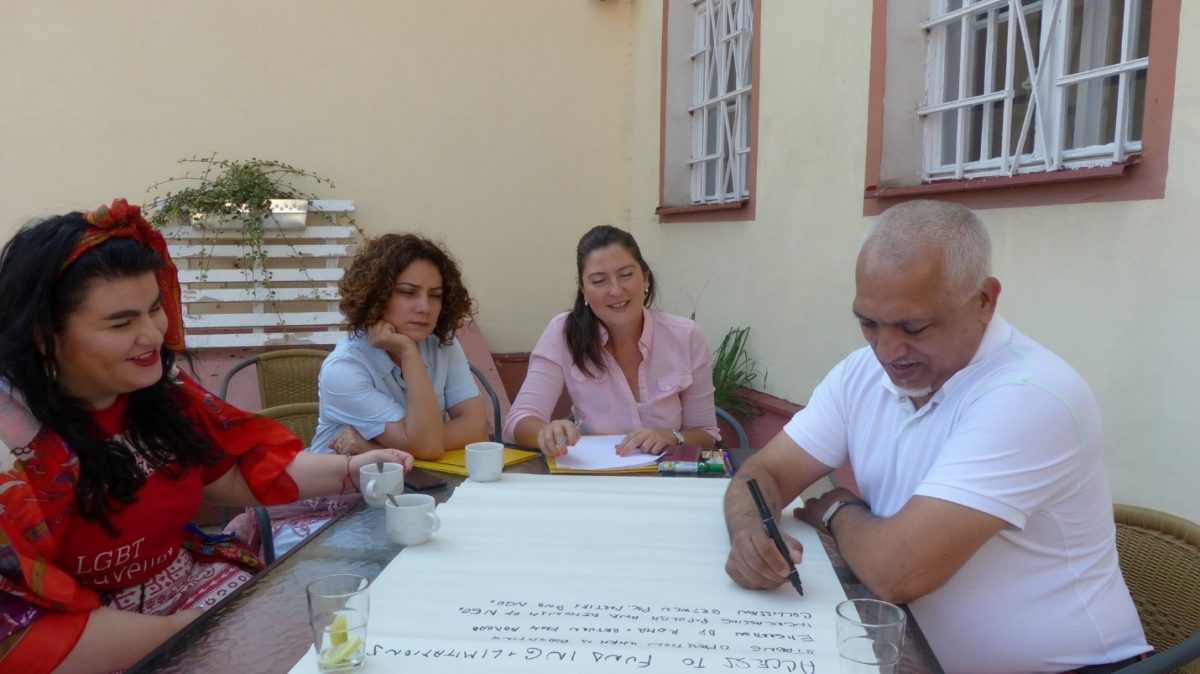
In August this year, about twenty Roma advocates from different European countries gathered in Tepla, a Czech village close to Usti and Labem. For five days, they joined ERGO Network to share and explore different methods of grassroots advocacy and community organizing. We explored ways for grassroots activists who want to advocate for combatting antigypsyism, empowering Roma and promoting social inclusion. We discovered that finding new partnerships and new approaches is proving to be effective. The participants, mostly experienced multipliers on the national level, shared knowledge and experiences with advocacy in difficult environments.

After we got to know each other better and created an open and engaging learning space, inspiring stories were told by our colleagues from Zero Discrimination Association (Turkey), Integro Association (Bulgaria) and Nevo Parudimos (Romania) about certain forms of mobilization and leadership. They triggered debates about gender and power relations and on building relationships with national and local authorities. They also provided us with examples on how local advocates participate in budget planning on the local level and in community-led local development.

Participants agreed that the traditional ways of advocacy seem less and less effective, particularly in countries with far-right governments and a high level of populism in politics.

Romani activist Monika Mihalickova from the Czech organization Romea gave the participants a short training social media fundraising. Miroslav Klempar shared the experiences from Awen Amenca, a movement that fights for quality and non-segregated education for Roma children, based on the value of Roma parents’ participation.

Our Macedonian partners, Fikrija and Denis Selmani triggered the attention of the participants with their successful involvement in mobilization of Roma university students and the Citizens’ Initiative “AVAJA” and its campaign “We Vote, We Decide”. We also met with Steve Hughes, who has 20 years of experience working as a community, union, and political organizer in both the United States and Europe.

Finally, the group had the pleasure to visit Romano Jasnica, a local Roma organization in Trmice founded in 1998 that focuses on providing social services, implementing educational, leisure and cultural activities for children, youth and adults at risk of social exclusion or socially excluded people. The organization connects work on social inclusion with creating employment opportunities, supporting young entrepreneurs, but also engaging Roma in the local politics. Already for the second term, there are two Romani members in the local council.

The participants appreciated the learning experience and emphasized the importance of different participatory methods that ERGO Network used to engage them as much as possible in diverse roles and capacities. With those methods and national follow up trainings in the Czech Republic, Slovakia and Hungary we will reach out to more Romani grassroots activists and organizers and make their voice heard also in the national and European policies.

The activity received generous financial support from the International Visegrad Fund and from the European Commission’s EaSI programme.

Join our team for 3 months!

Call for Solidarity Corps volunteer in ERGO Network

ERGO Network is looking for an enthusiastic and active young Roma who would like to join our office team in Brussels for 3 months in the framework of the European Solidarity Corps.

Download the call in pdf format here.

When: October to December 2019

Where: ERGO Network office in Brussels, Belgium

Who: Young Roma between 18 and 30 years old

Deadline for applications: 20 September 2019

During the 3 months in ERGO, you will learn about international advocacy, help us organise international meetings and events and get actively involved in Roma activism and international Roma networks in Brussels.

Your main tasks will be:

  • Communication and campaigning: contribute to ERGO’s daily communications work and our campaign on Roma youth employment
  • Advocacy and policy: Support ERGO staff in EU advocacy work on poverty reduction, social inclusion and antigypsyism; attend debates, hearings and meetings with other stakeholders to challenge stereotypes and racism, build partnership with Roma and non-Roma organizations from Belgium and other European countries.
  • Meetings and seminars: Assist in the organisation of meetings and events (Annual Members Meeting, ERGO Annual Conference)

Your profile:

  • Young Roma between 18 and 30 years living in an EU member state or in Macedonia or Turkey
  • Good English language skills, both oral and written
  • Computer literacy (experience with Microsoft office package and social media)
  • High motivation to learn more about Roma activism and advocacy work and to contribute to a small but very active European NGO
  • Previous involvement in Roma or (pro) Roma NGOs will be considered an advantage
  • Reliable, well organised and with attention to detail

You will work about 38 hours per week. Working hours will be from Monday to Friday between 9:00 – 17:00. However, working hours can be adapted to your needs and the activities you will be involved in.

We aim to support young people who are enthusiastic about our cause and want to gain experiences that can be later transferred to national or local NGOs. We especially welcome applications from people who are motivated to challenge stereotypes, antigypsyism and racism and who show an open attitude for a unique learning and life experience, as well as a volunteer spirit of creativity, initiative, responsibility and independence.

We offer:

  • An allowance of 1049 Euro that includes money for accommodation, meals, local transport, language course and pocket money
  • Additional health insurance through the European Solidarity corps
  • An exciting and unforgettable experience and learning opportunity, working for an international organisation in an international city!

How to apply:

Please send your motivation letter (1 page) and CV (max 2 pages) by 20 September to info@staging.ergonetwork.org.

Do not hesitate to contact us for more information.

Christine Sudbrock t: +32 2 89 31 045 | e: info@staging.ergonetwork.org

Western Balkans summit

Declaration on Roma integration in the EU enlargement processs signed at Western Balkans Summit

The sixth annual summit within the Berlin Process Initiative for European integration of Western Balkans states was held between 3rd and 5th of July 2019 held in Poznań.

At the initiative of North Macedonia, the Western Balkan countries signed a Declaration on Roma integration in the EU enlargement process as a pledge for their reiterated commitment to continue and enhance efforts for full equality and integration of Roma through implementation of specific set of measures in the areas of employment, education, housing, health, civil registration and non-discrimination.

With the Declaration they pledge to achieve the following objectives:

  • A. Employment: Increase the employment rate of Roma in the public sector to the rate proportional of the participation of Roma in the overall population; Increase the employment rate among Roma to at least 25% percent;
  • B. Housing: Wherever possible, legalize all informal settlements where Roma live; or provide permanent, decent, affordable and desegregated housing for Roma currently living in informal settlements that cannot be legalized for justified reasons;
  • C. Education: Increase the enrolment and completion rate of Roma in primary education to 90 percent and the enrolment and completion rate of Roma in secondary education to 50 percent;
  • D. Health: Ensure universal health insurance coverage among Roma to at least 95 percent or to the rate equal to the rest of the population;
  • E. Civil Registration: Ensure all Roma are registered in the civil registries;
  • F. Non-Discrimination: Strengthen the government structures to protect against discrimination and establish a specific sub-division for non-discrimination of Roma within the formal non-discrimination bodies to process complaints by Roma, provide legal support to alleged victims and identify discrimination schemes, including institutional and hidden discrimination.

Governments of the Western Balkan countries understand that progress on Roma integration is progress towards enlargement. The participation of strong Roma civil society organizations from the countries of the region was crucial.
National Roma civil society organizations from the Western Balkan countries have been strongly represented in the Summit, and their presence was of crucial importance to this process. Sitting alongside the government representatives, the message they sent is that the Roma civil society organizations in the Western Balkans have grown and are consolidated to be considered a partner in the activities and actions towards Roma integration, but also showing that Roma civil society organizations may play an important and critical role in the monitoring and guiding governmental institutions in their Roma inclusion processes.


RCC also introduced the results of the Balkan Barometer 2019, which showed “modestly optimistic” regional perceptions and attitudes across a wide array of social, political and economic factors impacting life in South East Europe.

`
Christine Sudbrock – Page 23 – ERGO Network

By continuing to use the site, you agree to the use of cookies. more information

The cookie settings on this website are set to "allow cookies" to give you the best browsing experience possible. If you continue to use this website without changing your cookie settings or you click "Accept" below then you are consenting to this.

Close