International Congress on Discrimination based on Work and Descent

International Congress on Discrimination based on Work and Descent tackling Casteism, Antigypsyism, Traditional and Contemporary forms of Slavery and Other Analogous Forms of Discrimination (ICDWD)

21-23 September 2019, New York

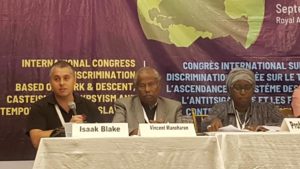
From 21 to 23 September, a delegation of Roma activists from ERGO Network took part in the International Congress on Discrimination based on Work and Descent tackling  Casteism, Antigypsyism, Contemporary forms of Slavery and Other Analogous Forms of Discrimination, which was held in conjunction with the United Nations General Assembly in New York. The ERGO Network delegation consisted of ERGO Network director Gabriela Hrabanova, Michal Miko (RomanNet, Czech Republic), Isaac Blake (National Federation of Gypsy Liaison Groups, UK) and Vesa Batalli (Voice of Roma, Ashkali and Egyptians, Kosovo). The conference was co-hosted by the Asia Dalit Rights Forum, the African Network on Discrimination based on Work, Descent and Contemporary Forms of Slavery, ERGO Network, the Inclusivity Project, Trust Africa and Boston Study Group.

The Conference was preceded by a Parliamentarian’s Roundtable on discrimination based on work and descent, hosted in the Permanent Mission to the UN of Senegal.

Communities discriminated based on Work and Descent (DWD) are some of the most excluded, segregated, and marginalized groups at the global and local levels within their social, economic, political, and cultural systems. The inequalities and disadvantages they experience exist in various services like education, hunger alleviation, health, water and sanitation, employment, voting rights, equal access to land and housing, access to religious institutions in the public sphere, disaster risk reduction and environmental health, some of which are represented in SDGs through definite goals. Gender equality, peace and justice constitute cross-cutting, significant determinants, which must be addressed to mitigate inequalities within the countries.
The Congress adopted the New York Declaration: Global March Forward to Eradicate Discrimination, calling upon the United Nations and States Parties to adopt effective measures towards ending all forms of discrimination based on work & descent, untouchability, antigypsyism, socio-cultural beliefs, and other analogous forms of discrimination including contemporary forms of slavery.

The ERGO delegation furthermore took part in the People’s Assembly organized by the Global Actions against Poverty and the United Nations Civil Society SDG Forum, which aimed to create a space for constructive and propositional dialogue between civil society and UN Member States, international organizations and other related constituencies on the possible responses to the challenges exposed by the first four years of implementation of the 2030 Agenda for Sustainable Development.


Roma Civil Monitor: the third cycle

Roma Civil Monitor partners gather at the Central European University to define the topics of the third round of civil society monitoring reports

Image credit CEU / Andras Dimeny (kepszerk.hu)

The year 2020 will mark the final year of the current EU Framework for National Roma Integration Strategies, within which Member States have developed their own national targeted policies for Roma or ‘sets of policy measures’. Since 2012 the Commission has been reporting annually on the implementation by the Member States and since 2016 the Member States have been reporting to the European Commission. Civil society efforts to produce reports about the implementation from their perspective were intensified in 2017 when the Commission funded the Roma Civil Monitor project.

The project involves about 90 civil society organizations and experts from all EU Member States (with the exception of Malta) as well as four NGOs with experience working internationally on Roma-related issues, including ERGO Network.

Monitoring reports are available for the first cycle, which investigated how the Member State strategies combat antigypsyism and discrimination, governance and, for the countries with the largest Roma communities, the impact of mainstream education policy on Roma. The findings of the second cycle are also now available. During this cycle, the reporting in all countries focused on education, employment, healthcare and housing.

This year in September representatives of the Roma civil society coalitions met at Central European University in Budapest to discuss which topics they are hoping to address in the third cycle reports. This time the focus will be on what has been missing from the implementation or from the strategies themselves, so the content will vary from country to country.

Some of the topics discussed were the following: Antigypsyism in policymaking; Ensuring Roma inclusiveness in mainstream programmes; Integrated approaches for Roma inclusion; Civil society, empowerment and participation; Social services, fighting homelessness, substance abuse; Youth, children protection and rights, parenting skills, 0-3 care and many other topics. ERGO Network’s advocacy and research coordinator together with colleagues from the Center for Policy Studies lead the workshop on combating antigypsyism and targeting mainstream. Many participants found the topic relevant and identified specific problems that they intend to address in their national context. The next step is both assisting the CSOs and experts in the preparation and the actual preparation of the third cycle reports.

We expect that the publication of the third cycle shadow reports will describe to what extent the situation has developed and where the biggest “blind sports” are, which would be one of the tools and resources used in the process of creation of the new EU Roma Strategic Framework.

Roma participation in Community-Led Local Development

Roma participation in Community-Led Local Development

Community-Led Local Development (CLLD) is an initiative for involving citizens at local level in developing responses to today’s social, environmental and economic challenges, and a promising tool for investing in Roma inclusion. The European Commission expects CLLD to facilitate implementing integrated approaches among the European Structural and Investment Funds (ESI Funds) to achieve the 11 thematic objectives set out in the Common Provision Regulation (CPR) at local level. It aims to give ownership to beneficiaries, with a special focus on marginalized communities, through capacity building, empowerment, full transparency, and sharing of the decision-making power. The Commission encourages the use of CLLD to allow local communities to take ownership of the targets of the Europe 2020 Strategy.

ERGO members conducted research in four key countries (Bulgaria, the Czech Republic, Hungary, and Romania), aimed at assessing the extent to which Roma inclusion was mainstreamed throughout the CLLD processes, in what concerns both the content of the activities, as well as stakeholder involvement. The research was funded through the International Visegrad Fund.
This research was aimed at ensuring increased awareness of the CLLD process, leading to more Roma NGOs taking part in CLLD. Another aim was that CLLD, as a good practice tool, would be continued after 2020, with 10% of EU funds being distributed according to CLLD principles.

Download the report here.

New school year for OTAHARIN

New school year for Otaharin

102 elementary school students in Bijeljina (Bosnia & Herzegovina) received school bags, materials and textbooks from  ERGO Network member Otaharin as an incentive to study well in this new school year.

One of the most important activities of the Association is emphasizing the enrollment of children in the first grade of school. This year, we enrolled 18 Roma children and organized a preparatory program for them during the summer months. Also, as every year, we support 12 high school students through purchasing of textbooks, school supplies and school bags.

Having a baby, needing to beg or to do housework are just some why young people drop out of school early. Our goal is to teach both children and parents that primary education is compulsory and that as many children as possible should return to school. The place for children should be the school, not the streets.

The provision of textbooks, school bags and school supplies was supported by our long-standing partners and donors CARE Deutschland e.V., Save the Children in the North West Balkans and Schüler Helfen Leben.

In September Otaharin also had the honour of hosting a delegation of the Parish of the Protestant Church from Grossberen (Germany).

For more than 15 years, representatives of this parish organise collections for the most vulnerable residents of Bijeljina and Živinice. This humanitarian aid is distributed to people in social need in cooperation with the Red Cross of the City of Bijeljina, the Centre for Social Work in Bijeljina and Otaharin.

The delegation of the Parish pays special attention to the first graders of Roma origin who, in addition to humanitarian packages, are also provided with special gifts for the beginning of the school. This year more than 250 children from the City of Živinice received humanitarian aid.

Our association and many socially disadvantaged families owe great gratitude to these humane people for their dedicated humanitarian work and dedication.

Humanity, as one of the qualities we can rarely feel and see, is shown year after year by our friends, representatives of the Parish of the Protestant Church of Grossberen. For 16 years, these good people have been collecting clothes, hygiene products, school supplies and toys for the socially disadvantaged people in the towns of Bijeljina and Živinice.

Drugs, No Thanks

Drugs, No Thanks

ERGO Network’s Croatian member organisation Udruga Roma Zagreb i Zagrebačke županije has been running the drug prevention project “Drugs, No Thanks”every year for the last 15 years. This year it was expanded to other types of addiction, especially gambling and betting, which is especially pronounced in our Roma population.

With this project, the organisation is helping a lot of young Roma to get rid of drug, alcohol, gambling and betting addictions.  They encourage them to get (further) education to improve their employability, so that they do not have to go work abroad.

During the project, they also issued a manual with information about different drug addictions that you can find here in Croatian.


`
Christine Sudbrock – Page 22 – ERGO Network

By continuing to use the site, you agree to the use of cookies. more information

The cookie settings on this website are set to "allow cookies" to give you the best browsing experience possible. If you continue to use this website without changing your cookie settings or you click "Accept" below then you are consenting to this.

Close