Exchange visit to Nevo Parudimos

Exchange visit to Nevo Parudimos

From 5 to 9 June 2019 ERGO Network visited Nevo Parudimos in their town of Resita in Romania, along with members from all over Europe to learn about the invaluable work Nevo Parudimos is doing in their country for their local Roma communities. Among the fellow member organizations who attended were staff from Pavee Point in Ireland, FAGIC from Spain, and RomanoNet and Life Together from the Czech Republic.

Once there everyone visited Nevo’s office where Daniel Grebeldinger presented the different projects they are involved in.

This includes youth work, social work, rural development policy and many volunteering projects. Nevo Parudimos is currently hosting 18 international volunteers and works with many local volunteers who support local schools, kindergartens, elderly homes and more. Another focus of the organization is on building local partnerships that benefit Roma communities, the municipality as a whole and the organization.

The participants also had the opportunity to drive though Resita visiting local Roma communities and hearing more about their specific issues and the work that Nevo Parudimos is doing to support them. The day closed with discussing what the other ERGO members could learn from Nevo Parudimos, how they deal with similar challenges and how they could get involved in Nevo’s projects.

The next day the group visited Dognacea, a village in the surrounding mountains that are governed by probably the only Roma woman mayor in the country, Elena Moise. Everyone was greeted with open arms when entering her office, she was so welcoming and willing to answer any questions we had. Elena Moise was previously a local school teacher

and for the last 12 years has taken the position of mayor.  After our conversations with her, it is safe to say she is an amazing and inspiring woman and her work is has changed the lives of many people in her village. Especially for the children in the schools, she is a role model who tells them to be proud of themselves. She said that whenever she feels down she goes to visit the local school to speak with the children to cheer up. Her message to us was that it is important to take up roles such as hers in order to do good for our communities, not to be scared of anyone and to be proud of what we do.

On the last evening, we all participated in a networking dinner to meet with Neo Parudimos’ partners, to make contacts and build relations between people working for the same cause. We met with Nadia Potoceanu, the president of Fundatia Activity for Sustainable Development, Lidia Rosianu, the head of the social department of the Municipality of Resita, Cristrian Chioncel, the Vice Dean of Eftimie Murgu University of Resita and Adrian Constantin, director of the Roma Radio Broadcast in Radio Resita.

Everyone left on the morning of the 9th to their respective countries. The exchange visit proved to be a success with our member organizations, and ERGO plans to organize similar visits to other members in the next years. This type of event is very important for our work to learn about the problems faced by Roma in different countries and to learn how local organizations are trying to find solutions to these problems.

Acts of Antigypsyism in Ukraine

On May 27th, an open discussion was organized by the International Charitable Organization Roma Women Fund Chiricli to discuss the racial attacks that have happened in the past, the event was called “A year after Roma pogroms: where are we now?”. The purpose of the event was to discuss past hate crimes, talk about how these attacks can manifest and to examine how to help the victims of these attacks in the hopes they can continue on with their lives as best they can. Thereby honouring the victims.

Among the guest speakers were Matthew Schaaf, (Director of the Freedom House in Ukraine) Vyacheslav Likhachev, (Head of the Monitoring Group on the Rights of National Minorities) Konstantin Tarasenko, (Head of the Human Rights Department of the National Police of Ukraine) Julian Kondur, (project coordinator of the Roma Women’s Fund Chiricli.)

It’s important to note before the event started, two members of the far-right movement were seen close to the venue, the Ukrainian crisis media centre on Khreshyatik street. Upon seeing these people near a Roma event the organizers requested assistance from Patrol Police as it was already known these same people had been involved in disrupting and dismantling public events related to Roma previously with the use of violence.

The discussion went off to a good start, the event had gathered attention because of the important topic so there was a sizeable audience. Despite this just as the second speaker finished his statement it was then followed by interruptions from the audience, by two men who identified themselves as patriots.

Their interventions were aggressive and discussion came to a halt as it was clear they could not continue further. In addition, one of the men clothed in camouflage revealed from his bag in front of the audience and speakers, an axe, two screwdrivers and two bottles of whiskey. This action was accompanied by the narrative that these items were taken from Roma who had allegedly used these items to attack people. The man in camouflage introduced himself as Sergey Yarosh.

This awful public display of racism was ended shortly after the police officers arrived at the venue. The perpetrators were gradually pacified and made to leave the building. However the discussion, unfortunately, could not be continued despite several efforts of the moderator to do so, as speakers were repeatedly interrupted and everyone was left shocked by the events that unfolded.

In conclusion, the event was disrupted by members of a far-right organization in Ukraine. Their exact affiliation or involvement in a specific organization was not clear, but they have been continually spotted near Roma related events. The perpetrators of this racial attack utilized public space and use of media to publicly display their hatred for Roma to an audience, they criminalized them without any real evidence or just cause.

These so-called patriots specifically attended this event in the hopes to destroy it and stop it from happening. It’s hard to fathom how they could justify attending an event that was set up to open discussion to address the violent attacks happening in our community, by brandishing weapons and speaking aggressively directed to Roma communities, their voices filled with hate. Racism against Roma is often described as the last acceptable form of racism, this act reinforces that premise.

Grassroots Advocacy Academy for multipliers

ERGO Network Grassroots Advocacy Academy for multipliers

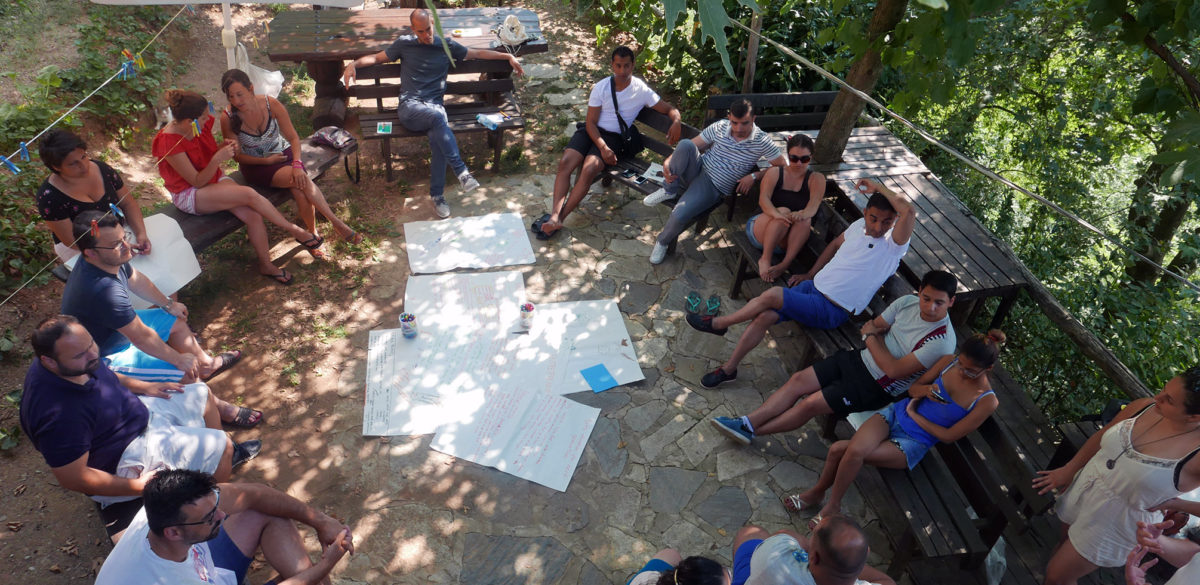
23-28 August 2019, Rehlovice (Usti nad Labem, Czech Republic)

Traditional ways of advocacy seem less and less effective, particularly when working in countries with far right governments and a high level of populism in politics. If grassroots activists want to advocate for combatting antigypsyism, empowering Roma and promoting social inclusion, they have to find new partnerships and new approaches to be effective.

In our Grassroots Advocacy Academy for multipliers, we want to share experiences with advocacy in difficult environments, build capacity for effective advocacy in our membership and support multipliers in organising national or local advocacy trainings for Roma activists.

We invite you to an interactive 5-day programme in a nice environment in Czech Republic to share experiences, learn from each other and together build more capacity to advocate effectively for Roma empowerment.

Objectives:

  • Explore and analyze different methods, ways and approaches of grassroots advocacy and community organizing
  • Share knowledge and experiences between ERGO Network members
  • Equip multipliers with knowledge of EU-driven Roma related policies that can support local advocacy
  • Equip multipliers with competencies and guiding principles to implement national or local advocacy trainings for Roma activists

Profile of participants:

  • Staff members or volunteers of (pro-)Roma civil society organisations OR
  • Staff members or volunteers of human rights organisations or training institutes
  • Experience in advocacy (and ideally also in capacity-building for advocacy)
  • Knowledge of Roma issues
  • Able to communicate in English

Conditions

The participation in the Academy is free thanks to a grant of the International Visegrad Fund and the European Commission’s EaSI programme. ERGO Network will cover the travel and accommodation costs.

We have 20 places. In case more people would like to participate, we will select based on motivation and geographical balance.

The Academy will take place from 23-28 August 2019 (including arrival and departure date)

in Rehlovice close to Usti nad Labem, Czech Republic at:  https://penzion-u-svate-barbory.hotel.cz/

Transfer from Prague will be organized.

If you are interested to participate, please register here by 13 June 2019.

Download the call for the ERGO Network Grassroots Academy.


Police action against Roma Travellers community in Belgium

OPINION

Unprecedented police action against Roma Travellers community in Belgium

A huge police action took place in Belgium in the morning of 7 May resulting in a massive arrest of Belgian Roma Travellers accused of trafficking of illegally obtained vehicles. The last action of this kind took place during the Second World War when 351 Roma Travellers from Belgium were transported to Auschwitz Birkenau. Today we see again a targeted action of the federal police towards the entire Roma Travellers community in Belgium.


We highly appreciate the work done by the police to tackle criminals in our society. This step was needed as we all are citizens of Belgium and we are responsible and stand as equals before the justice system as Belgian citizens. At the same time, we have concerns with the way these massive arrests have been conducted and we will allow ourselves to be critical towards the way justice is delivered.


Early in the morning 1200 police officers entered simultaneously in 19 locations in Belgium where Travellers parked their caravans. More than 200 persecutions took place. According to the media 76 people were arrested, while community members speak of a higher number. All belongings of the families were seized, including pocket money, jewellery, cars, caravans and other personal belongings. They could not even take food from the fridge before having to leave their homes. Bank accounts of innocent people were blocked without giving a reason. Some of the community members were released from custody without having been questioned, but their belongings are still confiscated. The spokesperson of the Prosecutor announced that 90 caravans and 91 cars are confiscated and one million Euros was seized on the spot. Today the families concerned are still without housing. Many of them stay with neighbours of other family members. 18 members of one family currently share one settled caravan that could not be moved by the police. There is still no clarity about whether and when they will be able to get back their belongings.


Arresting innocent people without any investigation or proof of crime is unacceptable today. This resembles a terrible historical moment for the Roma communities 80 years ago, when in the very same manner Roma people were arrested as entire communities during the Nazi persecutions. We are surprised to see that very similar actions are taking place today, in a time before elections. Arresting a community and not responsible individuals is an alert. We are seriously concerned that the Roma Travellers Community (similarly to refugees) is being used as a scapegoat to legitimize the racist attempts of some state representatives to be elected or re-elected, following examples of right-wing political movements across Europe.

We, as citizens are concerned about the violation of one of the very basic and universal human rights: the right to housing. According to Belgian legislation, caravans are recognised as housing. Confiscating caravans resulted in a great number of families: men, women and children deprived of their homes. Children, disabled people and pregnant women had to spend days and nights on the street without being offered appropriate alternative shelter. We were very critical towards similar attacks against Roma in Eastern Europe and signalled this to the EU institutions. Today an attack against Roma happened in the very heart of Europe: Brussels.


Today we are wondering what will happen to the families left on the street. For years, many Roma Travellers had to resettle every two weeks because of the lack of caravan sites in Brussels. We were continuously persecuted by the police, which led us to change our standing place constantly. Our children could not take advantage of the right to education, leading to a high illiteracy rate in our community. In addition to that on May 7, our housing rights were also violated. Today, in the 21 century we, the Roma community still have to fight for our fundamental rights, which are supposed to be granted to everyone.


We are calling the Belgian Ministry of Interior to take the necessary actions and to give the Roma and Travellers back their caravans, their only homes. We are demanding a stop to arrests of entire communities for the crimes of certain individuals. We are calling human rights organizations to support us in finding a way to solve this harsh situation for our families who currently suffer injustice and to call for a constructive dialogue with Belgian and international authorities.

`
Christine Sudbrock – Page 25 – ERGO Network

By continuing to use the site, you agree to the use of cookies. more information

The cookie settings on this website are set to "allow cookies" to give you the best browsing experience possible. If you continue to use this website without changing your cookie settings or you click "Accept" below then you are consenting to this.

Close