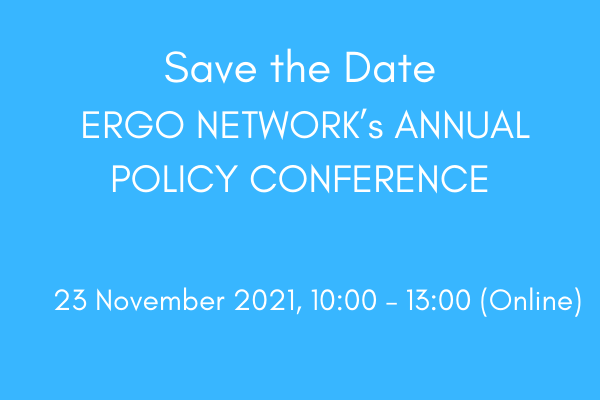
SAVE THE DATE FOR ERGO NETWORK’s ANNUAL POLICY CONFERENCE

SAVE THE DATE FOR ERGO NETWORK’s ANNUAL POLICY CONFERENCE

Implementing the EU Roma Strategic Framework

Roma access to adequate minimum income and social protection

23 November 2021, 10:00 – 13:00 (Online)

Please save the date for ERGO Network’s Annual Policy Conference, this year focusing on access to adequate minimum income, as well as taking stock of the first six months of the new EU Roma Strategic Framework. 

The Covid-19 public health crisis has worsened the situation for many Roma, Sinti and Travellers, mainly due to devastating living conditions, exclusion, and widespread antigypsyism.

Access to adequate minimum income and social protection is the cornerstone of the European Social Model and needs to be guaranteed also for Romani people. In a cash-based economy, providing people with sufficient financial resources is a necessary pre-requisite for fighting poverty and social exclusion, as well as for enabling individuals to reach their full potential and to access rights and opportunities on the labour market and in society. During the recovery from the devastating economic crisis due to the pandemic, this is today more important than ever. 

Furthermore, after advocating effectively for the adoption of a strong EU Roma Strategic Framework up to 2030, it is essential to now continue to monitor its implementation and the adoption of corresponding national frameworks in EU Member States and Western Balkan countries. Unfortunately, the targets set out in the Framework are often too low or non-ambitious and, while participation is made more visible than in the previous period, there are very few commitments made in this area, and the implementation of the EU Framework remains entirely up to national governments.  

Objectives

The first part of the event will serve to launch ERGO Network’s research report on “Roma access to minimum income and social protection”, based on five national case studies carried out in Bulgaria, the Czech Republic, Hungary, Romania, and Slovakia. The main findings and recommendations aim to kick-start a debate with policy makers on how to improve the adequacy and take-up on minimum income and social protection by Roma in Europe, including in the framework of the European Pillar of Social Rights Action Plan, and the foreseen Council Recommendation on Minimum Income (2022). 

The second part of the event will take stock of the first six months of the EU Roma Strategic Framework on Equality, Inclusion, and Participation, as well as of the Roma involvement with the preparation of the corresponding national frameworks. In the absence of a binding character of the EU framework, the event will assess how serious is the commitment of EU Member States to tackle antigypsyism, improve living conditions, and ensure meaningful participation of Roma.  

Participants 

The conference will bring together ERGO Network members from the grassroots level, EU policy-makers from across the institutional spectrum, as well as other relevant EU and national stakeholders. 

The agenda and registration link will be shared in the coming weeks. 

Looking back at the Romani Week 2021

Looking back at the Romani Week 2021

For the first time, due to the ongoing pandemic, Romani week was postponed from early spring this year to an online version organized from 27 to 30 September. As a platform to raise concerns, but also exchange knowledge between policymakers, experts, activists and organizations, the event focused on  debating post 2020 EU policies for Romani inclusion, advocating for specific subjects covering areas such as health, education, employment, online hate speech, environmental justice; and offerin specific recommendations on combatting antigypsyism, on the effectiveness of the post 2020 EU policies for Romani people, as well as on the national recovery and resilience plans.

ERGO Network was once again a proud co-organizer and partner to this edition of the Romani week, under the patronage of the European Parliament, European Commission and the Council of the European Union and its MEP hosts: Romeo Franz, Peter Pollák, Terry Reintke, Cornelia Ernst, Pierrette Herzberger-Fofana, Tomáš Zdechovský, Evin Incir, Rasmus Andresen, Anna Júlia Donáth, Dragoș Pîslaru and Sergey Lagodinsky.

ERGO’s participation started on 27 September with the speech of director Gabriela Hrabanova at the kick-off event Equality, Inclusion and Participation of Romani People by Law, highlighting that […] one of the ways forward is to have in place legislation […] having a specific directive, it increases chances to punish also specific forms of antigypsyism […].

Are the online platforms safe for Roma? – was the title of the second event during that day. Knowing that online hate speech has been steadily on the rise during the past decade, especially during the on-going Covid-19 pandemic, the event fostered a debate which led to identifying positive solutions, policy proposals, as well as advocacy points relevant for further addressing the new challenges arisen during the current pandemic that present new obstacles for a better inclusion of Roma in society. The event was hosted by MEP Pierrette Herzberger Fofana and co-organized by ERGO Network, Fundación Secretariado Gitano (FSG), European Roma Rights Centre (ERRC), and International Network Against Cyber Hate (INACH) as part of our common efforts of to tackle antigypsyist online hate speech.

The fight against institutional antigypsyism is for the first time at the centre of the new EU Roma Framework, marking the important shift in policy development approach on Roma inclusion at EU and national level. The second co-organized event by ERGO Network, together with the Central Council of German Sinti and Roma, European Roma Rights Centre, Roma Active Albania, Phiren Amenca and Equinet called Adopting National Roma Strategic Frameworks 2021 – 2030 – built on the results of the EU Platform for Roma Inclusion taking place on 21-22 September 2021 and used the results to inform about the follow-up steps by the European Commission in providing guidelines to Member States and the Enlargement region and of the civil society and other key stakeholders in the implementation and monitoring of the national Roma strategic frameworks.

The conference Addressing environmental justice in Roma communities – co-organized by ERGO Network in cooperation with the European Environmental Bureau and the European Public Health Alliance on 29 September focused on awareness raising of environmental determinants of health, such as environmental discrimination against Roma communities and its impact on health to set the issue on the European and national political agenda.

ERGO’s member Roma Active Albania co-organized and implemented the EU Award for Roma Integration in the Western Balkans and Turkey, 2021 which is supported by the European Union. The award ceremony Extraordinary People Promoting Equality through Employment – as this year the emphasize was on the importance of Roma employment, as a mechanism to break the circle of exclusion, was organized live in Brussels in the Concert Noble venue on 29 September in the afternoon (read more here).

Making EU funding & finance work for Roma – was the last event co-organized by ERGO Network on the 30th of September. The very insightful event informed about different EU funds and programmes available for Roma inclusion and showcasing examples of partnership´ alliances for the efficient use of EU funds, including the example of Community-Led Local Development presented by ERGO Network member Daniel Grebeldinger from Nevo Parudimos, Romania.

Meeting during this Romani week online was truly unusual; however, it did not change the objectives of this event. More than ever, actions need to follow the words spoken those days online. Recognition of antigypsyism must be strengthened at national level as well as real political will to combat it. We now need strong cooperation between stakeholders for an effective implementation of the EU Roma Strategic Framework. Only together, we can develop strategic and coherent responses to help the Romani communities across Europe.


Call on the European Parliament to uphold fundamental rights in AI and criminal law report

EDRi and 41 human rights organisations call on the European Parliament to uphold fundamental rights in AI and criminal law report

Artificial intelligence (AI) is, perhaps, the most important breakthrough technology of this century. Its applications are not only changing our daily life or the way we work or interact in society, but also our perception of the world. Some applications of AI are an acute threat to fundamental rights, as they allow, for example, for predictive policing and mass surveillance, which can easily enforce antigypsyism and other forms of racism in policing.

ERGO Network has therefore signed an open letter of European Digital Rights (EDRi), calling on Members of the European Parliament to uphold the protection of fundamental rights and freedoms in the LIBE Committee report on Artificial intelligence in criminal law and its use by the police and judicial authorities in criminal matters, which was voted on at the EP Plenary session on 5th October.

In ERDI’s open letter, we urged MEPs to support the LIBE Committee’s original report, which we strongly believe took the most balanced and proportional stance on artificial intelligence (AI) in law enforcement from a fundamental rights perspective. AI in the field of law enforcement offers particular challenges for fundamental rights, in particular rights to liberty, security, privacy, a fair trial and non-discrimination, and as such, require particular fundamental rights scrutiny and democratic oversight.

The pressure of civil society worked: the amendments that would have put fundamental rights at risk were not accepted.

The open letter can be found here.


EU Award for Roma Integration in the Western Balkans and Turkey

EU Award for Roma Integration in the Western Balkans and Turkey 

Extraordinary people promoting equality through employment

A highlight of the Romani Week 2021 was the only in-person event taking place in Brussels: The award ceremony for the 14 winners of the fourth edition of the “EU Award for Roma Integration in the Western Balkans and Turkey”! 

Launched in 2014, the  EU Award for Roma Integration in the Western Balkans and Turkey is organised by Roma Active Albania, member of ERGO Network, and funded by the European Union. It highlights the importance of Roma integration in the EU Enlargement process and shows the EU’s determination and commitment to improving the social inclusion of Roma people. With the Award, the EU recognises all efforts to empower Roma to reach their full potential as full members of the societies where they live and work. 

The 2021 edition invited nominations and self-applications for “Extraordinary people promoting equality through employment”. It recognises private and public initiatives that offer support, recognition and publicity to sustainable employment initiatives in Roma communities, especially among women, and that support positive role models and practical help.

Of the 67 applications submitted, 14 projects representing the Western Balkan partners and Turkey have been chosen for their outstanding contribution. The nominees often put themselves at risk by being role models and breaking established traditions. The winners include ERGO Network member Otaharin from Bosnia & Herzegovina, the Konak municipality from Turkey and the Roma Women Center Bibija from Serbia (full list of winners here). 

Adriatik Hasantari, Director of Roma Active Albania and Vice-Chair of ERGO Network, applauded all winners: “Your success in improving the economic situation of hundreds of Romani families proves that things can change when municipalities, companies, organisations and individuals are committed to and passionate about Roma inclusion. You are an inspiration to be followed by many”. 

Olivér Várhelyi, Commissioner for Neighbourhood and Enlargement, said: “Congratulations to all the winners for your contribution to such an important issue! You took courageous initiatives overcoming prejudices to promote Roma employment. With your diverse actions and your successful results, you show that progress on Roma employment is possible. I hope this Award will help expand your initiatives as role models for increasing Roma employment and for making our societies more equal and fair.”

The winners travelled to Brussels not only to been given their awards, but also to learn more about the EU’s role in Roma integration in the Western Balkans and Turkey and ERGO Network’s activities to empower Roma civil society and improve policy-making for Roma across Europe. During the next months, they will continue to share their experiences and learn together through a study visit to Spain and events organised in all partner countries of the Western Balkans and in Turkey. 

Find out more about the 14 winners and their achievements under the following links: 


Socio-economic inclusion and the fight against antigypsyism should complement each other


Socio-economic inclusion and the fight against antigypsyism should complement each other

Open letter to
European Commissioner for Neighbourhood and Enlargement Olivér Várhelyi
Western Balkan Heads of Economies and Governments of Albania, Bosnia and Herzgovina, Kosovo, Montenegro, North Macedonia and Turkey
Secretary General of the Regional Cooperation Council Majlinda Bregu
Slovenian Presidency of the Council of the European Union

German Federal Foreign Office

As (pro-)Roma civil society organisations active in the Western Balkans and Turkey, we would like to draw your attention to the serious shortcomings of the Conclusions of the Second Ministerial Meeting on Roma Integration of the Ministers of the Western Balkans responsible for Roma integration on 28 June 2021. The Conclusions unfortunately do not make any reference to the fight against antigypsyism or at least to the fight against discrimination, despite respective obligations of the „Neighbourhood and Enlargement Countries”.

In June 2019, the Prime Ministers of the Western Balkans signed the “Declaration of Western Balkans Partners on Roma Integration within the EU Enlargement Process”, the so-called Poznan Declaration. In this Declaration they reiterate their “commitment for integration of Roma in their societies and pledge to step up their efforts as part of the European Union enlargement process and regional cooperation.”

The Prime Ministers pledged to strengthen their government structures to protect against discrimination and to establish specific sub-divisions for non-discrimination of Roma within formal non-discrimination bodies to process complaints by Roma, provide legal support to alleged victims and identify discrimination schemes, including institutional and hidden discrimination.

Further, they pledged to envisage a stronger role of the Western Balkans partners in the European Union’s post 2020 policy on Roma integration by ensuring their participation o in the process in an observer status at minimum.

In September 2020, the European Parliament adopted the Report on the Implementation of National Roma Integration Strategies: combating negative attitudes towards people with Romani background in Europe, requesting inter alia a legislative proposal for the equality, inclusion and participation of Romani people and combating antigypsyism.

In October 2020, the European Union adopted the new “EU Roma Strategic Framework for Equality, Inclusion and Participation”, which is equally relevant for the countries in the Western Balkans. The new EU Framework identifies as a key priority the fight against antigypsyism as the root cause of social exclusion and racial or ethnic discrimination.

In March 2021, the Commission reaffirmed the importance of this new Framework when endorsing the EU Council Recommendations on Roma Equality, Inclusion and Participation. The recommendations also refer to the responsibilities of the bodies for the promotion of equal treatment (‘equality bodies’) and assign them an important role in the fight against antigypsyism.

Following all these political declarations and recommendations, the fight against antigypsyism – the specific racism towards Roma – as the root cause of social exclusion and discrimination should have been in the focus of governments’ commitment in the Western Balkans.

However, neither the Conclusions of the Ministerial Meeting on Roma Integration on 27 October 2020 nor the Conclusions of the Second Ministerial Meeting on Roma Integration on 28 June 2021 make any reference to the fight against antigypsyism or at least to the fight against discrimination.

Instead, they focus on employment measures, completion of the geographic mapping exercise of Roma settlements, registration and the inclusion of Roma in the EU Green Deal. These are all very relevant issues that should be urgently addressed, but they all fall short of addressing the root cause of the exclusion of Roma.

This approach is not only in contradiction to the commitments of the Poznan Declaration and the new EU Roma Framework, it will also negatively affect the effectiveness of any other measure.

It is common knowledge that measures in the socio-economic sphere will have a limited impact if antigypsyism is not tackled. Experience demonstrates that without fighting racism among potential employers and colleagues, for example, active labour market measures are less effective, since racism among employers and colleagues is one of the major obstacles for the employment of Roma.

According to the Balkan Barometer, 25% of the interviewed persons are uncomfortable or somewhat uncomfortable working with a Romani person. 30% are uncomfortable or somewhat uncomfortable buying a product from a Romani person (or produced by a Romani person). This data should make it clear that it is indispensable to fight antigypsyism.

Active labour market measures, including the need to formalise work, are indispensable. They should, however, not only be implemented in the private sector, but also in the public sector, not least since all governments have legal obligations to promote employment of Roma in the public sector – what they have so far failed to adhere to.

The Poznan Declaration stipulates to “increase the employment rate of Roma in the public sector to the rate proportional of the number of Roma in the overall population and to increase the employment rate among Roma to at least 25 per cent”. However, none of the conclusions of the Ministerial Meetings refer to this pledge.

Looking at more general attitudes of the majority populations towards Roma, things are even worse: 68% of respondents feel uncomfortable or somewhat uncomfortable with marrying a Romani person or if their child would marry a Romani person. 33% are uncomfortable or somewhat uncomfortable inviting a Romani person to their house and 26% are uncomfortable or somewhat uncomfortable if their children attend school together with Romani children.

Against this background, it is difficult to understand why governments in the Western Balkans do not take the fight against antigypsyism serious and step up their efforts, and why European Union institutions and individual Member States are reluctant to encourage the governments in the Western Balkans to finally start fighting racism.
As long as this approach will not change, the current efforts in employment, housing, registration, etc. remain mere lip services, since they omit to fight the root cause for the social exclusion and discrimination of Roma in the Western Balkans.
Equality Bodies and Ombudspersons could play a crucial role in fighting antigypsyism, and with further intensifying the cooperation with Romani civil society they could achieve an impact in society and politics.

We therefore call upon the governments in the Western Balkans, the institutions of the European Union as well as individual Member States of the European Union to increase their efforts in the fight against antigypsyism in the Western Balkans by:

  • Conducting public awareness campaigns on fighting antigypsyism;
  • Establishing close cooperation with the Romani civil society in fighting antigypsyism;
  • Conducting regular trainings on fighting antigypsyism for several target groups, involving Roma as trainers;
  • Contributing to creating new policy and legal frameworks for fighting antigypsyism;
  • Ensuring the participation of Roma in Equality Bodies and Ombudsperson Institutions;
  • Including a specific chapter on the situation of Roma or on antigypsyism in the regular reports to the Parliaments.

Signatories:
Roma Active Albania, Otaharin (Bosnia and Herzegovina), Voice of Roma, Ashkali and Egyptians (Kosovo), Advancing Together (Kosovo), Phiren Amenca (Montenegro), RROMA (North Macedonia), Forum Roma Serbia (Serbia), Zero Discrimination Association (Turkey), Central Council of German Sinti and Roma (Germany), ERGO Network (Belgium)

`
Ana Rozanova – Page 39 – ERGO Network

By continuing to use the site, you agree to the use of cookies. more information

The cookie settings on this website are set to "allow cookies" to give you the best browsing experience possible. If you continue to use this website without changing your cookie settings or you click "Accept" below then you are consenting to this.

Close