ERGO Network Snapshot of Housing and assistance for the homeless

Snapshot on the Situation of Roma in Europe: Housing and Assistance for the Homeless  

Our Snapshots on the Situation of Roma in Europe are a series of reader-friendly, visually attractive handouts, linking each of the 20 policy principles of the European Pillar of Social Rights to Roma rights and inclusion. Each Snapshot includes key statistics, a brief problem statement, and extensive policy recommendations.  

Many Roma across Europe live in de facto homelessness, or in insecure or substandard housing, in segregated informal settlements that lack access to services and pose environmental hazards. Widespread antigypsyism from all housing actors (landlords, sellers, banks, neighbours etc), ever-rising housing and utility costs, insufficient access to social housing, and forced evictions prevent them from accessing an adequate standard of living.  

  • Read the Snapshot here! 

For more information about our work on Housing and Assistance for the Homeless, please contact Amana Ferro (a.ferro@staging.ergonetwork.org), Senior Policy Adviser with the ERGO Network staff team. 

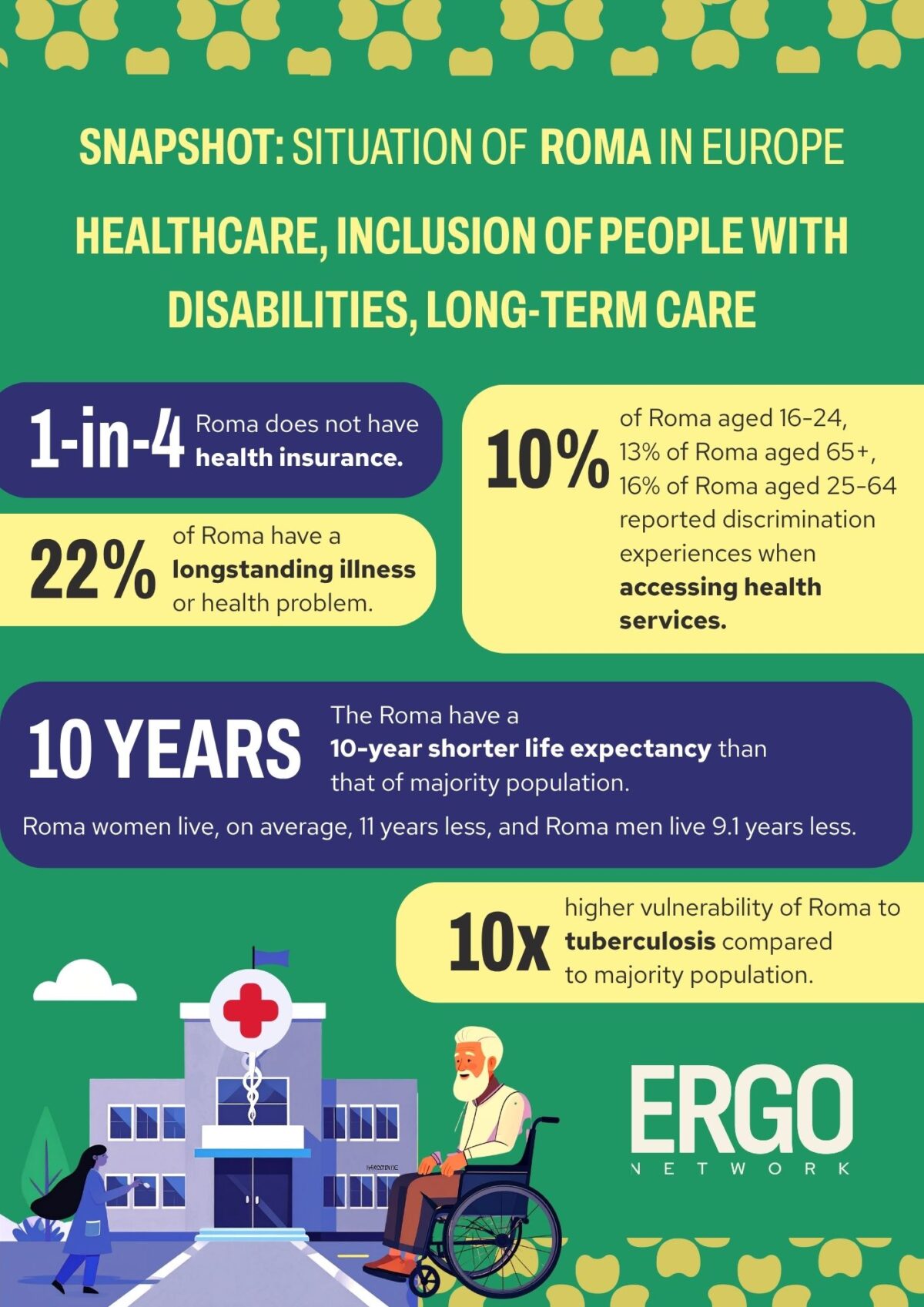
ERGO Network Snapshot of Health care, Inclusion of people with disabilities, Long-term care

Snapshot on the Situation of Roma in Europe: Healthcare, Inclusion of People with Disabilities, Long-Term Care  

Our Snapshots on the Situation of Roma in Europe are a series of reader-friendly, visually attractive handouts, linking each of the 20 policy principles of the European Pillar of Social Rights to Roma rights and inclusion. Each Snapshot includes key statistics, a brief problem statement, and extensive policy recommendations.  

Systemic health inequalities and entrenched unmet care needs are a daily reality for most of Europe’s Roma, entrenching disparities that range from life expectancy to prevalence of disabilities, across the medical spectrum, from mental health to sexual and reproductive health and rights. These are driven by social determinants such as poverty, antigypsyism, exclusion from services and insurance, and under-utilisation of Roma health mediators. 

  • Read the Snapshot here! 

For more information about our work on Healthcare, Inclusion of People with Disabilities, Long-Term Care, please contact Amana Ferro (a.ferro@staging.ergonetwork.org), Senior Policy Adviser with the ERGO Network staff team. 

ERGO Network Snapshot of Old Age Income and Pensions

Snapshot on the Situation of Roma in Europe: Old-Age Income and Pensions  

Our Snapshots on the Situation of Roma in Europe are a series of reader-friendly, visually attractive handouts, linking each of the 20 policy principles of the European Pillar of Social Rights to Roma rights and inclusion. Each Snapshot includes key statistics, a brief problem statement, and extensive policy recommendations.  

Most older Roma face stark health and income inequalities, due to a lifelong experience of poverty, poor housing, inadequate nutrition, and precarious work. At the same time, they are left with minimal pension entitlements, limited access to quality, inclusive, and proximity healthcare and long-term care services, and compounded discrimination based on both ethnicity and age, which, additionally, particularly impacts older Roma women. 

  • Read the Snapshot here! 

For more information about our work on older Roma, please contact Amana Ferro (a.ferro@staging.ergonetwork.org), Senior Policy Adviser with the ERGO Network staff team. 


European Commission releases Annual Sustainable Growth Survey (ASGS) 2022

European Commission releases Annual Sustainable Growth Survey (ASGS) 2022

What’s in it for Europe’s Roma?

On 24 November 2021, the European Commission published the Annual Sustainable Growth Survey 2022, accompanied by the draft Joint Employment Report 2022 (among other annexes), thus launching the European Semester 2022.

  • Read our full response to ASGS and the JER 2022 here!

The Annual Sustainable Growth Survey reaffirms that “the European Semester will remain the overall EU framework for the coordination of economic, employment and social policies”, while the Recovery and Resilience Facility remains “the key tool to implement the policy agenda” and is fully embedded in the European Semester. It also confirms the commitment to the four complementary dimensions of environmental sustainability, productivity, fairness, and macroeconomic stability.

For the second consecutive year, there is no mention of Europe’s Roma in this year’s Annual Sustainable Growth Survey and, unlike in previous years, there is equally no reference to ethnic or racial minority background. Similarly, the text contains no mention of antigypsyism or even discrimination anywhere in its content.

The main focus is on the green and digital transitions and, while social concerns are integrated as a component of these transitions and also have a dedicated section under the fairness objective, the prioritizing doesn’t seem to be at least on equal footing. The fairness section extensively covers education and training, as well as employment, however these are understood very narrowly from the perspective of their contribution to the twin transition. We appreciate the focus on combatting inequalities in education (including the digital divide) and the impetus to promote inclusion, diversity, and gender equality, as well as calls to stem energy poverty. However, we are missing references to ensuring access to fundamental services and rights, such as health or housing.

We are very pleased to see Europe’s Roma mentioned multiple times in the Joint Employment Report, concerning their heightened risk of experiencing poverty and social exclusion (including that of children), gaps in accessing education and training, school segregation, and the disproportionate impact of the Covid-19 pandemic (including on employment and income levels). Additionally, strong links are made to the EU Strategic Framework on Roma Equality, Inclusion, and Participation. However, disappointingly, while the document is quite extensive in covering Roma poverty and education, other thematic objective of the EU Roma Framework – employment, housing, health – are not covered at all in the Report. Equally, there is no mention of antigypsyism or racism.

Regarding civil dialogue, the Annual Sustainable Growth Survey only mentions civil society once, while the systematic involvement of social partners is much more consistently stressed. In the draft Joint Employment Report, civil society involvement is much better covered, with multiple references to its instrumental role as an important asset in implementing social and employment policies.

The ASGS also provides some clarity about the future of the European Semester, as well as what are the key steps and milestones to be expected for 2022. This year’s Semester will include the implementation of the Recovery and Resilience Facility, that of the European Pillar of Social Rights Action Plan, and – as a new element – that of the Sustainable Development Goals.

ERGO Network will continue to engage closely with the European Semester 2022, and strive to bring Roma rights and inclusion much more in focus in the delivery of these initiatives, and for better alignment of the priorities of the Semester and those of the EU Strategic Framework for Roma Equality, Participation, and Inclusion.

For more information about ERGO Network’s work on EU social inclusion and employment policy (European Semester, European Pillar of Social Rights, Sustainable Development Goals etc), please contact Senior Policy Adviser Amana Ferro.

Open Letter calling for meaningful debate on and written responses to European Citizens’ Panel recommendations

Open Letter calling for meaningful debate on and written responses to European Citizens’ Panel recommendations

Dear members of the Executive Board,

The Conference on the Future of Europe (hereafter: the Conference) is at a crossroads: either it will turn into an ugly interinstitutional battle happening largely behind closed doors, feeding cynicism about EU and the oft-declared ‘Europe of citizens’, or it will fully embrace the potential of meaningful and publicly accountable engagement with Europe’s citizens and residents. In order to increase our chances of the Conference going down the second road, we call on you to ensure that the recommendations coming out of the European Citizens’ Panels are all seriously and publicly debated and responded to in writing by the Conference Plenary and its Working Groups.

While the process of European Citizens’ Panels designed and implemented for the purpose of the Conference is very far from perfect, and while their output is not and should not be the exclusive input for the work of the Conference Plenary[1], the way this output is dealt with will be a crucial indicator for the success of the Conference[2]. If you invite 800 citizens from all across Europe to dedicate more than three weekends of their time to come up with recommendations for the future of the European Union, the least you owe them and the wider European public is a public debate followed by a clear, reasoned and detailed answer on each of their specific recommendations.

An important task of the Conference Plenary is to debate the recommendations coming out of the European Citizens’ Panels[3]. However, in order to ensure that this debate is meaningful and accountable, connected to the outcomes of the Citizens’ Panels, it should be followed by the adoption of a resolution in which the Conference Plenary responds concretely and in detail to each of the recommendations. In the absence of such a document, many citizens are likely to feel misled, as they will not see how their recommendations had a serious chance of being heard and making a difference. Even if the Conference Plenary disagrees with certain recommendations, it is of crucial importance to communicate and justify such opposition explicitly, publicly and in writing.

The Working Groups are the appropriate place to debate recommendations in detail and to prepare the final position of the Conference Plenary on citizens’ recommendations. In order to fulfil this role, Working Groups should be given the adequate resources and working structures, and their meetings should be live-streamed[4].

Considering the powers the EU institutions invested in you as Executive Board, as defined by the Joint Declaration, we count on you to adjust the Conference’s Rules of Procedure and the Working Groups Terms of Reference to accommodate our urgent requests for meaningful, publicly accessible Working Group and Conference Plenary debate on, and clear, detailed and reasoned written responses to, the European Citizens’ Panel recommendations.

We are looking forward to hearing back from you.

Sincerely,

List of civil society organisations co-signing this letter:

Alliance4Europe
Allianz für WERTEorientierte Demokratie (AllWeDo)
Alpe Adria Green
Another Europe
Asociación Musulmana por los Derechos Humanos
Balkan Civil Society Development Network (BCSDN)
Bulgarian Center for Not-for-Profit Law
Citizens for Europe
Citizens Take Over Europe
CIVICO Europa
Civil Society Development Foundation, Romania
Civil Society Europe
Culture Action Europe
Danubiana Network
Debating Europe
Democracy International
ENAR – European Network Against Racism
Equinox Initiative for Racial Justice
ERGO network
ETUC – European Trade Union Confederation
Eumans – citizens for democracy and sustainability
Europe for Scotland
European Alternatives
European Center for Not-for-profit Law Stichting (ECNL)
European Civic Forum
European Democracy Lab
European Environmental Bureau
European Federation of National Organisations Working with the Homeless
European House
European Movement Italy
European Network on Religion & Belief
Fix The Status Quo
Fórum dos Cidadãos
Friends of the European Republic
Gong
Greek Forum of Migrants
IGO – Interessenvertretung Gemeinnütziger Organisationen
ILGA-Europe
INITIATIVE FOR DEVELOPMENT AND COOPERATION
Institute of Public Affairs
Ligue de l’enseignement
Mehr Demokratie e.V.
Music Theatre International
National Network for Civil Society Germany (BBE)
OGA Ireland – Open Government Association Ireland
Politics for Tomorrow / nextlearning e. V.
Pulse of Europe
Regional Roma Educational Youth Association – RROMA
Social Platform
Society for Sustainable Living/STUŽ
SOLIDAR
Stand Up for Europe
Take a Break from Brexit
TGEU
The ECI Campaign
The Good Lobby
The Wheel
Unconditional Basic Income Europe
Understanding Europe

This letter is sent to Executive Board members on Thursday, 20 January 2022, with a total of 58 co-signatories. If your organisation still wants to support this letter and remain updated, including about possible future actions, please fill out this form.

Footnotes:
[1] In this context, we want to mention and recognise the work done by the Civil Society Convention on the Future of Europe in bringing civil society actors together and developing common proposals for the Conference Plenary to debate and consider.
[2] We note that our call for written replies to recommendations from the European Citizens’ Panels does not preclude the Conference Plenary additionally developing written responses to recommendations from National Citizens’ Panels, from the Civil Society Convention on the Future of Europe and/or from other sources, as collected on the Digital Platform.
[3] See articles 5 and 17 of the Rules of Procedure of the Conference on the Future of Europe.
[4] Up until now, only one Working Group meeting was ever live-streamed, the ‘EU in the world’ Working Group meeting taking place on 17 December at 11:00 CET (find the recording here).

`
Ana Rozanova – Page 33 – ERGO Network

By continuing to use the site, you agree to the use of cookies. more information

The cookie settings on this website are set to "allow cookies" to give you the best browsing experience possible. If you continue to use this website without changing your cookie settings or you click "Accept" below then you are consenting to this.

Close