Joint Briefing for United Nations Committee on the Rights of Persons with Disabilities

Joint Briefing for United Nations Committee on the Rights of Persons with Disabilities regarding the review of the implementation of the CRPD by the EU

Together with other human rights organisations, ERGO endorsed a Joint Briefing to inform the UN Committee on the Rights of Persons with Disabilities about issues of inequality and intersectional discrimination faced by persons with disabilities with intersectional identities in the European Union (EU). Its objective is to inform the adoption of the List of issues prior to reporting on the EU.

The endorsing organisations are alarmed by the rate of discrimination faced by persons with disabilities in all their diversity in Europe. The EU has not taken enough measures to address equality and non-discrimination in its legislation and policies, and in particular to address intersectional and multiple forms of discrimination.

In particular, the EU is yet to:

  • Adopt legislation and policies to prevent and combat discrimination on all grounds and in all areas of life
  • Adopt legislation and policies to prevent and combat hate speech and hate crime, including based on disability and other grounds
  • Ensure that Equality Bodies are protected by standards that among others, harmonise the mandate of equality bodies so that they can adequately and efficiently combat disability-based discrimination and support victims of unequal treatment
  • Adopt intersectional policies and targeted measures against intersectional discrimination

The organisations recommend that the CRPD Committee request information on those issues and pay particular attention to the diversity of persons with disabilities in its List of issues prior to report and Concluding observations.

Download the joint report

 Contributors and endorsement

  • AGE Platform Europe
  • Equinox Initiative for Racial Justice
  • Eurochild
  • The European Disability Forum (EDF)
  • The European Network Against Racism (ENAR)
  • The European Network of Equality Bodies (Equinet)
  • The European Roma Grassroots Organisations (ERGO)
  • The European Youth Forum
  • Hope and Homes for Children
  • ILGA-Europe
  • Lumos
  • Transgender Europe (TGEU)

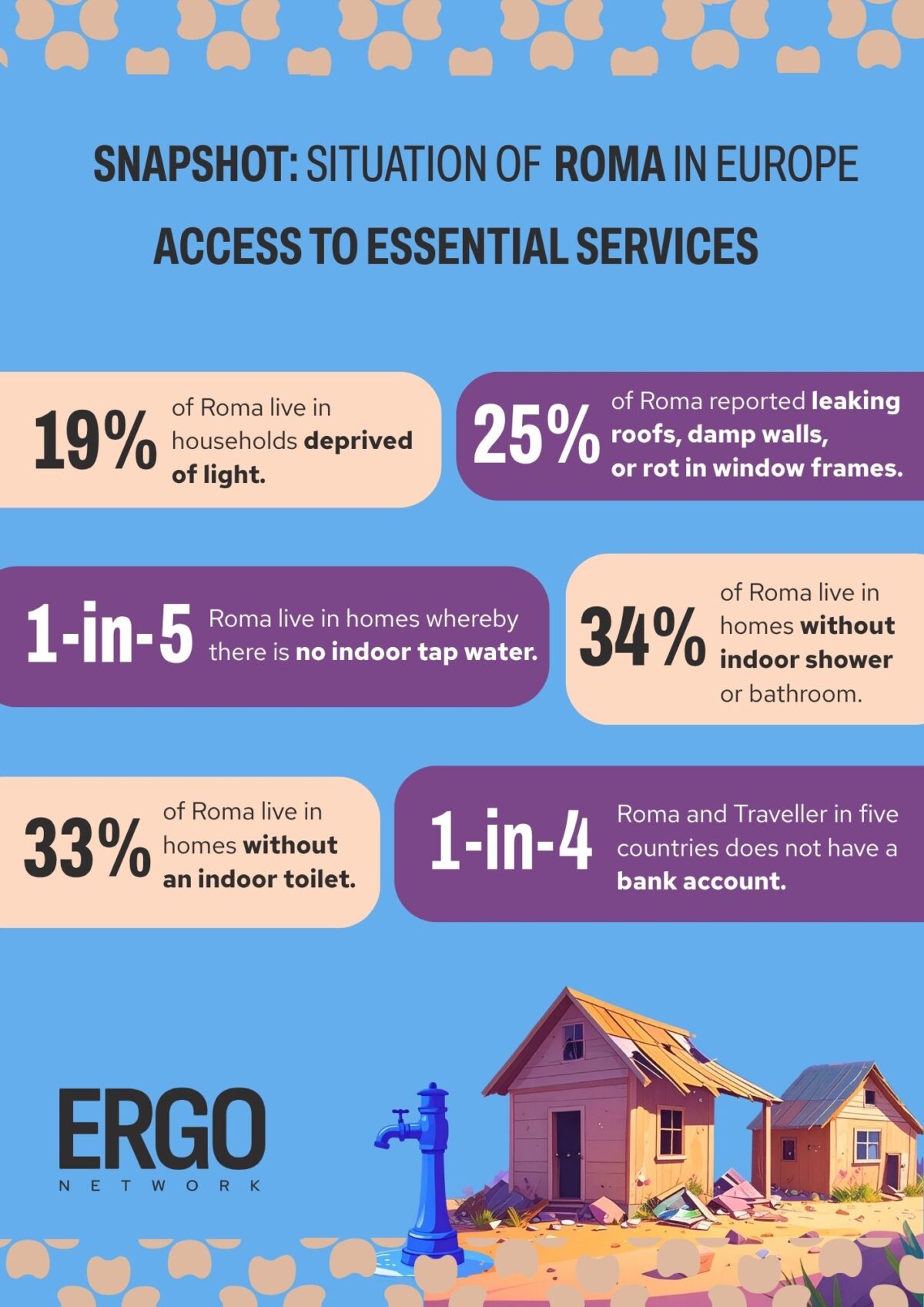
ERGO Network Snapshot of Access to Essential Services

Snapshot on the Situation of Roma in Europe: Access to Essential Services  

Our Snapshots on the Situation of Roma in Europe are a series of reader-friendly, visually attractive handouts, linking each of the 20 policy principles of the European Pillar of Social Rights to Roma rights and inclusion. Each Snapshot includes key statistics, a brief problem statement, and extensive policy recommendations.  

Roma communities across Europe continue to face multiple, complex obstacles in their efforts to access essential services, ranging from clean water and heating, to transport and digital inclusion. These obstacles revolve around extreme poverty, inadequate service infrastructure, administrative exclusion and undocumented status, antigypsyism, and – not least – the ongoing and increased privatisation of public services. 

  • Read the Snapshot here! 

 For more information about our work on Access to Essential Services, please contact Amana Ferro (a.ferro@staging.ergonetwork.org), Senior Policy Adviser with the ERGO Network staff team. 

Safer online spaces for Roma: Must be backed up by action!

Safer online spaces for Roma: Must be backed up by action!

Twitter believes that everybody should be empowered every day to speak their mind about issues that matter most to them and to be part of the public conversation.

Unfortunately, not everyone at Twitter has the same positive experience. Historically marginalised and underrepresented groups have important messages and ideas which can inspire everyone around the world and raise awareness about important issues in our societies. Individuals identifying with these groups, however, sometimes face harassment and abuse on the platform, which can jeopardize their freedom of expression.

Given our background and experience with antigypsyist hate speech online, Mustafa Jakupov, policy and project coordinator of ERGO network was invited to take part in the EMEA Safer Internet Day Summit on the 10th of February to make sure the Roma voices are heard.

We believe that everybody needs to feel safe online, to get active, and to speak up in front of a global audience.

Safer internet twitter summit

The use of “innocent jokes” does not soften the online hate speech against Roma, but it perpetuates stereotypes and prejudices under an umbrella of humour where other aggressive comments and xenophobic spreads are distributed and multiplied. The recent example of the comedian Jimmy Carr in his show Dark Matter on Netflix proves this.

The British comedian has, in a recent Netflix stand-up special, said that:

“When people talk about the Holocaust, they are talking about the tragedy of 6 million Jewish lives lost to the Nazi war machine. But they never mention the thousands of Gypsies killed by the Nazis. Nobody ever wants to talk about it because nobody ever wants to talk about the positive aspects.”

The whole statement was dressed up as an edgy and even more – educational – joke, playing the card of “if you don’t laugh, you are just not smart enough to understand it”. However, although in his later performances Jimmy Carr has kept to his image of a brave honest man making fun of serious matters, the hypocrisy lies on the surface. He is not making fun of Holocaust per se, only targeting the two most vulnerable groups of the survivors (Roma and Jehovah’s Witnesses). The comedian is acting as a regular bully attacking only those, who he knows will not fight back – and thus feeding into the general discourse of antigypsyism and hate speech.

Hate speech as a manifestation of antigypsyism needs particular attention because of its multiplier effect:

  •  It influences public opinion, fuels tension, and paves the way for discrimination and hate crimes. Online media plays a particular role in spreading and inciting hate speech. It strengthens stereotypes, uses offensive language, denies, or trivializes antigypsyism.
  •  Through social media hate speech reaches millions of people and allows perpetrators to anonymously incite hatred and violence.

Safer internet twitter summit

‘Haters’ do not use the term Roma but some hybrid terms that all society acknowledges as Roma. This requires IT companies to have knowledge of these terms, or in other words, the IT companies must keep up with the different forms of online antigypsyism.

Living in the times of Covid-19, online antigypsyism is becoming normalized for the whole society and not just the right-wing supporters. Laws are important, but prevention should be more highlighted. Therefore, creating a space for Roma where they can create content for counter-narratives is important, because finding quality content on Roma is hard. Another weak link in antigypsyism is the data collection as this will show the dimensions of hate speech.

The use of artificial intelligence to detect hate speech before it is posted is being developed, however, this might be tricky as the language is evolving as well and the AI models must adapt. On the other hand, people must be present as they will need to finalize the decision. This brings us to the importance of filing complaints.

Collaboration between CSO and IT platforms is crucial and there should be mutual learning and recommendations input. This also needs to be reflected in a form of cooperation between institutions, media, and CSO’s, where opportunities for spreading counter-narratives are supported, a distinctive law framework is created to criminalize hate speech and effective mechanisms are put in place that would involve CSO’s in the development of AI models and software in order to avoid further discrimination of marginalized groups in online places.

European Commission’s Action Plan for Social Economy – What’s in it for Europe’s Roma?

European Commission unveils the EU Action Plan for Social Economy

– What’s in it for Europe’s Roma?

On 9 December 2021, the European Commission proposed an EU Social Economy Action Plan, aimed at putting forward concrete measures to help mobilise the full potential of social economy, including through improved visibility and recognition and access to finance and markets.

ERGO Network has closely engaged with the run-up to the Action Plan, with a view to raising awareness on the key role social economy can play in contributing to Roma inclusion and to delivering on the objectives of the EU Roma Strategic Framework. In 2020, we released a  comprehensive position paper, The role of Social Economy in supporting Roma social and economic inclusion. A close-up on the Covid-19 pandemic and the recovery strategies. With our members, we have reviewed the proposed EU Social Economy Action Plan in light of the key messages of our own position paper.

  • Read ERGO Network’s full response to the EU Social Economy Action Plan here!

Regrettably, there is only one mention of Europe’s Roma in the Action Plan, namely in the Introduction, with no other references to ethnic background, minorities, or racialised communities in the rest of the document. For social economy enterprises to actually support vulnerable groups such as the Roma, clear indicators that monitor Roma participation in social economy initiatives are needed. Additionally, social economy actors must be mindful of deeply rooted discrimination and antigypsyism and make conscious efforts to combat any such tendencies.

ERGO Network salutes proposals to better include social economy business models in entrepreneurship educational curricula, and the commitment to support the development of social impact measurement and management, including involving stakeholders in the development of assessment methodologies. However, we are disappointed to see that the contribution of social economy to reducing poverty and social exclusion is insufficiently mentioned, while failing to create fruitful synergies with the EU Roma Strategic Framework, as well as with the European Pillar of Social Rights in a comprehensive way.

While we welcome that developing policy and legal frameworks is one of the explicit objectives of the Action Plan, we would have liked to see the key aspect of the social and societal goals more strongly emphasised, as well as an explicit commitment to embed a partnership approach involving key stakeholders, including Roma communities and their civil society representatives.

ERGO Network appreciates that the Action Plan highlights the added value that social economy enterprises bring to local communities, stressing their strong local roots and the impetus to serve the communities where they are based. However, the role and potential of these communities is insufficiently taken into account in the document. Social economy initiatives must enshrine a broad bottom-up approach, based on real community needs and grassroot input, giving the Roma a voice in the process.

While the Action Plan clearly spells out the need for business development support for social enterprises, disappointingly nothing is said about supporting Roma social entrepreneurs. This is a glaring missed opportunity to tap into the enormous potential and competences that the Roma bring to the table. More targeted support is needed to build the capacity of the Roma, and the existence and potential of social enterprises need to be better promoted in Roma communities.

We equally welcome that the Action Plan acknowledges the key role of public financial support for social enterprises, as well as the commitment to increase the level of support in the next programming period. However, the document doesn’t take into account the fact that marginalised and racialised communities face additional barriers in accessing funding, nor does it put forward proposals to address them.

Social economy offers great potential to address Roma poverty, employment, health, education, accommodation, nutrition, and to keep alive Roma culture and crafts. ERGO Network expresses its hope that the gaps identified above will be remedied through implementation and stands ready to support these efforts, at both the EU and the national level.

For more information about our work on Social Economy, please contact Amana Ferro (a.ferro@staging.ergonetwork.org), Senior Policy Adviser with the ERGO Network staff team.

Council Conclusions on Racism and Antisemitism

Council conclusions on racism and antisemitism: European Union (EU) the Member States must commit to fighting structural racism and ensure equality for all people living in the EU

The European Network against Racism, Equinox Initiative for Racial Justice, the European Roma Grassroots Organisations Network (ERGO) and the Forum of European Muslim Youth and Student Organisations (FEMYSO) support the initiative proposed by the French Presidency to have Council Conclusions on Racism and Antisemitism adopted by the Council of the EU.

We believe Council Conclusions are an important step forward which will show the support and commitment of Member States to the EU Anti-Racism Action Plan (EU ARAP), adopted in September 2020. The EU Commission has constantly referenced the EU ARAP to affirm its commitment to addressing racial injustice in response to anti-racism protests in Europe and the Black Lives Matter movement.

The EU ARAP was a landmark document as for the first time the EU officially recognised institutional forms of discrimination. Civil society has raised concerns for many years about how deeply structural racism is embedded in European society and how it is having a significant impact on the lives of many people in Europe, especially during this unprecedented health crisis. Civil society organisations and human rights advocates have also warned that denying the existence of systemic racism poses an increased threat to the rule of law and fundamental rights.

Therefore, it is important that the Council Conclusions also recognise structural and institutional racism and build on the important work done by the European Commission and civil society.

For the next meeting on Fundamental Rights of the Council of the EU (FREMP), we call on Member States to support and include the following recommendations in the Council Conclusions:

To Member States:

- Recognise structural and institutional forms of racism which stem from many European Member States’ historical role in discriminating against racialised people., in the past and present.

- Ensure that all forms of racism (including antisemitism, antigypsyism, islamophobia, afrophobia/anti-black racism, anti-Asian racism, anti-migrant racism, discrimination against indigenous people, etc.) and their manifestations are mentioned and addressed through an intersectional approach with equal attention and refrain from creating hierarchy between groups affected by racism, which only further reinforce inequalities.

- Collect equality data disaggregated by race and ethnicity as a major tool to understand racial inequalities and assess progress of policies as per recently published in the European Commission’s guidance note on the collection and use of equality data based on racial or ethnic origin.

- Carry out equality impact assessments of legislation and policies in Member States, with an intersectional approach.

- Adopt or improve National Action Plans against Racism following the Common Guiding Principles adopted by the European Commission’s NAPAR subgroup.

- Address the structural obstacles that prevent hate crime and hate speech reporting and access to rights and remedy, such as tackling lack of accountability of law enforcement in case of re-victimisation, police violence, criminalisation and suspicion of migrants and racialised people based on racial prejudices and denial of basic rights

- Use existing budget allocations to explore and adopt structural reforms for law enforcement and the criminal justice system to address existing institutionalised racism and to encourage a move away from criminalisation of certain communities.

To the European Commission:

- Strengthen the work and position of the EU anti-racism Coordinator and for the implementation of the EU ARAP, including by ensuring coherence between equality issues and having Commissioners directly supervising anti-racism work.

- Provide more resources to mainstream racial equality across all policy areas and in the different Directorates-General, including by carrying out equality impact assessment of policies and legislation, with an intersectional approach.

- Monitor the situation of anti-racist human rights defenders and ensure support, including by strengthening the chapters on civic space and fundamental rights in the European Commission’s Rule of Law report.

- Ensure that all forms of racism are treated equally and centered under the mandate of the anti-racism coordinator, ensuring that coordinators on antisemitism and anti-Muslim hatred are working in close collaboration.

The full document can be found here: Council Conclusions

For more information about this, please don’t hesitate to contact our Senior Policy Officer Isabela Mihalache at i.mihalache@staging.ergonetwork.org

`
Ana Rozanova – Page 32 – ERGO Network

By continuing to use the site, you agree to the use of cookies. more information

The cookie settings on this website are set to "allow cookies" to give you the best browsing experience possible. If you continue to use this website without changing your cookie settings or you click "Accept" below then you are consenting to this.

Close