Promoting Inclusivity: Roma and Non-Roma Youth Leading Social Change 

On December 7, in Brussels, ERGO Network had the dissemination event of the “Roma Youth Bring Change” project supported by Erasmus. 

The project brought together Autonomia Foundation (Hungary), RRoma (North Macedonia), and ERGO Network to showcase and disseminate the methodology of community detective and community campaign games and case studies in North Macedonia and Hungary focusing on social issues – planned and implemented by and targeting Roma and non-Roma young people. The project was a success and gave young Roma skills to be campaign promoters and game facilitators.

The event’s innovative outcome involves gamification and community campaigns for inclusivity and the fight against discrimination. 

See more:

For more information about this project and event, please don’t hesitate to contact: info@staging.ergonetwork.org

Research report on Roma access to quality and affordable housing

ERGO Network launches its research report on Roma access to quality and affordable housing

The European Roma Grassroots Organisations (ERGO) Network held its annual Policy Conference on 28 November, entitled “Implementing the EU Roma Strategic Framework. Roma access to quality and affordable housing.” Many Roma still live in informal settlements and segregated neighbourhoods, in inadequate dwellings and disastrous living conditions, with severe environmental consequences. Unable to meet ever-rising housing costs or to prove legal ownership of their home, they endure forced evictions, homelessness, and antigypsyism from local authorities, landlords, and neighbours.

The EU Roma Strategic Framework for Equality, Inclusion, and Participation 2020 – 2030 includes as one of its four sectoral objectives “Increase effective equal access to adequate desegregated housing and essential services”, while the Council Recommendation on Roma Equality, Inclusion and Participation features a comprehensive section on “Access to adequate desegregated housing and essential services”, calling on Member States to “ensure equal treatment of Roma people in access to adequate desegregated housing and essential services.” Ensuring access to housing and adequate services and providing support to the homeless are also extensively covered by the European Pillar of Social Rights (Social Pillar), the compass for Europe’s recovery, while it is also supported by Goals 6, 7, 11, 13 and 15 of the Sustainable Development Goals of the United Nations.

During 2023, ERGO Network conducted in-depth national case studies in six countries (Bulgaria, the Czech Republic, Hungary, Romania, Slovakia, and Spain), looking at the realities of Roma housing and living conditions, as well as at the key barriers the Roma face when trying to access quality and affordable housing in these countries. Additional benchmarking evidence was provided by our members in Albania, Bosnia and Herzegovina, Ireland, Kosovo, North Macedonia, and Türkiye. The main findings and recommendations were brought together in an EU synthesis report, launched in the framework of the above-mentioned event.

Key messages of the report:

  1. Roma living conditions are significantly worse than those of the majority, while most Roma experience de facto homelessness.

Urgent and significant investment is needed to improve the structural condition of the dwellings that most Roma inhabit, including their connection to utilities, in order to render them compliant with the United Nations definition of adequate housing.

  1. Most Roma live in segregated communities and / or informal settlements, many exposed to environmental hazards.

Countries need to develop comprehensive desegregation plans with clear targets and indicators, which should also tackle the legalisation of irregular housing situations and the environmental consequences stemming from the use of unsuitable locations.

  1. High costs of housing and overcomplex administrative procedures further reduce Roma access to housing.

Roma housing and energy poverty must be addressed through improving access to income and better regulation of the housing and utilities market; bureaucratic procedures should be simplified, including decoupling access to services from ID papers and a fixed address.

  1. The Roma continue to face antigypsyism and forced evictions.

Anti-bias training must be compulsory for all housing actors, including local authorities, coupled with strong anti-discrimination legislation and mechanisms; evictions should be a last resort and must entail due notice and the provision of decent alternative housing.

  1. Social housing holds great potential for Roma housing, but is currently under-utilised.

The social housing stock needs to be expanded and improved, while its allocation should follow a rights-based, housing-first approach, reducing conditionality and unaffordability and ensuring that vulnerable groups such as the Roma are prioritised.

  1. Roma communities and their civil society organisations must be involved, in order to co-create sustainable ways forward.

Policymakers and all housing actors must cooperate closely with Roma stakeholders and their civil society representatives to ensure evidence-based solutions, support disaggregated data collection, foster common understanding, and bridge cultural gaps.

With this research, we aim to kick-start a debate with policymakers on improving the availability, accessibility, affordability, quality, and inclusiveness of housing for Europe’s Roma.

For more information about ERGO Network’s work on Roma access to quality and affordable housing, please contact Senior Policy Adviser Amana Ferro.

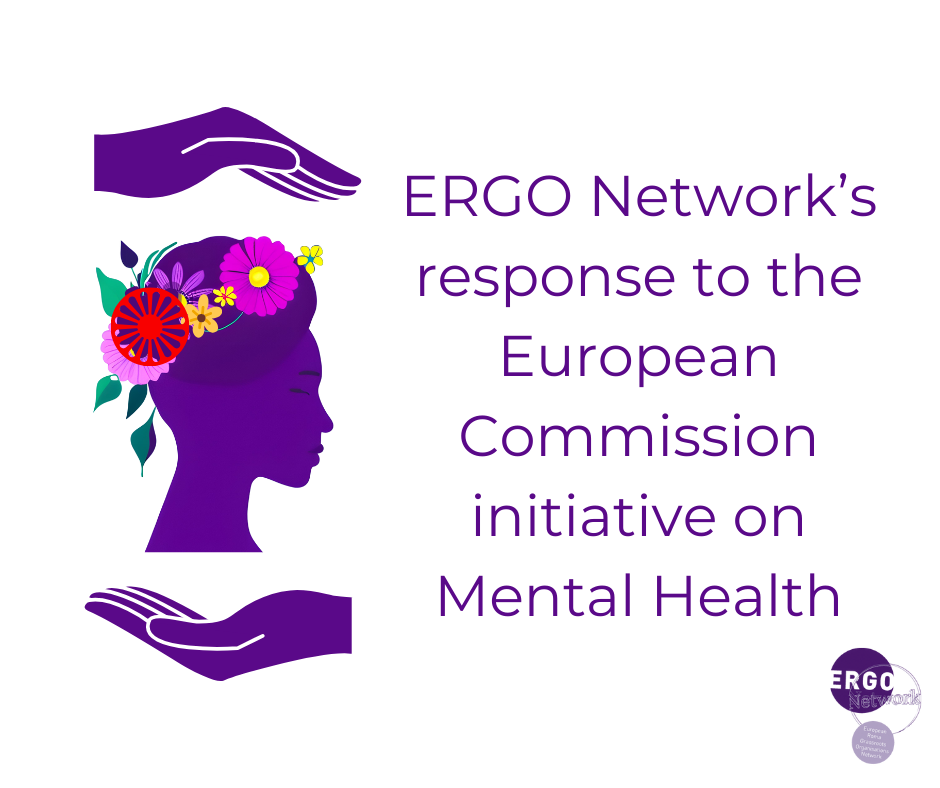
European Commission releases initiative on mental health: What’s in it for Europe’s Roma?

On 7 June 2023, the European Commission put forward a Communication laying out a comprehensive approach to mental health, aimed at helping Member States and stakeholders take swift action to deal with mental health challenges. The Communication features 20 European flagships and identifies financing opportunities worth EUR 1.23 billion.

ERGO Network’s research report Roma access to healthcare and long-term care (2022) includes a dedicated chapter on Roma mental health. Our findings show that the Roma experience a higher risk of being in poor mental health, however, most of them cannot access much-need care and support due to unavailability of services in communities, high costs of consultations, antigypsyism and stigma, and lack of trust in the healthcare system overall. See below for a summary of our analysis of the EC Communication from this perspective.

  • Read our full response to the Communication here!

We warmly welcome that the Roma are explicitly mentioned in the Communication, with statements closely aligned with our own findings. We also particularly appreciate the social determinants of health perspective, looking at poverty, discrimination, and poor access to quality housing, education, and employment. The text also features clear links with the EU Roma Strategic Framework for Equality, Inclusion and Participation, which is mentioned twice, as well as with the Council Recommendation on Roma Equality, Participation and Inclusion. We are equally happy to see that the Communication mentions ethnic minorities, underlining that inequalities based on ethnicity have an important impact both on mental health as well as on access to adequate care. Last but not least, discrimination is comprehensively mentioned throughout the document, including explicit references to the discrimination faced by the Roma.

However, antigypsyism as such is not mentioned, nor is there any reference to racism or the EU Anti-Racism Action Plan. While comprehensive efforts and funds are dedicated to combatting the stigma and discrimination associated with mental health, which is very welcome, no similar efforts are foreseen to combat discrimination on other grounds (such as ethnic or racial background), despite it being acknowledged as a determinant of poor mental health. The sections on the prevention of psycho-social risks at work and on reinforcing mental health systems and improving access to treatment and care fail to mention discrimination in the workplace, or when seeking support services. It is a missed opportunity to not have included requirements for anti-bias training for mental health professionals and for Member States to promote the hiring of minority mental health workers and mental health mediators.

An encouraging flagship initiative is aimed at improving data collection through the European Health Interview Survey (EHIS), where we hope that data will also be broken down by ethnic background, to have a complete picture of the state of Roma mental health and of their access to and take-up of corresponding support services. Part of the EUR 28 million that the European Commission pledges in order to provide psychological first aid to people fleeing the war in Ukraine and their children must be dedicated to combatting racism and antigypsyism, given overwhelming evidence from the ground that Roma families escaping the war have been severely discriminated in host countries, often being turned away, not believed, denied help, or persecuted because of their ethnicity.

Overall, we broadly welcome the European Commission’s comprehensive approach to mental health, as a very important first step in improving mental health in Europe. However, the Communication falls short of being a strategy with targets and monitored objectives, and many of the initiatives and funds are not new. Disappointingly, the main social and material determinants of mental health – poverty and discrimination – are correctly identified, but not sufficiently addressed. Lastly, stakeholders (including civil society) are only mentioned once in a general sentence, while nothing is said about giving ownership to the affected communities and individuals themselves, as they should be closely associated to the design, implementation, and monitoring of policies affecting their lives and wellbeing.

ERGO Network hopes that the gaps identified above will be remedied through implementation and through subsequent EU policy measures, and we stand ready to support these efforts at both EU and national level.

`

For more information about our work on Roma mental health, please contact Amana Ferro (a.ferro@staging.ergonetwork.org), Senior Policy Adviser in the ERGO Network staff

EC Spring Package 2023 – What’s in it for Europe’s Roma?

European Commission releases Spring Package 2023 – What’s in it for Europe’s Roma?

On 24 May 2023, the European Commission published the so-called Spring Package, comprising the 27 Country Reports, 27 Country-Specific Recommendations, and the accompanying Communication on the Spring Package, in the framework of the 2023 European Semester. ERGO

Network and its national members have reviewed the Package, to see to which extent it explicitly mentions Roma rights and inclusion, ethnic minorities, discrimination, and racism, as well as to assess whether national civil society was involved in the drafting of the Country Reports.

  • Access the full analysis here.

Key Findings

  1. The Communication on the Spring Package mentions the Roma once, in the context of improving their labour market participation – nothing on health, housing, education, poverty.
  2. 7 Country Reports include references to the Roma (BG, CZ, GR, HU, IE, RO, SK) in 2023, the same number as in 2022, but still insufficient as Roma live in 26 EU Member States.
  3. Only one Preamble to Country-Specific Recommendations (HU) mentions the Roma, a step down from 2022, when Hungary received an actual Recommendation on Roma inclusion.
  4. Ethnic minorities, discrimination, and racism are absent from all documents, with only discrimination mentioned in passing in the Country Reports for Belgium and Slovakia.
  5. Civil society organisations were poorly associated to the drafting of the Country Reports, and the Spring Package references to their role are few and vague (4 Country Reports, no CSR).

Overall, while our members welcome references to Roma communities in some countries, they lament that most of the Spring Package 2023 doesn’t explicitly mention them, whereas the Roma are present in all Member States except Malta, and experience rates of poverty and social exclusion of over 80% in all of them except the Czech Republic. This situation was exacerbated by the aftermath of the Covid-19 pandemic, the war in Ukraine, and the rising cost of living and energy price spikes. As the Package itself highlights these very challenges, it would have warranted more attention paid to one of Europe’s most left-behind communities.

The recurrent focus on supporting just transitions and mitigating the consequences for vulnerable groups is very positive, however it is our members’ experience that, unless the Roma are explicitly named as key target beneficiaries of support measures, mainstream initiatives and broad national and EU funds end up not reaching them. Europe’s Roma must be specifically prioritised in the EU’s Recovery Package and associated funds, if the EU is serious about delivering on its commitments for Roma equality, inclusion, and participation by 2030.

Our members equally express disappointment that issues of discrimination and antigypsyism are not present in the Package, while these phenomena have increased in recent years. The fact that the country analyses and recommendations do not seek to establish explicit synergies with the EU and national Roma Frameworks, and with the National Action Plans against Racism, is considered a tremendous missed opportunity.

Finally, they deplore the lack of recognition and support given to civil society organisations in the documents, given that most of them are not only on the frontlines, providing essential support to communities in need, but they equally possess the knowledge, expertise, and direct links to beneficiaries which are needed to inform the design of public policies and ensure both ownership and effectiveness of interventions.

For more information about ERGO Network’s work on the European Semester and associated frameworks (European Pillar of Social Rights, Sustainable Development Goals etc), please contact Senior Policy Adviser Amana Ferro.

EC on strengthening social dialogue – What’s in it for Europe’s Roma?

European Commission releases initiative on strengthening social dialogue – What’s in it for Europe’s Roma?

On 25 January 2023, the European Commission put forward an initiative on strengthening social dialogue, aimed at empowering social partners to deliver on their role to ensure social fairness and democracy at work, and to boost Europe’s prosperity and resilience. The initiative includes a Council Recommendation, which sets out how EU countries can further strengthen social dialogue and collective bargaining at national level, as well as a Communication on reinforcing and promoting social dialogue at EU level.

ERGO Network has engaged with the preparation of this initiative during 2022, with a view to raise awareness on the specific concerns of Roma workers. We contributed to the call for evidence issued by the European Commission in October last year, based on our Snapshot on social dialogue and involvement of workers. We have reviewed the proposed initiative in light of this input.

  • Read our full response to the initiative here!

We warmly welcome this initiative of the European Commission to ensure that social dialogue continues to fulfil its key role for just, resilient, inclusive, and democratic societies, particularly at a time when several Members States are attempting to shrink trade union powers. However, the approach does not seem to be inspired by a view to contribute to inclusive labour markets, through supporting diversity and giving a voice to the most disenfranchised, including vulnerable groups.

We are very disappointed to note that there is no reference to Europe’s Roma in either the proposed Council Recommendation or the Commission communication. Moreover, there is no mention of ethnic minorities or ethnic background, or migrant or refugee workers, or other key groups of workers facing discrimination in employment. In fact, there is no mention of racism or discrimination in the two documents.

We further appreciate that the initiative clearly points out the decline in trade union coverage over the past three decades, however these findings are disaggregated by gender, but not by any other indicator relating for example to race and ethnicity, age, disability, sexual orientation or gender identity etc. Equally disappointingly, the European Commission puts forward no proposals on how to improve trade union membership. This should have been a key objective of the initiative, as a means to strengthen legitimacy and credibility of social partners.

We salute that the initiative makes a strong plea for trade unions to take into account the emergence of new forms of employment including the self-employed, and to make efforts to include these workers in their structures. This can be very positive for Roma workers, often excluded from the traditional labour market due to widespread antigypsyism, and hence forced to engage in atypical forms of work to survive.

In the context of the evolving nature of labour markets, it is regrettable and inaccurate that both documents use “company” in an interchangeable way with “employer”, thus completely overlooking labour relations in the public and the third sector, where adequate social dialogue to protect workers’ rights is just as needed.

It is high time that the European Commission put forward a similar initiative, codifying, supporting and strengthening civil dialogue. Social fairness and democracy must be guaranteed for the whole of society, not just in the workplace.

Finally, we are pleased to see the European Commission’s commitment to promote social dialogue and collective bargaining in the context of the enlargement process, supporting candidate countries to strengthen their social dialogue processes.

For more information about our work on the Roma employment, please contact Amana Ferro (a.ferro@staging.ergonetwork.org), Senior Policy Adviser in the ERGO Network staff.

`
Publications – Page 3 – ERGO Network

By continuing to use the site, you agree to the use of cookies. more information

The cookie settings on this website are set to "allow cookies" to give you the best browsing experience possible. If you continue to use this website without changing your cookie settings or you click "Accept" below then you are consenting to this.

Close