Ineffectiveness or misuse of EU funds

Ineffectiveness or misuse of EU funds

In 2020, in the framework of ERGO Network’s Work Programme “Roma Included in Social Europe” funded by DG EMPL, ERGO members from Romania (Policy Centre for Roma and Minorities), Bulgaria (Integro Association), Hungary (Butterfly Development) and Slovakia (Roma Advocacy and Research Centre) conducted case studies to support monitoring of funds and to contribute to a better design of funding programmes.

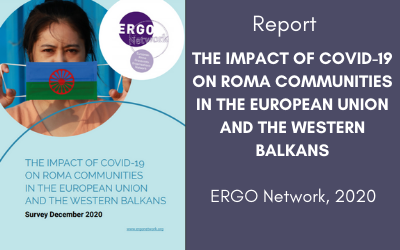
THE IMPACT OF COVID-19 ON ROMA COMMUNITIES IN THE EUROPEAN UNION AND THE WESTERN BALKANS

The Impact of Covid-19 on Roma Communities in the European Union and the Western Balkans

This survey was possible with the valuable contributions from ERGO members and partners from the European Union and Western Balkan countries and Turkey. We would like to thank in particular Roma Active Albania in Albania, Otharin in Bosnia and Herzegovina, expert Orhan Tahir in Belgium, Integro in Bulgaria, Slovo 21 and Life Together in Czechia,
Amrita OBK association in Hungary, Pavee Point in Ireland, Voice of Roma Ashkali and Egyptians in Kosovo*, RROMA in North Macedonia, Nevo Parudimos in Romania, Roma Forum in Serbia, Roma Advocacy and Research Centre in Slovakia and Zero Discrimination association in Turkey as well as Roma and Traveller communities in all the respective countries.

Download link

ERGO’s response to EC proposal for Joint Employment Report 2021

European Commission releases proposal for Joint Employment Report 2021 – What’s in it for Europe’s Roma?

On 18 November 2020, the European Commission published the draft Joint Employment Report, published this year separately from the Annual Sustainable Growth Strategy (ASGS), which was released in September (see ERGO Network’s reaction to it here).

This year’s disconnect between the ASGS and the draft Joint Employment Report means that the former was not underpinned by the latter, and that Europe’s priorities for a green, digital, sustainable and inclusive recovery were not guided by in the in-depth analysis of realities on the ground that the Report provides. The structure of the Joint Employment Report does not appear to have changed (as it was the case for the ASGS), as it continues to track Member State performance in the areas covered by the Employment Guidelines and by the Social Scoreboard of the European Pillar of Social Rights. The impact on the pandemic on the employment and social situation in Member States is equally included in detail throughout the Report, as well as the national measures aimed at mitigating it.

ERGO Network warmly welcomes the multiple explicit references to the European Roma in the draft Joint Employment Report, but laments that, once again, they are exclusively mentioned in relation to education (pages 61, 88, and 107). The Report highlights that “Roma inclusion in education is a challenge that could become more prominent as a result of the COVID-19 crisis”, that “Effective enforcement of legislative changes for Roma inclusion in mainstream education remains important”, and that “The NEET rate of Roma is much higher than that of the general population.” Travellers are also named once in the document, in the same section.

The focus on improving Roma access to quality and inclusive mainstream education is very welcome, particularly as it also refers to obstacles such as severe poverty and housing exclusion. ERGO Network shares the concerns related to the impact of the coronavirus pandemic, which has seen a large number of Roma children deprived of the possibility to access online education, which only contributes to widening the gap with the general population. The digital divide is equally mentioned, in what concerns lack of access to infrastructure (internet coverage, electricity), equipment (PC, tablets etc) and knowledge (digital skills).

While the importance of affirmative action is recognized as a useful approach for ensuring equal opportunities, the Report takes a strong stance against segregation, calling for active measures to prevent it, as well as additional financial and professional support. Measures include educational mediators, scholarships, after school activities, language courses, free public transport, access to early childhood education and care, setting up antisegregation working groups, combatting the placing of Roma children in special needs classes or schools. These are very positive steps, already recorded in a number of countries, very much in line with ERGO Network’s own position and recommendations on quality, inclusive, and desegregated education.

Despite the very positive content on combatting school segregation and improving Roma educational attainment and completion, all the above measures are one sided and refer exclusively to educational establishments, while no mention is made of wrap-around support for families, access to adequate income, support towards quality jobs, decent housing, other services. This is despite the Report’s own admission that “In all Member States, the poverty risk for children raised by a single parent or in families with more than 3 children or with a migrant or Roma background is two to three times higher than that of other children.”

Tackling structural problems like persistent poverty or rampant discrimination, does not seem to be a concern, nor is proposing an integrated approach to the multiple difficulties faced by Roma citizens in Europe. The EU Strategic Framework for Roma Equality, Inclusion, and Participation is not mentioned anywhere in the text, nor is its predecessor. The Report completely overlooks the fact that the Roma are overrepresented in unemployment and poverty rates and face significant obstacles in accessing adequate social protection and key services, such as affordable housing, or quality health- and long-term care, including childcare. The Report also contains no reference to the situation of ethnic minorities or combatting antigypsyism and racism.

Encouragingly, the Joint Employment Report contains a full paragraph supporting the participation and direct engagement of beneficiaries and their civil society organisations in the design and implementation of policies that concern them (page 122), which is also stipulated in Guideline 7 of the Employment Guidelines.

ERGO Network hopes that the new decade will bring closer alignment between the EU Roma Strategic Framework and the European Semester, in full synergy with delivery on the of the Sustainable Development Goals and the European Pillar of Social Rights, to ensure that Europe’s Roma are not left behind, particularly in the context of the Covid-19 pandemic and recovery.

Reinforced Youth Guarantee – will Roma youth be included?

The Council of the EU adopts a recommendation for more inclusive measures to boost youth employment by reinforcing the Youth Guarantee – Will Roma youth be included?!

On 30th of October, the Council of the European Union adopted by unanimity a Recommendation on ‘A Bridge to Jobs – Reinforcing the Youth Guarantee’.  The new scheme affirms the upcoming commitment of the EU Members States to set national schemes in order to help young people receive an offer of employment, education, traineeship or apprenticeship within a period of four months of becoming unemployed or leaving formal education. This initiative comes at an urgent time across the EU, during the COVID 19 pandemic, which brought high youth unemployment rates and increased the number of young people not in employment, education, or training (NEETs). Even before the crises Roma youth which as it shown in the last data issued by Fundamental Rights Agency 63% of Roma aged 16-24 were not employed, in education or training (55% of young Roma men and 72% of young Roma women

This is not a new initiative, it follows the EU Council Recommendation of 22 April 2013 on establishing a Youth Guarantee, which numerous studies and ERGO research showed that failed to reach its full potential nor to include the most disadvantaged groups, such as Roma youth.

What is new?

The new Recommendation is considering the concerns of youth organizations and tackles some of the gaps in its implementation, identified as well by ERGO Network. The Recommendation extends the age limit for targeted young people from 25 to up to 29 years old. The new Recommendation also clearly state that the Members States should create supportive measures at national, regional, and local level by providing clear guidelines such as:

  • mapping – identifying target groups, available services, skills needs and young people at risk of becoming a NEET
  • outreach – targeted information campaigns among young people and reaching out to NEETs
  • preparation – better profiling to match needs and responses, counselling, and guidance, and improving digital and other important skills
  • offer – employment incentives, quality and equity, and post-placement support

Now is the moment to make sure that the Member States include the voice of the most deprived in the implementation of the Youth Guarantee, and that they  take into account the situation of Roma youth. One of the main concerns when it comes to the Roma youth is the outreach offer and preparation in a time of pandemic, where many times the ones that need to be a priority are left out due to centuries of discrimination and low standards of education, which is the result of ongoing poverty cycles.

ERGO Network asks Member States to:

  • Invest in continued education (and training): enrolment in formal education or training programs leading to a recognized qualification, keeping in mind an individual approach.
  • Train employment officers and employers to fight antigypsyism: There is a need to train the employment offices as well as potential employers on historical and present antigypsyism, specially to counter the phenomenon during the recruitment process.
  • Improve cooperation between young Roma and labor offices: Governments should encourage a closer communication between labor offices and young Roma people and their civil society representatives, to increase the number of Roma youth engaged with activation programs
  • Hire Roma mediators as social workers/employees of the public employment services and local authorities with the main file and aim to assist Roma youngsters to access the initiatives under the Youth Guarantee, to ensure individual empowerment and ownership.
  • Take a holistic approach: Programs should be created to directly fight youth unemployment with an embraced holistic and multi-sectoral approach, in line with the Active Inclusion Recommendation. Efforts to support young people towards quality education and employment should be complemented by access to adequate income and services such as housing, transport etc
  • A more flexible and accessible registration process of public employment services, to ensure that no young person falls through the gaps and remains out of the social systems of their country – a situation young Roma often find themselves in
  • More partnerships with educational institutions and NGOs who can more easily reach out to Roma and other marginalized groups. This requires dedicated funding that will allow these partners to support the public employment services in the delivery of the Youth Guarantee, or to directly establish contacts with employers and support the skills development of young people.

It will now be up to the Member States to implement the Reinforced Youth Guarantee. We will continue the monitoring and advocating for young Roma people to have quality opportunities through this initiative, on equal footing with majority youth.

For additional information regarding our work on the Youth Guarantee and Youth Employment, please contact Policy Officer Carmen Tănasie in the ERGO Network staff (c.tanasie@staging.ergonetwork.org).

ERGO Network response to the Annual Sustainable Growth Strategy 2021

ERGO Network response to the Annual Sustainable Growth Strategy 2021

While there is no explicit mention of the European Roma in this year’s Annual Sustainable Growth Strategy, ERGO Network welcomes that “people with a minority racial or ethnic background” are indicated as having been disproportionately hit by the coronavirus crisis (page 9). We further salute commitments to “address long-standing challenges that affect the fairness
in society … and rising inequalities” (page 3), and to “support those who have been hit hardest by the crisis, such as … vulnerable groups” (page 4). Other proposed measures have the potential of being positive for Roma communities, hinging on the right implementation: reducing inequalities, addressing labour market segmentation, increasing the inclusiveness of the education systems (particularly for disadvantaged groups), ensuring equal access to affordable, accessible, quality healthcare, childcare, and long term care, tackling the digital divide, reducing energy poverty, and ensuring a just and socially fair transition across green policy areas.

Download the response here

`
Publications – Page 11 – ERGO Network

By continuing to use the site, you agree to the use of cookies. more information

The cookie settings on this website are set to "allow cookies" to give you the best browsing experience possible. If you continue to use this website without changing your cookie settings or you click "Accept" below then you are consenting to this.

Close