New school year for OTAHARIN

New school year for Otaharin

102 elementary school students in Bijeljina (Bosnia & Herzegovina) received school bags, materials and textbooks from  ERGO Network member Otaharin as an incentive to study well in this new school year.

One of the most important activities of the Association is emphasizing the enrollment of children in the first grade of school. This year, we enrolled 18 Roma children and organized a preparatory program for them during the summer months. Also, as every year, we support 12 high school students through purchasing of textbooks, school supplies and school bags.

Having a baby, needing to beg or to do housework are just some why young people drop out of school early. Our goal is to teach both children and parents that primary education is compulsory and that as many children as possible should return to school. The place for children should be the school, not the streets.

The provision of textbooks, school bags and school supplies was supported by our long-standing partners and donors CARE Deutschland e.V., Save the Children in the North West Balkans and Schüler Helfen Leben.

In September Otaharin also had the honour of hosting a delegation of the Parish of the Protestant Church from Grossberen (Germany).

For more than 15 years, representatives of this parish organise collections for the most vulnerable residents of Bijeljina and Živinice. This humanitarian aid is distributed to people in social need in cooperation with the Red Cross of the City of Bijeljina, the Centre for Social Work in Bijeljina and Otaharin.

The delegation of the Parish pays special attention to the first graders of Roma origin who, in addition to humanitarian packages, are also provided with special gifts for the beginning of the school. This year more than 250 children from the City of Živinice received humanitarian aid.

Our association and many socially disadvantaged families owe great gratitude to these humane people for their dedicated humanitarian work and dedication.

Humanity, as one of the qualities we can rarely feel and see, is shown year after year by our friends, representatives of the Parish of the Protestant Church of Grossberen. For 16 years, these good people have been collecting clothes, hygiene products, school supplies and toys for the socially disadvantaged people in the towns of Bijeljina and Živinice.

Join our team for 3 months!

Call for Solidarity Corps volunteer in ERGO Network

ERGO Network is looking for an enthusiastic and active young Roma who would like to join our office team in Brussels for 3 months in the framework of the European Solidarity Corps.

Download the call in pdf format here.

When: October to December 2019

Where: ERGO Network office in Brussels, Belgium

Who: Young Roma between 18 and 30 years old

Deadline for applications: 20 September 2019

During the 3 months in ERGO, you will learn about international advocacy, help us organise international meetings and events and get actively involved in Roma activism and international Roma networks in Brussels.

Your main tasks will be:

  • Communication and campaigning: contribute to ERGO’s daily communications work and our campaign on Roma youth employment
  • Advocacy and policy: Support ERGO staff in EU advocacy work on poverty reduction, social inclusion and antigypsyism; attend debates, hearings and meetings with other stakeholders to challenge stereotypes and racism, build partnership with Roma and non-Roma organizations from Belgium and other European countries.
  • Meetings and seminars: Assist in the organisation of meetings and events (Annual Members Meeting, ERGO Annual Conference)

Your profile:

  • Young Roma between 18 and 30 years living in an EU member state or in Macedonia or Turkey
  • Good English language skills, both oral and written
  • Computer literacy (experience with Microsoft office package and social media)
  • High motivation to learn more about Roma activism and advocacy work and to contribute to a small but very active European NGO
  • Previous involvement in Roma or (pro) Roma NGOs will be considered an advantage
  • Reliable, well organised and with attention to detail

You will work about 38 hours per week. Working hours will be from Monday to Friday between 9:00 – 17:00. However, working hours can be adapted to your needs and the activities you will be involved in.

We aim to support young people who are enthusiastic about our cause and want to gain experiences that can be later transferred to national or local NGOs. We especially welcome applications from people who are motivated to challenge stereotypes, antigypsyism and racism and who show an open attitude for a unique learning and life experience, as well as a volunteer spirit of creativity, initiative, responsibility and independence.

We offer:

  • An allowance of 1049 Euro that includes money for accommodation, meals, local transport, language course and pocket money
  • Additional health insurance through the European Solidarity corps
  • An exciting and unforgettable experience and learning opportunity, working for an international organisation in an international city!

How to apply:

Please send your motivation letter (1 page) and CV (max 2 pages) by 20 September to info@staging.ergonetwork.org.

Do not hesitate to contact us for more information.

Christine Sudbrock t: +32 2 89 31 045 | e: info@staging.ergonetwork.org

Save the Date

Before the summer break, we are announcing the dates for some important events in the second half of the year. Mark the dates in your calendar – more information will follow soon!

20-23 October: Annual Members Meeting in Skopje, North Macedonia

20 October: Meetings of the ERGO Network Board, Advisory Committee and Working Groups (Skopje, North Macedonia)

25-27 November: Coordination meeting of ‘Roma Included in Social Europe’ programme (Brussels)

25 November: ERGO Network conference on ‘Education: how to achieve policy change in hostile environments?’ (Brussels)

Towards a more holistic approach to Roma inclusion

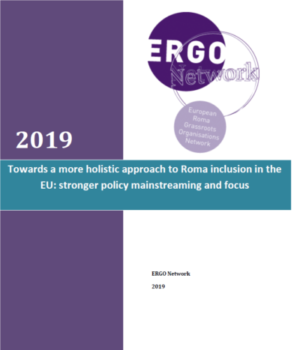
Towards a more holistic approach to Roma inclusion in the EU: stronger policy mainstreaming and focus

The long term perspective of the Roma inclusion process implies that, at this stage, expecting major socioeconomic impact of the Roma integration process is premature. Although the necessary policies, tools and structures linked with the inclusion of Roma were put in place in the Member States, the actual implementation is still at an initial phase without mainstreaming them in the EU general policy initiatives.

Existing assessments of implementation of the social inclusion policies and programmes at EU and national level revealed that the policies and programs did not reach marginalised groups, and did not manage to improve the situation of Roma. This is why ERGO Network, with contributions from its allies, published a policy paper that provides specific recommendations on possible ways of mainstreaming Roma inclusion in the next Multi-Annual Financial Framework and post 2020 EU Roma Framework, key recommendations for the mainstream policies, and finally, not only initiatives/actions that should be taken by the European Commission, but also those that should be taken by Member States.

Report: Falling through the cracks

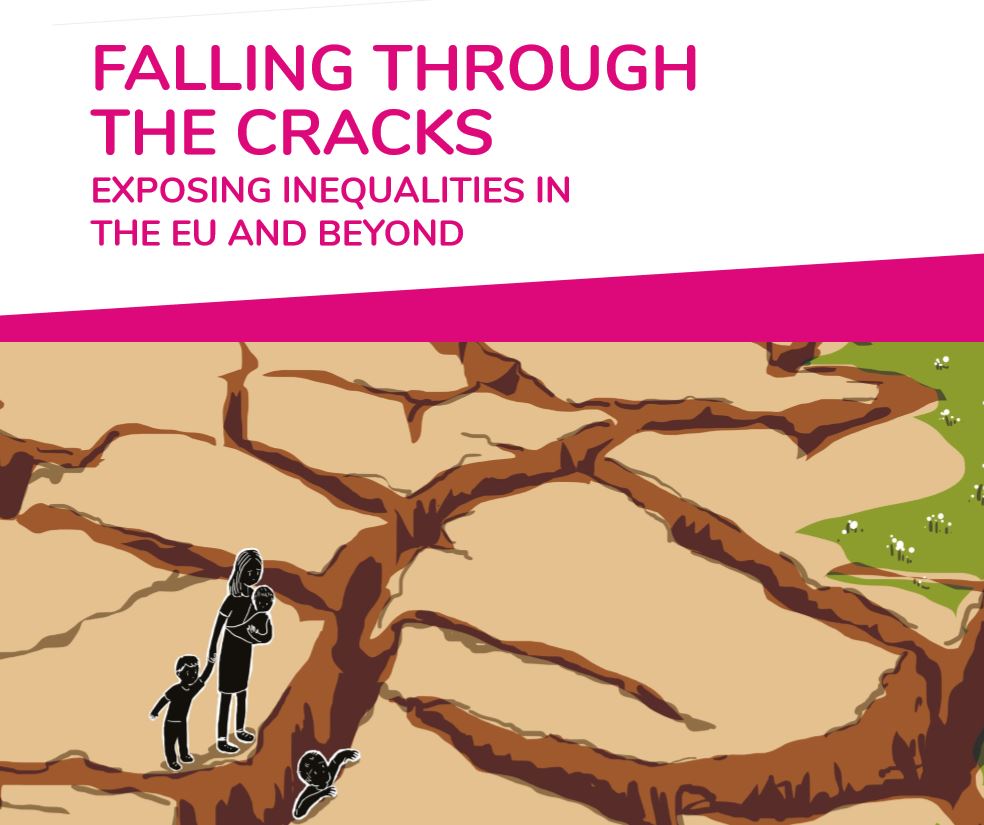
ERGO Network analyses SDG 10 for report ‘Falling through the cracks: exposing inequalities in the EU and beyond’

ERGO Network’s chapter “Reducing Inequalities between Roma and Non-Roma: EU, SDG 10 and Combating Exclusion of Roma”, is published as part of a bigger report “Falling through the Cracks – Exposing Inequalities in the EU and beyond”, published by SDG Watch Europe, Make Europe Sustainable for All and Faces of Inequality. Besides our chapter dedicated to Roma inclusion, issues such as environmental injustice towards Roma are addressed throguhout the whole report.

SDG 10 – ‘To reduce inequalities within and between countries’ – is highly relevant for Roma. The goal is being reviewed in 2019 in the UN-led process that monitors progress towards achieving the Sustainable Development Goals. SDG indicators could potentially be used in the future by the creators of new Roma related policies, as currently all analyses of Roma-related policies show that a lack of concrete and measurable indicators lead to the failure of national Roma-related policies. The SDG indicators .  The chapter written by ERGO Network looks at issues where there is a strong overlap between SDG Goal 10 and EU ‘Roma objectives’.

We as civil society have taken the opportunity to provide yet another analysis of inequality that affects Roma people across the European Union. We use this moment to present concrete policy recommendations to the EU and the UN agenda simultaneously. Our purpose is to provide information and proposals to address inequalities effectively.

Download the report here.

`
General – Page 32 – ERGO Network

By continuing to use the site, you agree to the use of cookies. more information

The cookie settings on this website are set to "allow cookies" to give you the best browsing experience possible. If you continue to use this website without changing your cookie settings or you click "Accept" below then you are consenting to this.

Close