

Exchange visit to Nevo Parudimos
From 5 to 9 June 2019 ERGO Network visited Nevo Parudimos in their town of Resita in Romania, along with members from all over Europe to learn about the invaluable work Nevo Parudimos is doing in their country for their local Roma communities. Among the fellow member organizations who attended were staff from Pavee Point in Ireland, FAGIC from Spain, and RomanoNet and Life Together from the Czech Republic.
Once there everyone visited Nevo’s office where Daniel Grebeldinger presented the different projects they are involved in.

This includes youth work, social work, rural development policy and many volunteering projects. Nevo Parudimos is currently hosting 18 international volunteers and works with many local volunteers who support local schools, kindergartens, elderly homes and more. Another focus of the organization is on building local partnerships that benefit Roma communities, the municipality as a whole and the organization.
The participants also had the opportunity to drive though Resita visiting local Roma communities and hearing more about their specific issues and the work that Nevo Parudimos is doing to support them. The day closed with discussing what the other ERGO members could learn from Nevo Parudimos, how they deal with similar challenges and how they could get involved in Nevo’s projects.
The next day the group visited Dognacea, a village in the surrounding mountains that are governed by probably the only Roma woman mayor in the country, Elena Moise. Everyone was greeted with open arms when entering her office, she was so welcoming and willing to answer any questions we had. Elena Moise was previously a local school teacher
 and for the last 12 years has taken the position of mayor. After our conversations with her, it is safe to say she is an amazing and inspiring woman and her work is has changed the lives of many people in her village. Especially for the children in the schools, she is a role model who tells them to be proud of themselves. She said that whenever she feels down she goes to visit the local school to speak with the children to cheer up. Her message to us was that it is important to take up roles such as hers in order to do good for our communities, not to be scared of anyone and to be proud of what we do.
On the last evening, we all participated in a networking dinner to meet with Neo Parudimos’ partners, to make contacts and build relations between people working for the same cause. We met with Nadia Potoceanu, the pre sident of Fundatia Activity for Sustainable Development, Lidia Rosianu, the head of the social department of the Municipality of Resita, Cristrian Chioncel, the Vice Dean of Eftimie Murgu University of Resita and Adrian Constantin, director of the Roma Radio Broadcast in Radio Resita.
Everyone left on the morning of the 9th to their respective countries. The exchange visit proved to be a success with our member organizations, and ERGO plans to organize similar visits to other members in the next years. This type of event is very important for our work to learn about the problems faced by Roma in different countries and to learn how local organizations are trying to find solutions to these problems.


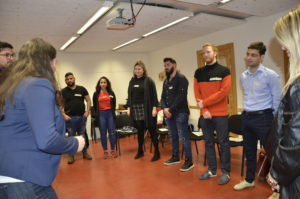 The Roma Week would not make any sense without the active involvement of Roma activists from across Europe. Therefore, together with the Central Council of German Sinti and Roma, the Documentation and Cultural Centre and ternYpe International Roma Youth Network, ERGO Network invited a group of youth activists to prepare for the week in the Roma Youth Advocacy Training. Moreover, ERGO Network coordinated the participation of the most important Roma civil society activists in Europe under the umbrella of the ‘Alliance against Antigypsyism’ together with the Central Council of German Sinti and Roma.
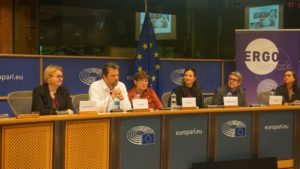 On Wednesday, ERGO Network together with Cornelia Ernst MEP brought the UN’s Sustainable Development Goals as a tool to support the fight against antigypsyism to the agenda. The panel discussion was held together with Global Call to Action against Poverty (GCAP), Sozialfabrik and Soraya Post MEP. The panellists discussed recommendations to civil society on how to use the 2030 Agenda, brought by ERGO Network in the new paper ‘
 Members of the European Parliament from different political groups signed a pledge affirming that they will continue to work to achieve non-racist EU elections, an effective Post-2020 EU Roma Framework and a continuation of the fight against antigypsyism in the new legislative period. The undersigned MEPs pledged to create a European society in which Roma can access and enjoy their rights set in our Treaties, in which Roma can fulfil their true potential, in which dehumanisation of Roma is stopped, a healthy European society free from racism, such as antigypsyism – a Europe that we can be proud of.
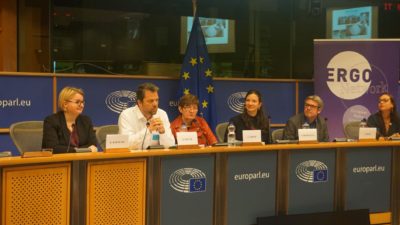
 Stefan Meyer of Fresno Consulting presented the
 Paul Divakar, Chairperson of the Asia Dalit Right Forum, brought the global perspective to the panel and pointed out that the SDGs must be designed in a way that they also serve those who are excluded in their societies, across the globe. “If we are not named in the indicators, if there are no data, what do we do? That´s why need to fight for our rights together.”