ERGO’s monitoring of the European Semester

ERGO Network continues its monitoring of the European Semester and meets the cabinet of Commissioner Nicolas Schmidt

The European Semester had a surprise early start this year, with the Annual Sustainable Growth Strategy (ASGS) released two months earlier than expected, in September 2020. This year’s document is driven by an overriding impetus to fight the immediate consequences of the Covid-19 pandemic and build a green and digital Europe, and is built around the Recovery and Resilience Facility, the central pillar of Next Generation EU, which is the European Union’s “emergency temporary recovery instrument to help repair the immediate economic and social damage brought about by the coronavirus pandemic, support an economic recovery and build a better future for the next generation. ERGO Network members are already engaging on the ground with the drafting of the National Plans that Governments need to submit to access these funds.

While there is no explicit mention of the European Roma in the Annual Sustainable Growth Strategy, ERGO Network welcomes that “people with a minority racial or ethnic background” are indicated as having been disproportionately hit by the coronavirus crisis. There is a lack of coordination and complete disconnect between Europe’s growth and recovery strategies and the EU Roma Strategic Framework for Equality, Inclusion, and Participation. While it is indicated that the National Resilience and Recovery Plans should be consistent with other national initiatives, such as the Energy and Climate Plans and the Partnership Agreements and Programmes, sadly nothing is said about coherence with the National Roma Integration Strategies. You can read ERGO Network’s full response to the ASGS here.

The situation is mirrored by the draft Joint Employment Report, which was released as usual at the end of November. This year’s disconnect between the ASGS and the draft Joint Employment Report means that the former was not underpinned by the latter, and that Europe’s priorities for a green, digital, sustainable and inclusive recovery were not guided by in the in-depth analysis of realities on the ground that the Report provides. While the Roma are mentioned a number of times throughout the document, it is exclusively in the context of access to education. While the focus on improving Roma access to quality and inclusive mainstream education is very welcome, particularly as it also refers to obstacles such as severe poverty and housing exclusion, tackling structural problems like persistent poverty or rampant discrimination does not seem to be a concern. The Report also contains no reference to the situation of ethnic minorities or combatting antigypsyism and racism. Read ERGO Network’s full response to the draft Joint Employment Report here.

Based on the extensive work carried out by the ERGO Network to include a Roma perspective on the European Semester and other social and economic inclusion strategies at EU level, we secured a meeting with the Cabinet of Nicolas Schmit, European Commissioner for Jobs and Social Rights. The exchange, attended from the Commission side by Policy Advisors Christoph Nerlich and Anouk Faber, focused on how to create positive synergies between the EU Roma Strategic Framework and the European Green Deal, the European Pillar of Social Rights, and the Multi-Annual Financial Framework 2021-2027. It also touched upon other social policy topics that ERGO Network is working on, and which fall under the purview of DG Employment, such as the the Youth Guarantee, Child Guarantee, the impact of the Covid-19 pandemic, as well as social economy and minimum income.

ERGO Network members Katalin Nagy (Butterfly Development, HU), Pedro Aguilera (Federation of Roma Associations in Catalonia, ES), and Adriatik Hasantari (Roma Active Albania, AL) spoke about how the upcoming Social Economy Action Plan and the reinforced Youth Guarantee can be very useful tools to contribute towards reducing the gap between Roma and majority populations, as well as about the importance of including the Western Balkans and Enlargement and Neighbourhood Countries in the learning and exchanges about Roma inclusion in Europe. Cabinet members Ms Faber and Mr Nerlich confirmed Commissioner Nicolas Schmit’s commitment to Roma rights and inclusion and exchanged with ERGO Network members and staff about the best ways to engage with the above-mentioned policy frameworks in order to ensure a strong Roma dimension in Europe’s social and economic development strategies, as well as drew the attention to the key role of EU Funds (including InvestEU and ReactEu) to support these processes. Find the full meeting of the report here.

ERGO Network will continue to push for bringing Roma rights and inclusion much more in focus in the processes of the European Semester and the disbursement of Recovery and Resilience funds, and for better alignment with the priorities of the Sustainable Development Goals and the European Pillar of Social Rights. Hopefully the new decade will bring closer alignment between the EU Roma Strategic Framework and these frameworks, to ensure that Europe’s Roma are not left behind, particularly in the context of the Covid-19 pandemic and recovery.

For more information about our work on the European Semester, please contact Senior Policy Adviser Amana Ferro in the ERGO Network Brussels Secretariat.

ERGO’s Annual Members Meeting 2020

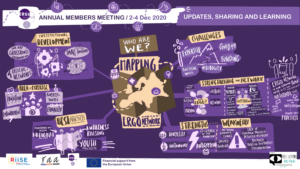
ERGO’s online Annual Members Meeting 2020

This year ERGO Network’s Annual Members Meeting took place under unique circumstances, forcing us to move online and to create as much exchange and networking on an online platform.

From 2-4 December 2020, ERGO Network met on Zoom with its members to analyze the work that has been done, reflect on this year’s special situation and how it impacted our work with Roma communities, and to deliberate about ERGO Network engagement in the upcoming years.

One afternoon was dedicated to building membership capacity, focusing this year on making the best use of online working environments and wellbeing of staff during the pandemic.

The meeting also provided the basis for a new 10-year strategic plan, while also introducing final steps for legally moving ERGO Network to Belgium.

The first day started with a welcome from Director Gabriela Hrabanova,  board co-chair Daniel Stanislav and vice-chair Adriatik Hasantari. The board praised the flexibility, collectiveness and connectedness of the members during such an uncertain and though year.

During this day, participants attended breakout rooms designed to provide with updates and project presentations. Each of the four rooms, moderated by staff and members of ERGO Network, tackled ERGO’s core working areas of 2020, such as  Roma in post-2020 European Frameworks, a Covid-19 study, our work on employment and the new projects “New Solutions to Old Problems” (NSOP) and “Peer education to counter antigypsyist hate speech online” (PECAO).

The second day invited participants to two working groups on employment and data collection. Amana Ferro and Carmen Tănasie from the ERGO Network Secretariat in Brussels provided participants with updates regarding the state of play of current and upcoming employment work, covering the main EU policy frameworks and the specific actions under the Youth Guarantee and ERGO Network’s Employment Campaign.

Isabela Mihalache, Senior Policy Officer, helped the participants to understand better the role of data collection in the delivery of our advocacy work.

The third day  started with sharing about the past and looking at the present in order to set the ground for planning our future. The statutes of a new legal organization was discussed and agreement was reached to move the organization officially to Belgium.

Members then had an open space to share where they see ERGO now and where they want to see it in the future, laying the ground for the start of a 10 year strategy.


Ineffectiveness or misuse of EU funds

Ineffectiveness or misuse of EU funds

In 2020, in the framework of ERGO Network’s Work Programme “Roma Included in Social Europe” funded by DG EMPL, ERGO members from Romania (Policy Centre for Roma and Minorities), Bulgaria (Integro Association), Hungary (Butterfly Development) and Slovakia (Roma Advocacy and Research Centre) conducted case studies to support monitoring of funds and to contribute to a better design of funding programmes.

Intercultural Achievement Award for Roma Active Albania

Intercultural Achievement Award for Roma Active Albania

ERGO Member Roma Active Albania won the recognition award in the Intercultural Achievement Award (IAA) 2020 organised by the Austrian Federal Ministry for European and International Affairs with  the project “EU Award on Roma Integration 2019 – Unknown Heroes”. The project was organised  in partnership with the European Commission, DG NEAR and supported by the European Union. Participation in different conferences and seminars, as well the work of the partners in the Western Balkans and Turkey have positioned Roma women as a key factor in scoring tangible results in the Roma integration agenda. The award have brought additional recognition to the wider area of women empowerment.

The project honors women who brought tangible impact for Roma integration and empowerment in the Western Balkans and Turkey and provided political leverage enriching the policy dialogue of Roma integration with the cross-cutting issue of women empowerment.

The project got recognition in a competition of 300 entries from 41 countries under the category “Recent events” and a certificate for the recognition was delivered to Roma Active Albania in the Austrian Embassy in Tirana.

Through this award steps such as by setting up and running non-profit organisations and community centres, combatting violence against women, fighting early marriages, facilitating women to access to their legal rights, etc. received the deserved recognition as a way of improving the integration of Roma minority by acting locally.

Meaningful participation is key

Securing meaningful participation: a key element of success for the EU anti-racism action plan

Open letter to EU Commission President von der Leyen, Vice-President Jourova and Commissioner Dalli

As organisations working to achieve racial equality and justice, we welcome the EU Action Plan Against Racism published by the European Commission on 18 September 2020. For the first time, the EU explicitly acknowledges the existence of structural, institutional and historical dimensions of racism in Europe and the need to address them through wide-ranging policies. There are a number of positive proposals in the action plan, in line with what ENAR has been calling for, but also gaps that need to be addressed.

Many plans against racism in the past have remained on paper. In order to avoid this and fulfil the potential of this action plan to improve the lives of people affected by racism, there must be strong processes in place to ensure that it is implemented, with clear and measurable targets, and that progress is monitored.

The processes related to this plan are as important as its content as they will allow for its legitimacy, ownership and most importantly, its efficiency in countering structural racism. There should be a strong focus on ensuring that racialised groups with key expertise from civil society organisations are consulted and engaged in a meaningful and timely manner on the implementation of the plan.

We welcome the fact that the plan foresees some mechanisms to secure resources particularly by strengthening participation of civil society organisations working with racialised groups, including:

1. The appointment of an EU anti-racism coordinator.
2. At least two meetings per year with civil society organisations active in the fight against racism at European, national and local levels.
3. Existing high-level groups on racism and non-discrimination playing an important role in implementation and cooperation.
4. The new internal Task Force on Equality ensuring racial equality mainstreaming and consultation.
5. Funding for civil society available under the Citizens, Equality, Rights and Values Programme and Horizon Europe.

We call on the European Commission to ensure that the action plan is a meaningful EU tool to address structural racism with adequate resources and expertise, by strengthening the following processes:

1. A structured and permanent participatory mechanism for civil society

There should be strong mechanisms in place to regularly involve EU and NGOs including racialised groups in policy discussions, design and implementation, to ensure policies meaningfully address issues of racialised groups according to their lived experiences and unique expertise. This is even more crucial considering the lack of racial diversity in institutions currently in Europe. We need a clear structure allowing civil society to be in a regular dialogue with the European Commission.

The European Commission should therefore set up a permanent European Commission advisory committee on anti-racism involving NGOs, Member States and social partners to support the implementation of policies, in particular the framework of National Action Plans against Racism.

In addition, the mandate of the two high-level groups on combating racism and on non-discrimination should be strengthened, by widening their scope to include structural and institutional racial discrimination. They should also be both opened to participation of civil society and supported by a regular steering group of European umbrella NGOs working on anti-racism and non-discrimination.

2. An operational and anti-racism expert profile for the EU coordinator against racism

The coordinator should play a key role in overseeing the implementation of the plan, and coordinating actions across different policy areas in the European Commission, closely liaising with civil society organisations.

To that end, this person should be appointed based on relevant skills and competences, have strong expertise on anti-racism issues and intersectionality, and be from a racialised group. This person should have a good knowledge of anti-racism movements in Europe to secure engagement and participation of a wide diversity of civil society experts. We also request that the recruitment process is fair, clear and transparent.

Moreover, the coordinator should be strongly supported by a dedicated team, in close collaboration with existing services of the European Commission.

3. Clear coordination of anti-racism work within the European Commission

We welcome the comprehensive anti-racism framework laid out in the Action Plan. However, it is important to clarify how the coordinator and different services will work together to coordinate and monitor its progress. To improve efficiency of the work and coordination among the different strands of work highlighted in the Action Plan, we call for:
• The Commission Directorate General for Justice’s services to be organised by re-grouping all teams working on different forms of racism and racial discrimination in one unit, with more resources allocated and a strengthened mandate of the Commissioner for Equality to oversee this work, under the direct supervision of President Ursula von der Leyen.
• The task force for equality to closely work with this unit, to include a specific working group on racial equality mainstreaming, to ensure transparency about its work and to involve civil society.

4. Dedicated funding

The EU anti-racism action plan should be implemented with dedicated and adequate human and financial resources, including via specific budget lines for the European Commission’s services. Funding should be secured for the implementation of EU and national action plans against racism, in addition to specific priorities under the Citizens, Equality, Rights and Values Programme and the European Structural Funds.

We would welcome the opportunity to meet with you to present these demands in more details and discuss together how to move forward.

Yours sincerely,

Karen Taylor, Chair of the European Network Against Racism

Co-signed by:

1. Adé Olaiya, UNESCO Inclusive Policy Lab Expert
2. Altera (Italy)
3. Anti-Racist Forum (Finland)
4. Apna Haq (UK)
5. Asociación Musulmana por los Derechos Humanos – AMDEH (Spain)
6. Bepax (Belgium)
7. Center for Intersectional Justice – CIJ
8. Center for Peace Studies (Croatia)
9. Central Council for German Sinti and Roma (Germany)
10. Collective against Islamophobia in Belgium – CCIB (Belgium)
11. Competence network against Islamophobia and anti-Muslim hatred (CLAIM, ZEOK e.V., aej e.V.) (Germany)
12. Conseil représentatif des associations noires de France – CRAN (France)
13. Czech Helsinki Committee (Czech Republic)
14. Dokumentations- und Beratungsstelle Islamfeindlichkeit & antimuslimischer Rassismus -Dokustelle (Austria)
15. Each One Teach One (Germany)
16. ENAR Denmark (Denmark)
17. Ethnic Debate Forum (Denmark)
18. Euro-Mediterraan Centrum Migratie & Ontwikkeling – EMCEMO (The Netherlands)
19. European Forum of Muslim Women – EFOMW
20. European Muslim Youth and Student Organisations – FEMYSO
21. European Network of Religion and Belief – ENORB
22. European Network of Women of African Descent – ENWAD
23. Farid Hafez from Salzburg University (Austria)
24. European Roma Grassroots Organisations Network – ERGO
25. Fair Play (Denmark)
26. Friends of the Earth Europe
27. FTI Consulting (Belgium)
28. ICA Spain (Spain)
29. Inequalities Research Network, University of Leeds (UK)
30. Integratiepact vzw (Belgium)
31. Irish Network against Racism – INAR (Ireland)
32. Karamah EU
33. Minderhedenforum (Belgium)
34. Mouvement contre le racisme, l’antisémitisme et la xénophobie – MRAX (Belgium)
35. New Horizons Project
36. New Women Connectors (Belgium)
37. Open Society European Policy Institute – OSEPI
38. ORBIT vzw (Belgium)
39. Quartiers du monde (Belgium)
40. Roma Active Albania (Albania)
41. Stichting Ocan (The Netherlands)
42. Siempre (Belgium)
43. SOS Malta (Malta)
44. Waterford Integration services (Ireland)
45. Zivilcourage und Anti-Rassismus Arbeit – ZARA (Austria)

- Download the open letter

`
General – Page 27 – ERGO Network

By continuing to use the site, you agree to the use of cookies. more information

The cookie settings on this website are set to "allow cookies" to give you the best browsing experience possible. If you continue to use this website without changing your cookie settings or you click "Accept" below then you are consenting to this.

Close