For more information about ERGO Network’s work on anti racism contact Isabela Mihalache , Senior Policy Adviser in the ERGO Network Brussels team.
Global Forum on Communities Discriminated on Work and Descent (GFoD) is the global advocacy mechanism of Communities Discriminated on Work and Descent (CDWD). More than 260 million people across the world are discriminated on the basis of work and descent and are more commonly known as Dalits, Roma-Sinti, Quilombola, Burakumin, Oru, amongst many other names. Discrimination on Work and Decent (DWD) is a global phenomenon which lacks public recognition and acknowledgement and affected communities are among the most marginalised and excluded people. ERGO Network is a member organization of the GFoD ensuring the voice of Romani people from Europe.
GFoD is looking for 12 RE-CDWD to support global advocacy processes at the national, regional and global level. Two of those candidates will be working in close cooperation with the ERGO Network and will be recruited on the basis of requirements and qualifications listed below ensuring the knowledge about the Romani communities and related legal and policy backgrounds in European countries.
The positions are approximately 15 % Full Time Equivalent (FTE) or up to 20 hours per month.
Requirements and qualifications
In order of preference, characteristics and qualifications are listed below. Please note that given our preference for candidates, it is not an imperative that the person is fluent in English.
Recruitment and timeline
Please submit your applications to info@staging.ergonetwork.org until the 07.05.2021 midnight CET with a subject line “GFoD Rights Expert – application”. Please submit your CV together with a one page over letter referencing relevant experience mentioned under Requirements and Qualifications. Interviews will start in the mid of May. We prefer applications in English.
Successful candidates will be appointed for a 12-month period with an initial 3 moth trial period.
Due to the high volume expected applications only shortlisted candidates will be contacted.
Raising awareness about antigypsyism among mainstream organisations
In ERGO Network we believe that positive change for Roma is possible when antigypsyism is recognized and tackled as the root cause for inequality, and when Roma can take part in civic life as equal stakeholders.
In the past couple of weeks, ERGO was invited to speak in workshops and events addressing antigypsyism among mainstream organisations and stakeholders.
For example, our Director Gabriela Hrabranova and our policy and project coordinator Mustafa Jakupov, together with Roma historian Michal Mižigár from the Czech Republic kicked-off a series of online workshops called “Addressing racism in the EU region” dedicated for staff learning and development of the British Council. The first session called “The social and historical context of the Roma minority in Europe and understanding antigypsyism” managed to attract 124 participants and received a lot of positive feedback and comments. One of the participants of the workshop shared:
“I actually pulled my headphones out and turned up the volume so my boyfriend could listen in as well in the background. It’s worth saying that he is not always completely ‘of the British Council school’ of respecting diversity and inclusion, particularly when it comes to Roma people. His father was a police officer in a small Romanian town for many years, and he grew up surrounded by a lot of prejudices about Roma people. We have had A LOT of arguments on this topic. Anyway, I can honestly say that he found it absolutely fascinating – he genuinely said it opened his eyes to perspectives he had never considered before. So thank you again. I’m very much looking forward to the second session.”
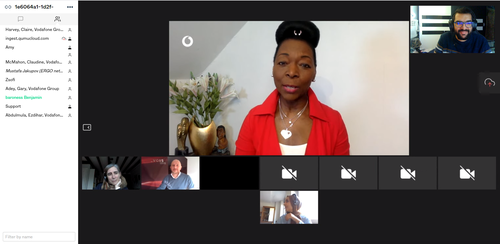
Our policy and project coordinator Mustafa Jakupov took also part in a session organized by Vodafone for the International Day of Elimination of Racial Discrimination, as part of Vodafone’s global webinars on the important topic of inclusion, allyship and anti-racism. He was joined by the Baroness Floella Benjamin, who shared her life struggles and successes and Ezdihar Abdulmula, who spoke about Islamophobia. Mustafa shared about antigypsyism and why sometimes we feel uncomfortable to recognize or address it, as it challenges our privileged position and makes us admit to ourselves that we believe in the myth of the society run by merits, not privilege.
When it comes to standing up to racism, we must take the words of Baroness Benjamin that one way to oppose racism is to keep our 4 C’s close to heart and mind: consideration, contentment, confidence and courage!
Roma are the embodiment of the 4 C’s in Europe for over 700 years! And nowadays, we are the ones reminding Europe about its own values, which in the eyes of a pandemic are easily getting forgotten!
Draft Recovery and Resilience Plan of the Republic of Bulgaria
Integro Association held a special seminar to discuss the draft Recovery and Resilience Plan (RRP) with a wide range of representatives of Roma communities, Community Action Groups, municipal officials and local authorities who participate in the ROMACT Program of the European Commission and the Council of Europe.
The seminar made the following recommendations for the draft RRP of
Bulgaria:
The full text of the position can be found here.
News from Czech ERGO member Slovo 21
Invisible Power Coalition
Migrant and Roma women in the Czech Republic and other parts of Europe
face economic and social inequalities and live in a position particularly vulnerable to violence and discrimination. Compared to most women in the Czech society, these women are often at higher risk of social exclusion, live under worse material conditions, and have a lower quality of life. The problems of these women are often overlooked, which is why the Invisible Power coalition, with the support of the German EVZ Foundation, was founded—to give these women space to be seen and heard. The coalition represents a collaborative effort of the Czech Women’s Lobby (CWL) and its member organizations Association for Integration and Migration (SIMI) and SLOVO 21, under which the Roma women’s group Manushe operates.
The Invisible Power focused on two levels of support for Roma and migrant women. The first was to involve these women in a network of women’s rights organizations and to strengthen mutual solidarity also between women from disadvantaged groups. Secondly, we wanted to raise public awareness of the situation these groups of women find themselves in. Another equally important goal was to strengthen the self-esteem of these women through self-expression, especially by means of storytelling during events organized for the general public, writing articles about their stories, and participating in public debates.
The project provided women without self-esteem with space for self-expression and made it possible for Roma and migrant women to be seen and heard at 4 public events, 5 thematic meetings, 3 networking meetings, and 1 conference, alongside other media outputs and networking meetings. A total of 34 migrant women and 148 Roma women took part in these activities.
The article is available here.
ROMA ORGANIZATIONS LAUNCH CAMPAIGN FOR CENSUS: ME SOM ROM, ME SOM ROMŇI, AMEN SAM ROMA! A SO TU?

The umbrella organization RomanoNet, in cooperation with other organizations (including Slovo 21, z.s.), has prepared an online campaign to reach out to Roma to declare their Roma nationality at this year’s Census of Population, Housing and Dwellings or to use Romani as their mother tongue.
The campaign responds to the low awareness of Roma men and women in connection with the Census 2021 and also refutes the myths that are spreading among the Roma themselves about the census.
The campaign is based on videos in which Romani men and women explain why, in their opinion, it is essential to state Romani nationality in the census form and Romani as their mother tongue. The videos are then placed on the website www.amensamroma.cz and are shared on social networks. Due to the COVID-19 pandemic, the campaign takes place exclusively in the online space.
(Article in Czech is available here )
NEW PROJECT ANDROMEDIA – IN MEDIA
The Romani culture and arts are a part of the national, European and world cultural and artistic space, and it keeps growing and developing constantly. There is a new generation of young educated artists and performers active in the area of music, dance, new media, arts, alternative arts, theatre and literature. Unfortunately, there is a substantial lack of interest and knowledge of critics who would be able to approach critically to Romani culture and arts.
The AndroMedia (in English “In Media”) project contributes to dealing with this problem and supports to development of artistic critical reviewing through interdisciplinary activities including several workshops, seminars, discussions with audience and experts, in both direct and online communication.
Project activities will help develop participants’ capacities in culture as they improve competencies of future critics – students of journalism and ethnomusicology, and Romani writers. The project also implements Audience Development Strategies and launches the Online Discussion Forum which will contribute to social dialogue.
Project is supported by EHP Fonds 2014 – 2021, Culture program. Project duration: 1.12.2020 – 30.4.2022.
STRENGTHENING THE CAPACITIES OF ROMA AND PRO-ROMA ADVOCACY ACTORS
Everyone should have the knowledge to influence and improve their lives in society. Only a society in which everyone has a voice, including minorities, can be considered democratic.
Based on the experience gained so far, we are coming up with a new project “Strengthening the capacities of Roma and pro-Roma actors in the field of advocacy”, which will focus on strengthening the competencies of employees of the organization Slovo 21, z.s. in the field of advocacy, so that the Roma are able to participate well in the integration process in 4 selected cities (Náchod, Budišov nad Budišovkou, Rokycany, Prague).
The employee expects 8 half-day theoretical trainings and 16 half-day practical workshops (2 trainings and 4 workshops in each locality) in the field of advocacy activities. The participants will then be permanently supported by experts in the form of tailor-made consultations.
We will establish cooperation with members of the local Roma community, who in cooperation with us will participate in solving the integration of Roma into the local level and other local Roma and pro-Roma non-profit organizations.