Open Call for Anti-Bias Training

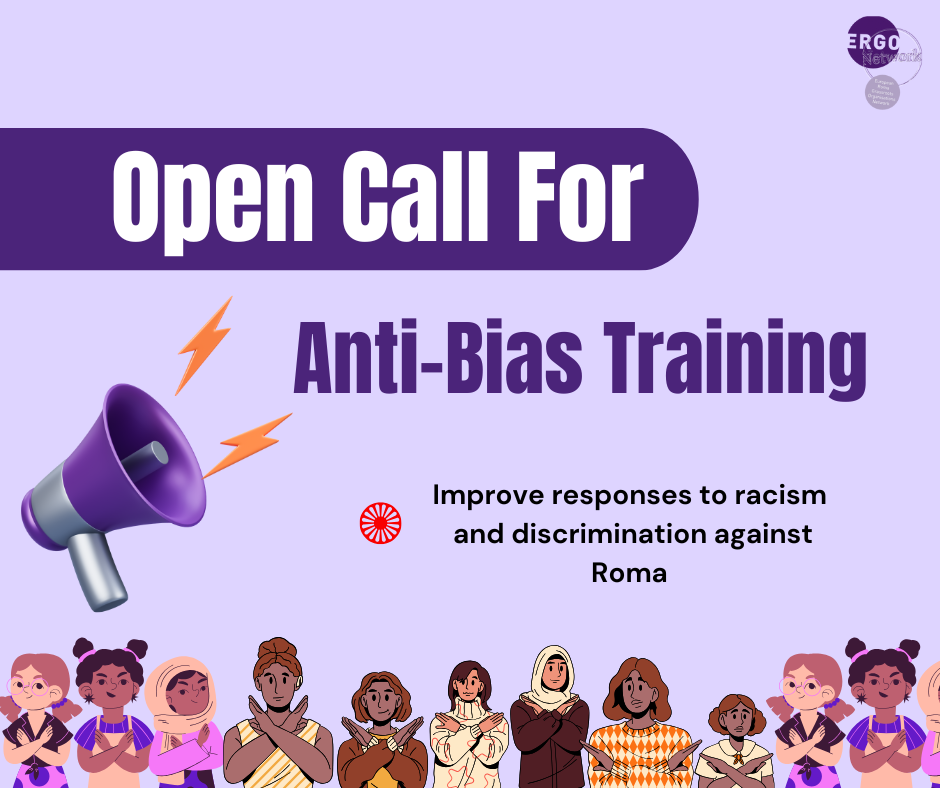
Open Call for Anti-Bias Training

ERGO Network is contracting 2 (pro-)Roma civil society organisations to implement and test ‘Anti-bias trainings’ using the ERGO Network training manual to fight antigypsyism for public servants or civil society representatives working with Roma.

Additionally, the contracted organisations will receive coaching from ERGO Network to conduct the trainings, if required. 

The curriculum provides a step-by-step description of how to conduct training for public servants or civil society representatives on promoting equality and non-discrimination and fighting antigypsyism.  

Objectives 

The training manual focuses on developing knowledge, attitudes and skills to improve responses to racism and discrimination against Roma and promote equality and non-discrimination in a one-day training. 

After attending the programme, participants will:  

  • Recognise and understand the dynamics of antigypsyism and the impact it has on Roma or related groups. 
  • Understand and be able to apply relevant legislation if needed. 
  • Develop and apply knowledge, skills and attitudes to respond to antigypsyism and discrimination and promote positive narratives and inclusive policies.  
  • Support the exchange of experiences and good practices addressing issues of discrimination of Roma. 
  • Drive policy change by recognising antigypsyism as a primary cause of inequalities for Roma.

Target audience 

The manual targets primarily public servants and civil society representatives working with Roma. However, it can be adapted and used to benefit other categories of professionals and audiences.

Methodological principles 

  • The training is interactive and uses a combination of individual and group methods. 
  • The training is motivational. It is aimed not only at building skills and knowledge but also at demonstrating the adverse impact of antigypsyism and discrimination. 
  • The programme follows a human rights-based approach based on respect for fundamental human rights and equality before the law. 

Fee 

We will contract two organisations, each for a fee of 2,820€.  The organisations will have to cover any meeting costs (catering, room rent, and eventually travel) with this fee.  

Contractual obligations 

The contracted organisations will have to deliver at least one full-day in-person training with at least 10 participants and provide ERGO Network with a report, including the agenda, invitation to the training, report of the delivered training and photos, and the signed participants’ list.  

The ‘Anti-bias training’ fee can be used for one or several trainings. The more participants you are able to reach, the better.  

The deadline for delivering this report is 30th October 2025.

Application 

Please specify in your application your target group, the number of people you plan to invite, whether you have already established contacts with the target group, and how many trainings you plan to deliver (if more than one).  

If you are interested in organising such a training, please send us your application by  22 February 2025 to info@staging.ergonetwork.org.  The ERGO Network secretariat will then select two organisations based on the quality of the proposals.  

 Funded by the European Union.

Human Rights Day – A call for transitional & reparative justice for Roma

Human Rights Day – A call for transitional & reparative justice for Roma

Written by: Stelina Dungaj, ERGO Network 

Human Rights Day, celebrated annually on December 10th, serves a reminder of our shared commitment to upholding freedom, security, peace and justice, rights which are, unfortunately, unattainable for many, including the Roma community – the largest minority group in Europe. Roma communities have long endured discrimination, marginalisation, and exclusion.

For centuries, they have fought against systemic racism and forced assimilation, with the scars of historical injustices still visible today. This day serves as an opportunity to reflect on the struggles of the Roma and the importance of addressing both past wrongs and ongoing inequalities.

The historical injustices faced by Roma, including forced sterilisation, the Roma Genocide, and the systemic discrimination they faced during the Holocaust, continue to have a profound impact on their lives. This legacy of oppression has left deep wounds that are perpetuated by modern-day antigypsyism—a pervasive form of racism that still shapes the experiences of Roma across Europe. 

Today, Roma NGOs and advocates call for transitional justice—a process that acknowledges past wrongs and helps to heal the trauma caused by centuries of systemic racism, in an effort to seek reparations, recognition of historical injustices, and the dismantling of the structural barriers that continue to hinder their social and economic inclusion.

The need for transitional justice is not only about rectifying the past; it is about addressing present-day discrimination that continues to affect Roma communities. Many Roma continue to face obstacles in accessing education, healthcare, housing, and employment, and are disproportionately affected by poverty and social exclusion. These ongoing injustices are deeply linked to the systemic racism that traces back to centuries of antigypsyism, which remain entrenched in various societal structures.

To effectively address the multifaceted issues faced by Roma communities, particularly the specific forms of racism they endure, a comprehensive and proactive approach is required. One critical step to address historical injustices is through education. This includes the integration of Roma history, culture and language into school curricula at all levels of education.

This would help foster empathy, understanding and respect for the Roma people, thus breaking the cycle of discrimination that perpetuates exclusion. Educating the broader population about the historical and contemporary struggles of the Roma is a crucial step toward building a more inclusive society.  

Additionally, empowering Roma individuals to take leadership roles in various sectors is essential for ensuring that their voices heard, and concerns are addressed. By ensuring Roma representation in all leadership positions, in government, education or inter-governmental organisations, it would bring invaluable perspectives of the lived experiences of the communities, necessary to create more informed and culturally sensitive policies. Furthermore, such representation serves as a powerful symbol of equality and empowerment, showing that Roma can thrive in leadership roles and that their contributions are vital to the growth and success of society.  

However, Roma inclusion requires more than just representation; it requires the active dismantling of the structures of racism and exclusion that have persisted for centuries. Antigypsyism is a complex and deeply entrenched form of racism that operates both institutionally and socially, creating barriers to Roma’s full participation in society. This form of racism does not only manifest in individual prejudices but is also embedded in societal systems, from the police force to education and employment.

Combating antigypsyism requires a comprehensive and proactive approach that addresses both the historical and contemporary dimensions of this issue. Transitional justice for Roma must involve more than symbolic recognition; it requires concrete measures to address the ongoing impacts of historical trauma. This includes not only educational reforms and leadership opportunities but also reparative justice initiatives that directly address the social and economic inequalities Roma face.

Roma communities need support in overcoming the barriers to full participation in society—barriers that stem from the discrimination and violence of the past but are sustained by the pervasive stereotypes and systemic racism that continue today. 

For this reason, on December 10th, 2024, ERGO Network has officially launched the European Working Group on Antigypsyism and Transitional Justice for Roma. This event has brought together policymakers, experts, and Roma leaders from across Europe to discuss critical issues facing Roma communities and to advance the cause of transitional justice.

The aim of the Working Group is to provide a platform for political advocacy and strategic development, focusing on creating frameworks for transitional justice mechanisms at both national and EU levels. Through this collective action, the Working Group seeks to transform the way Roma communities are treated, advocating for a future where their rights, dignity, and history are fully recognised and respected. 

The importance of this initiative was underscored by the Council of Europe Commissioner for Human Rights, Michael O’Flaherty, who expressed strong support for the Working Group during his speech on Human Rights Day. He highlighted the persistent and widespread human rights abuses faced by Roma communities and emphasised the need to confront the past while addressing ongoing injustices.

Stressing that antigypsyism remains pervasive today, O’Flaherty called attention to the collective responsibility of non-Roma communities in perpetuating prejudices and urged for localised, country-specific approaches to transitional justice. He commended the Working Group’s mission and focus on justice and redress, calling for sustained efforts to uphold the dignity and rights of Roma people. 

Thus, for the Roma community, this day it is not only a moment to reflect on the past but also a call for action – a moment to acknowledge the enduring impact of historical injustices and the pervasive influence of antigypsyism. The fight for Roma justice is a fight for human rights and equality.

It is a call to break the cycles of exclusion, discrimination, and violence that have persisted for centuries. The struggle for Roma inclusion must be an integral part of the broader fight for human rights everywhere. Addressing the challenges faced by Roma communities requires a multifaceted approach that combines historical recognition, inclusive education, systemic reform, and empowerment.

Only by working together—governments, civil society, international organisations, and Roma themselves—can we create a world where no one is left behind, and human rights are truly universal. Today, let us commit to ensuring that the fight for justice and equality for Roma becomes a central part of the broader movement for human rights and social justice around the world. 


Click here to see the video message from Michael O’ Flaherty, Commissioner for Human Rights of the Council of Europe for the Launch of the European Working Group on Antigypsyism and Transitional Justice for Roma

Register now for the upcoming Conference on Ukrainian Roma Refugees

Register now for the upcoming Conference on Ukrainian Roma Refugees

Venue: Hotel Chambord, 82 Rue de Namur, 1000 Brussels, Belgium & Online

Date: Wednesday, November 13 2024 

The ERGO Network, with the support of the European Philanthropic Initiative for Migration (EPIM), is organising a conference focused on advocacy and coordination for Ukrainian Roma refugees. As the situation continues to evolve, we must come together and discuss practical ways to address the needs of this vulnerable community. 

This event will serve as a platform to address the issues of Ukrainian Roma refugees and discuss strategies for effective advocacy and coordination efforts to support them during this challenging time. 

The ERGO Network, alongside its members, is committed to creating an inclusive environment where the voices of Ukrainian Roma refugees can be heard and their specific needs addressed. The conference will bring representatives from various sectors, including EU institutions, civil society organisations, government agencies, and international organisations. The goal is to foster collaboration and develop comprehensive plans for supporting Ukrainian Roma refugees. 

Attendees will engage in discussions aimed at identifying best practices for advocacy and resource mobilisation, ensuring that the unique challenges faced by Ukrainian Roma are adequately recognised and addressed in policy frameworks. 

In addition to organising the conference, the ERGO Network is actively supporting Ukrainian Roma refugees through various initiatives, particularly in countries such as Poland, Czechia, Hungary, and Moldova. This includes providing humanitarian assistance, facilitating access to social services, and promoting awareness of their rights. By collaborating with local organisations, community leaders, international organisations, and institutions, the ERGO Network is working to ensure that Ukrainian Roma refugees receive the necessary support for their integration and well-being. 

The conference will serve as a pivotal moment to amplify these efforts and strengthen the network of advocates committed to empowering Roma communities in the face of adversity. 

Agenda

Wednesday, November 13

9:00 – 9:30: Opening Remarks and Introduction to the event

  • Gabriela Hrabaňová, Director, ERGO Network
  • Sheena  Elaine Keller, Senior Sector Officer- EEA grants
  • Martin Mühleck, Directorate-General for Neighbourhood and Enlargement Negotiations (DG NEAR)
  • Csilla Volgyi, Policy Officer at the Directorate-General for Migration and Home Affairs, European Commission

9:30 – 10:15: Panel Discussion – Challenges Faced by Ukrainian Roma Refugees in Moldova

Moderator: Dejan Markovic, ERGO Network

  • Elena Sirbu – Roma Women’s Platform Moldova
  • Natalia Kropivka – UNHCR Moldova

10:15 – 11:00: Panel Discussion – Challenges Faced by Ukrainian Roma Refugees in Poland

Moderator: Dejan Markovic, ERGO Network

  • Elżbieta Mirga-Wójtowicz – Fundacija Jaw Dikh Poland
  • Mateusz Płoskonka – Municipality of Krakow, Department of Social Policy and Health

11:00 – 11:30: Coffee Break

11:30 – 12:15: Panel Discussion – Challenges Faced by Ukrainian Roma Refugees in Hungary

Moderator: Stephan Mueller, Central Council of the German Sinti and Roma

  • Fanni Székely-Trendl – Romaversitas Foundation
  • Eszter Benkő – Hungarian Helsinki Committee

12:15 – 13:00: Panel Discussion – Challenges Faced by Ukrainian Roma in the Ukraine

Moderator: Gabriela Hrabanová , ERGO Network

  • Igor Lossovsky – State Service of Ukraine for Ethnopolitics and Freedom of Conscience
  • Yulian Kondur – International Charitable Organisation Roma Women Fund Chiricli
  • Natalia Tomenko – YNGO ARCA

13:00 – 14:00: Networking Lunch

14:00 – 14:45: Panel Discussion – Challenges Faced by Ukrainian Roma Refugees in the Czech Republic

Moderator:  Gabriela Hrabanová, ERGO Network

  • Lidija Grebo – Slovo 21
  • Jan Husak – Romodrom o.p.s.

14:45 – 15:30: Panel Discussion – Challenges Faced by Ukrainian Roma Refugees in the West Europe

Moderator: Isabela Mihalache, ERGO Network

  • Stephan Mueller- Zentralrat Deutscher Sinti und Roma
  • Guillermo Ruiz – Melde- und Informationsstelle Antiziganismus (MIA), Germany

15:30 – 16:15: Panel Discussion – Sharing Best Practices from of the International organisations in support of Roma refugees 

Moderator: Dejan Markovic, ERGO Network

  • Valeria Morica – World Bank
  • Gyorgy Sumeghy – Habitat for Humanity International
  • Ulrike Pusch – Solidaritätsdienst International e.V.

16:15 – 16:45: Coffee Break

16:45 – 17:30: Closing Session: Recommendations and Future Steps

For more information about the event, please contact our coordinator for Ukraine, Dejan Markovic d.markovic@staging.ergonetwork.org.

This conference is supported by the European Philanthropic Initiative for Migration, EPIM.

Call for Branding Agency Proposals for ERGO Network

Call for Branding Agency Proposals for ERGO Network

Introduction
ERGO Network (European Roma Grassroots Organisations) is a European advocacy network that champions the rights of Roma communities across Europe. With members and partners in over 20 countries, ERGO Network works to combat antigypsyism, promote social inclusion, and ensure the active participation of Roma people in European society. To further strengthen our mission and elevate our voice, we seek a creative branding agency to help us redefine and enhance our brand identity.

Objective
ERGO Network is looking to develop a strong and cohesive brand identity that reflects our inclusivity, empowerment, and advocacy values for Roma communities. The chosen agency will work closely with us to design a fresh visual identity that will resonate with our stakeholders, partners, and the communities we serve.

Scope of Work
The selected agency will be responsible for the following deliverables:

  • Logo Design: A new or refined logo that reflects our mission and values. Multiple formats should be provided for use across various platforms.
  • Visual Identity: Design a comprehensive visual identity system, including a colour palette, typography, and design elements.
  • Brand Templates: Create templates for presentations, letters, reports, social media posts, and official documents to ensure a consistent brand image.
  • Brand Guidelines: Develop a detailed brand manual outlining the correct logo usage, colours, typography, and other visual elements.
  • Optional: Discuss website design enhancements in line with the new branding

Target Audience
ERGO Network’s primary audience includes policymakers, Roma grassroots organisations, international NGOs, EU institutions, and the general public. Our brand identity must resonate with these diverse groups while reflecting the values of inclusivity, dignity, and justice.

Tone and Style
We seek a brand identity that communicates empowerment, professionalism, and trust. It should be modern, engaging, and adaptable across different media (digital, print, social media).

Submission Requirements
Interested agencies should provide:

  • A portfolio showcasing relevant work, especially for NGOs or social impact organisations.
  • A brief description of your approach to the project, including creative concepts and strategies.
  • A list of deliverables, along with a timeline for the project.
  • A cost estimate or detailed pricing breakdown.
  • References from previous clients in the NGO or advocacy sector (if applicable).

Timeline

  • Call Opens: 17/10/2024
  • Submission Deadline: 23/10/2024 Midnight
  • Selection of Agency: 25/10/2024

Budget
Please include a cost estimate for the project based on the scope outlined above. We are open to discussing adjustments based on the agency’s proposal and expertise.

Evaluation Criteria
Submissions will be evaluated based on the following:

  • Creativity and originality in previous work
  • Experience with NGOs or advocacy organisations
  • Alignment with ERGO Network’s values and mission
  • Affordability and transparency in pricing
  • Ability to deliver within the timeline

How to Apply
Please submit your proposal via email to info@staging.ergonetwork.org by 23/10/2024. For any questions or further details, feel free to reach out before the deadline.

We look forward to collaborating with a talented and passionate agency to create a brand identity that supports our mission and amplifies the voices of Roma communities across Europe.

Why the 2024 European Commission Hearings Matter for Roma Rights

Why the 2024 European Commission Hearings Matter for Roma Rights

As the new European Commission takes shape, civil society organisations, policymakers, and citizens closely watch the hearings to understand how the next generation of European leadership will address key social and human rights challenges. For the Roma —one of the most marginalised and discriminated groups in Europe—this moment is critical. The Commissioner-designate for Crisis Management, Preparedness and Equality and the Commissioner-designate for Democracy, Justice and Rule of Law are pivotal in setting the agenda for combating discrimination, ensuring inclusion, and addressing systemic inequalities, including antigypsyism.

Ahead of the European Commission’s hearings, European Parliament Committees have submitted written questions for all the Commissioners-designates for their confirmations. While we found some positive aspects, we feel that the questions submitted by the Civil Liberties, Justice and Home Affairs (LIBE), Women’s Rights and Gender Equality (FEMM), and Employment and Social Affairs (EMPL) committees in general fail to include a consistent approach to intersectionality and antiracism.

In our analysis of these questions, we focused on how well the perspectives of racialised minorities, including Roma, are integrated into the inquiries and the extent to which intersectionality is being mainstreamed. These timely questions will shape the EU’s approach to equality and justice for the next five years. 

This analysis aims to preview a broader concern: how the European Union’s policies on equality and justice will address the structural challenges and systemic inequalities faced by racialised groups across member states. It also asks whether the European Parliament will hold other institutions accountable for safeguarding fundamental rights, particularly for marginalised and vulnerable populations, in its commitment to democracy, justice, the rule of law, equality, and non-discrimination.

Questions for the Commissioner-Designate for Democracy, Justice and Rule of Law, Michael MCGRATH

LIBE Committee’s Questions: A missed chance to advocate for marginalised communities

The recent written questions posed by the LIBE Committee (Committee on Civil Liberties, Justice and Home Affairs) to the Commissioner-designate for Justice, Democracy, and Rule of Law reveal a significant oversight in addressing the specific needs of vulnerable and marginalised groups, particularly racialised communities such as the Roma.

While the questions address the promotion and respect of fundamental rights, including through the implementation of the relevant EU Court of Justice and ECHR case law and possible financial sanctions linked to breaches of the Fundamental Rights Charter and the protection and funding of civic society – the LIBE Committee’s questions fall short of tackling the systemic challenges faced by racialised minorities, who disproportionately suffer violations of their rights. The questions emphasise institutional accountability and legal frameworks without acknowledging how marginalised groups experience structural inequalities in housing, education, and policing. This omission is particularly concerning given the ongoing discrimination that communities like the Roma face within European justice and law enforcement systems.

By emphasising broad principles of justice and using fundamental rights language in general terms, the LIBE Committee risks missing the chance to stand up for those who face persistent discrimination, inadvertently reinforcing existing inequalities. The tone of the questions also raises concerns about a possible shift in the LIBE Committee’s priorities under this mandate, as it seems to be moving away from being vocal about defending the rights and freedoms of the EU’s most vulnerable and marginalised communities.

FEMM Committee’s Questions: A broader approach lacking intersectionality

The FEMM Committee (Committee on Women’s Rights and Gender Equality) adopts a similarly broad and universal approach to gender-based violence and equality. While the committee underscores the need for cohesive legislative proposals between justice and equality, its questions treat women as a uniform group, overlooking the distinct challenges faced by those at the intersections of race, migration status, and socio-economic background.

Vulnerable women, including Roma and migrant women, often face compounded discrimination, heightening their risk of violence and exclusion. By failing to address issues such as access to services and bias in the justice system, the FEMM Committee misses a crucial opportunity to advocate for targeted measures that could address the structural barriers these women face.

Questions to the Commissioner-Designate for Preparedness, Crisis Management and Equality, Hadja LAHBIB: Failing to Prioritise Intersectionality

LIBE Committee’s questions: Inconsistent language undermines the fight against intersectional discrimination

The questions posed by the LIBE Committee regarding anti-discrimination and other equality legislation include some positive aspects, such as the need for a legislative approach to fill gaps in the EU’s anti-discrimination framework. This includes unblocking the horizontal Anti-Discrimination Directive, ensuring the effective enforcement of EU anti-racism and anti-discrimination legislation, strengthening the rights of persons belonging to minorities, and extending the list of EU crimes to include hate speech and hate crimes, among other issues. 

However, it would have been preferable for the LIBE Committee to use language that reflects the reality on the ground, specifically by mentioning racialised minorities instead of persons belonging to minorities, as the former are most affected by racial discrimination and inequality in Europe.

Although the question regarding the synergy and mainstreaming of EU equality strategies mentions both the Antiracism Action Plan and the EU Roma Strategic Framework, the question of creating safe and inclusive spaces for all individuals fails to mention other factors such as race, religion, disability, or age. This inconsistency may indicate a lack of political will among some members of the LIBE Committee to address intersectional injustice and inequalities coherently.

FEMM Committee’s questions fall short of fully addressing intersectionality in gender equality

A similar inconsistency regarding intersectionality is found in the questions addressed to the Commissioner-designate on Equality by the FEMM Committee. While intersectionality is acknowledged in health, education, and the provision of goods and services, it is omitted when discussing how women’s rights and gender equality are prioritised within the Commissioner-designate’s portfolio and across the new Commission.

When discussing women in precarious situations or conditions of vulnerability, the FEMM Committee focuses only on homeless women or women in rural and remote regions without acknowledging intersectionality as a factor compounding the vulnerabilities of women in such situations. Furthermore, when gender-based violence is discussed, the experiences of racialised women are not apparent, despite evidence that law enforcement frequently demonstrates bias when addressing cases of gender-based violence involving victims from racialised backgrounds.

Finally, when the LIBE Committee asks how the Commissioner-designate will ensure the full implementation of the Directive on Violence Against Women and Domestic Violence and the Istanbul Convention across the EU, the question remains too generic, raising concerns about for whom strictly these measures are intended.

EMPL questions overlook intersectionality in addressing vulnerabilities of marginalised groups

Unfortunately, the questions from the EMPL Committee reflect a similar approach, with a lack of consistency to intersectionality or the need to address the compounded vulnerabilities faced by racialised women or other individuals from racialised groups while only making specific references to persons with disabilities.

While the Committee is inquiring about an inclusive approach to equality, by creating links with the new Anti-Poverty Strategy, the European Pillar of Social Rights Action Plan and the new European Affordable Housing Plan, it fails to emphasise the vulnerability of racialised communities in Europe, including the Roma, which faces some of the highest poverty rates across the EU.

While we have focused specifically on the questions from the LIBE and FEMM Committees due to their relevance for racialised minorities, it is essential to note that other committees have submitted questions to the Commissioners-designate that also warrant attention. A common concern throughout is that many of these inquiries lack specificity regarding the unique challenges racialised and marginalised communities face in the EU and throughout Europe.

Suggestions for improving the questions from an intersectional and anti-racism perspective

As we look forward to the upcoming hearings, there are several ways that the individual MEPs, who are members of LIBE, FEMM, and other committees, can improve their inquiries to ensure they prioritise intersectionality and a cross-cutting approach to fighting racism and discrimination:

  1. Equality Data Collection: Questions on (equality) data should explicitly include an intersectional perspective. For example:
    • How will you ensure that equality data collection includes an intersectional analysis that captures the experiences of individuals with multiple marginalised identities?
  2. Engagement with Marginalised Communities: Greater emphasis is needed on how Commissioners will engage with marginalised groups:
    • How will you ensure the meaningful participation of marginalised groups and civil society, which represents their interests, in developing and implementing policies and legislation?
  3. Addressing Economic Barriers: Questions should tackle the compounded economic barriers faced by racialised women:
    • What strategies will you implement to support women’s economic empowerment from racialised communities?
  4. Mental Health and Discrimination: The intersection of mental health with discrimination needs more attention:
    • How will you address the mental health needs of marginalised groups experiencing discrimination and exclusion?
  5. Environmental and Social Justice: The EU should consider the intersection of environmental degradation and inequality:
    • What initiatives will you propose to address the intersectional impacts of environmental degradation on vulnerable groups?
  6. Global Role in Promoting Intersectional Equality: The EU’s role in global migration and refugee policy should reflect a commitment to intersectionality:
    • How will your strategies consider the rights of migrants and refugees from diverse backgrounds?

A call for intersectionality in EU policy

As the European Commission hearings proceed, Roma rights and other intersectional inequalities must remain a focus for the new leadership. The questions posed thus far highlight significant gaps in addressing the systemic challenges faced by racialised communities. These oversights are not merely symbolic; they reflect a broader issue of how critical committees engage with the rule of law and justice matters. The lack of emphasis on intersectionality, racism, and equality in these inquiries raises urgent questions about the European Parliament’s commitment to holding the incoming commissioners accountable.

As MEPs also have the possibility for oral questions, members of LIBE and FEMM can still refine their questions, and our recommendations are designed to ensure that the inquiries in the Commissioners; hearings reflect the realities of millions of racialised and vulnerable communities in Europe. The stakes are high—these questions will shape how the EU operates over the next five years. If the European Parliament and its committees are not prepared to be bold and ambitious from the onset, particularly in advocating for the rights of racialised communities, they risk undermining the fundamental rights and equal opportunities for all. Civil society has already voiced its concerns, and these perspectives must be integrated into the decision-making processes.

`
General – Page 10 – ERGO Network

By continuing to use the site, you agree to the use of cookies. more information

The cookie settings on this website are set to "allow cookies" to give you the best browsing experience possible. If you continue to use this website without changing your cookie settings or you click "Accept" below then you are consenting to this.

Close