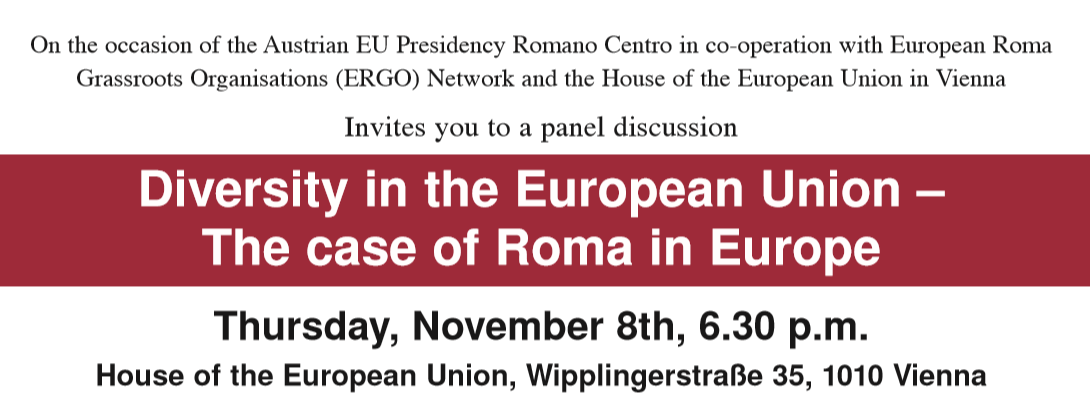
Diversity in the European Union – The case of Roma in Europe

On the occasion of the Austrian EU Presidency Romano Centro in co-operation with European Roma Grassroots Organisations (ERGO) Network and the House of the European Union in Vienna invites  you to a panel discussion  Diversity in the European Union – The case of Roma in Europe. The event takes place on Thursday, November 8th at 6.30 p.m.

Roma are the largest ethnic minority in Europe. As a result of century-old antigypsyism in mainstream society Roma women and men are disproportionately affected by racism and discrimination, poverty and social exclusion. In order to improve the living situation of Roma women and men and to provide equal opportunities and rights to all EU citizens, in 2011 the European Commission adopted the Framework for National Roma Integration Strategies up to 2020 (EU Roma Framework) that obliges all EU Member States to develop and implement national strategies for Roma in the fields of education, employment, housing and health. Since then EU Member States have set national goals and committed financial resources to foster social inclusion and anti-discrimination of respective Roma populations.

At the same time, in recent years we witness a rise of populist and right wing groups and political parties in Europe – inside and outside the EU – and public discourse scapegoating migrants, refugees, faith com- munities and other minorities such as Roma. These groups are made responsible for social problems and become target of populist hate speech and hate crimes.

The recent violent attacks against Roma, for example the stabbing of a Roma man in Ukraine, the killing of a young Roma girl in Greece this June, the racist attack against a Roma man in Slovakia, or the anti-Roma rhetoric of the Italian Minister of Interior Salvini, who announced a census and deportation of Roma migrants, are only few examples of this t trend.

Two years before concluding the EU Roma Strategy in 2020 and in the middle of deliberations on the next EU programming period 2020-2027, we take the opportunity of the Austrian EU Presidency to look at the results so far and the challenges encountered, and to discuss how widespread antigypsyism obstructs the achievement of equal rights and opportunities for Roma in Europe.

Please register at office@romano-centro.org.


Click here to see the full invitation and speakers list.

Minimum Standards for Minorities in the EU

On Monday 3 September 2018, the European Parliament Committee on Civil Liberties, Justice and Home Affairs (LIBE) held a mini-hearing on minimum standards for minorities in the EU. The respect for the rights of persons belonging to minorities is one of the EU’s founding principles and the effective protection of minorities across the EU needs to be strengthened.

ERGO Network Executive Director Jamen Gabriela Hrabanova was one of the experts invited to the hearing to give input to the Committee’s report on the topic.  She pointed out that Roma and other minorities enrich the diverse cultural heritage of the EU; the protection of their rights, however, is currently not ensured. EU Member States have different definitions for minorities and apply different standards for their protection. There is a need for a common understanding and definitions, but also for ensuring the protection of minorities especially against discrimination and any forms of racism.

The Roma Civil Monitor, a project issuing civil society shadow reports on National Roma Integration Strategies in 27 EU member states, shows that even where Roma are recognised as minority, respect of their rights is still lacking or the minority status is only granted for ‘autochthonous’ Roma and not those of migratory background.

ERGO Network believes that the lives of minorities in every country are fragile; the policy frameworks on minorities are depending on political will and societal climate.  For Roma the situation is even more difficult, as there is no home country standing behind them to support the growth of their cultural heritage and language or to ensure the full recognition and protection of their rights. The European Union is the safeguard that brings hope to many.

Minimum standards for minorities should ensure rights to both ethnic and national minorities. They should also pay attention to intersectionality, especially when it comes to discrimination of LGBTI and people with disabilities.

During the hearing, Gabriela Hrabanova furthermore expressed the importance of addressing antigypsyism as core problem for the exclusion of Roma. “Antigypsyism is not explicitly recognized in the relevant policy and legislative documents and antigypsyist crimes are often not seen as such by the responsible institutions”, says Hrabanova. As stated in the European Parliament Resolution on fighting Anti-Gypsyism from 2015 and in the LIBE Committee Report on Anti-gypsyism from 2017 the situation of Roma is worsening and there is a need for urgent action to ensure the remedy of the centuries’ long discrimination and marginalization.

Member states should take both proactive and reactive measures to safeguard equal access of members of minority groups to services, goods, information, etc. and to provide mandatory trainings to duty-bearers.

But importantly, there will be no achievement without real and systemic consultations of minority groups at local, regional and national level to prepare, run, monitor and evaluate both minority specific and mainstream programmes in order to ensure their inclusiveness and non-discrimination.

2017 ERGO Network Annual Report

2017 ERGO Network Annual Report

ERGO Network’s annual report for 2017 is now available. Read the  2017 ERGO Annual Report and learn how ERGO Network and  its members introduced and pursued numerous initiatives to fight antigypsyism and to empower Roma in 2017. In addition the annual report 2017 presents the initiatives undertaken by ERGO to ensure networking between, and capacity building of member organisations. The report contains relevant information and graphs on the achievements and progress made to strengthen the Roma community. ERGO Network will definitely keep the wheel rolling to support the implementation of more and better measures for Roma.

Read the  2017 ERGO Annual Report

Will the EU include Roma in the so-called ‘Union that protects, empowers and defends’?

Will the EU include Roma in the so-called ‘Union that protects, empowers and defends’?

The European Commission entitled its proposal for the next Multi-Annual Financial Framework ‘A budget for a Union that protects, empowers and defends’, but will it really defend all its citizens? While we remember the victims of the Roma Holocaust on 2nd of August, racist crimes against Roma still continue in Europe today.

Approximately 12 Million Roma are European citizens, and according to the Fundamental Rights Agency, 80% of them are at risk of poverty. One in three Roma are victims of harassment and 20% of non-Roma would not like to have a Roma colleague.

Antigypsyism, a specific form of racism against people who are perceived as Gypsies, is today the most widespread and socially accepted form of racism and is the basis of the social exclusion and poverty of Roma people.

In 2011 the EU adopted a Framework in order to improve Roma inclusion, but its mid-term review in 2017 showed a very little progress and highlighted the importance of focusing on antigypsyism in the next EU Roma Framework. It confirmed that ‘fighting antigypsyism and stereotypes by targeting majority society is a pre-condition for generating political will and for the success of any Roma inclusion intervention.’

Also in 2017 the European Parliament adopted a report on the “Fundamental rights aspects in Roma integration in the EU: fighting anti-Gypsyism”, highlighting the persistent antigypsyism in politics and societies across Europe, despite the efforts undertaken under the EU Roma Framework and the legislative framework against discrimination, hate speech and hate crime.

Is there an end to the Genocide of Roma in Europe?

However, while we commemorate the Roma Holocaust on 2nd of August, today’s reality proves that extreme efforts are still needed to combat antigypsyism across the EU. More than 70 years after the end of World War II, antigypsyism finds its expression in a series of hate crimes. These crimes are hardly followed up, their racist character is often ignored and they meet little outrage by the majority society.

The following are only the most widely reported crimes of the last few months – we can believe that they are not the only ones:

  • A 13-year old Roma girl in Amfissa, Central Greece was shot by a local businessman on June 4, 2018. The man drove by the Roma camp and fired with a shotgun at the inhabitants, killing the young girl.
  • In July 2018 in the outskirts of Rome a 14-month old Roma baby girl was shot in the back while being in her mother’s arm. The man who shot her with an air rifle from his balcony claims it was an accident as he was cleaning his gun.
  • In July 2018 a 21-year old Romani man was beaten up by skinheads in a pub in Žilina, Slovakia. The skinheads were screaming “We will kill you, Gypsy scum”. According to the European Roma Rights Centre (ERRC), a policewoman who came with the ambulance said: “The town center is not for Gypsies, but for whites.”
  • In July 2018 In Greece, a Roma man was shot in the face by his non-Roma neighbor who claims the reason was an argument about leaves flying into his garden. (source: http://www.newspallinis.gr/2018/07/blog-post_83.html?m=1)
  • Just outside the EU’s borders, in Ukraine, 23-year old David Popp was murdered in his sleep in the frame of several anti-Roma pogroms by neo-Nazi gangs .

At the same time, Matteo Salvini, Minister of the Interior of Italy, asked for a census of Roma and regretted that he could not just kick them all out of the country; but even this, or hate speech in the European Parliament, regular evictions of Roma from their homes or the demand for segregation of Roma children in school by non-Roma parents do not cause any bigger concern by decision-makers and citizens in the EU.  These cases of extreme racist violence, however, should lead the EU institutions to take real action.

Will next EU Programming Period include more than a lip service to combatting antigypsyism?

The next EU Multi-Annual Financial Framework is currently negotiated. It is now time to dedicate sufficient resources to combatting antigypsyism through a strong EU Roma Framework that has the fight against antigypsyism at its core. Addressing the social policy areas of employment, education, housing and health is crucial for their social inclusion, but will not be enough to end Roma exclusion when hate crimes remain completely unchallenged.

With the Race Equality Directive, the Charter of Fundamental Rights and the Articles 2 (rights of minorities) and 10 (combatting discrimination) of the Treaty of the European Union, a strong legal basis exists for the EU to combat antigypsyism. The next MFF is the chance for EU policy-makers to give more substance to these commitments and to do everything in their power to make sure that Roma will not have to face a new genocide.

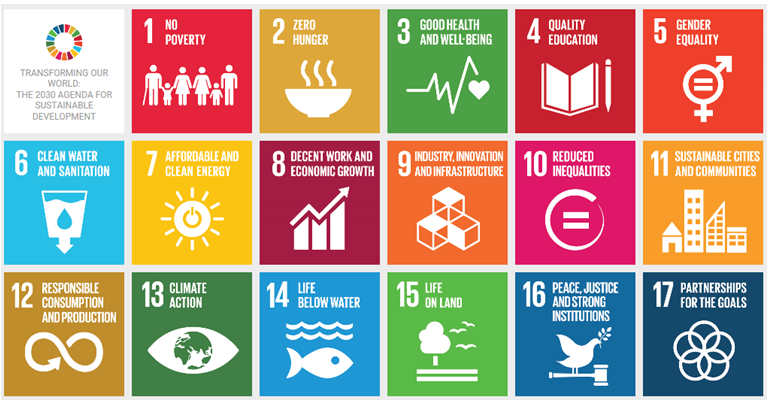
Roma inclusion in the SDGs: Call for experts

ERGO Network is contracting an external consultant to prepare a report on the Sustainable Development Goals as a tool for Roma inclusion


Download the complete call for an external consultant.

Roma in the Sustainable Development Goals

Since the universal acceptation of the Agenda 2030 in 2015, the Sustainable Development Goals and their targets stimulate action in areas of critical importance for humanity and the planet. All UN Member States are asked to work towards fulfilling the SDGs until 2030. They are thus an important advocacy tool for civil society in order to push their governments and international institutions towards ending poverty and hunger, protecting the planet and fostering peaceful, just and inclusive societies.

ERGO Network intends to include the SDGs in its work with Roma and pro – Roma grassroots organisations across Europe.

Role of the consultant

We are searching for an external consultant who will prepare a report on the role of the Sustainable Development Goals in the field of Roma inclusion and combatting antigypsyism. Specifically, the consultant is expected to prepare a report of approximately 20 pages in English including the points given in the attached call.

Profile

  • Proven knowledge about Roma and sustainability issues, specifically the Agenda 2030
  • Experience working with civil society organisations in the fields of advocacy and capacity-building
  • Excellent writing skills
  • Proven research and analytical skills
  • Ability to work independently

Contract and budget

The independent evaluator will be subcontracted to fulfil part of the work programme in the Framework Partnership Agreement between ERGO Network and DG Employment. The expert has no rights vis-à-vis the European Commission.

The expert shall be paid for the execution of the activities and services a fee of 3,000 EUR, all taxes and VAT included.

Timing

The deadline for the first draft of the report is 1 November. A final version should be finished, after feedback from the ERGO Secretariat, by 15th December.

Application procedure

Interested and qualified candidates should submit the following documents:

  • Motivation letter
  • CV
  • Sample writing (at least 2 pieces)

We will select the expert according to the principle “Value for money”. Please send your application to info@staging.ergonetwork.org, by August 20th 2018, 23:59 CET.

For further questions, please contact Christine Sudbrock (c.sudbrock@staging.ergonetwork.org, +32 2 893 10 49)


`
Christine Sudbrock – Page 33 – ERGO Network

By continuing to use the site, you agree to the use of cookies. more information

The cookie settings on this website are set to "allow cookies" to give you the best browsing experience possible. If you continue to use this website without changing your cookie settings or you click "Accept" below then you are consenting to this.

Close