Confronting antigypsyism is the responsibility of the mainstream society

Confronting antigypsyism is the responsibility of the mainstream society

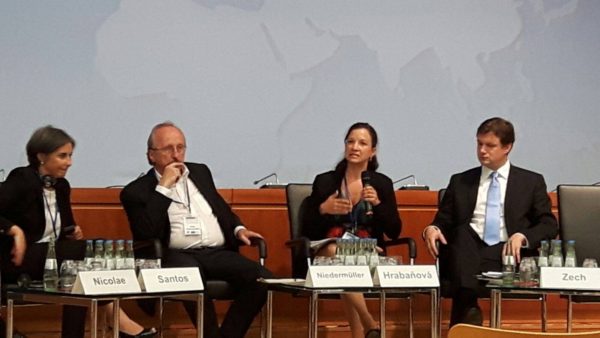
On 6 September 2016, ERGO Network was present at a high level event hosted by the OSCE Chairperson-in-Office, co-organized with ODIHR, the Council of Europe and the Central Council of German Sinti and Roma. It brought together more than 130 participants, including members of the OSCE Parliamentary Assembly, the Parliamentary Assembly of the Council of Europe, the European Parliament and of national parliaments, along with high-ranking governmental representatives, civil society representatives, and other relevant stakeholders in the fight against antigypsyism.

“In order to put an end to the common practices of the antigypsyism, there is a strong need to mobilize the support of civil society. Civil society needs to monitor the hate speech, the discrimination and give grassroots organizations the tools to address and fight antigypsyism at the local level” said Gabriela Hrabanova the Deputy Director of ERGO Network. In support of those arguments, ERGO presented the reference paper of the Alliance Against Antigypsyism.

The conference underlined the common voice of the international community to address the continued discrimination caused by this specific form of racism against Roma and Sinti within the current challenging regional political context across Europe. All the speakers stressed the need to strengthen alliances among stakeholders, including the civil society, and to build a firm stand of political leaders against antigypsyism. “It is high time that political leaders, political groups and institutions at national and European levels take a strong stand against antigypsyism as the root cause of the social exclusion of Roma,” said Soraya Post, Swedish Member of the European Parliament and Co-President of the Anti-Racism and Diversity Intergroup (ARDI). She continued: “Until this specific form of racism is systematically addressed, the success of actions in other policy areas will be limited.”

EC Assessment of the Implementation of the EU Framework for National Roma Integration Strategies

European Commission’s Assessment of the Implementation of the
EU Framework for National Roma Integration Strategies:
Member States need to step-up their efforts

The report is based on information submitted by Member States of the efforts made to integrate Roma, supplemented by input from civil society. ERGO Network concludes that the report clearly indicates a lack of action in crucial areas -also those Member States with a significant number of Roma.
Therefore, ERGO Network supports the urgent call of the European Commission’s on Member States to address the key priorities and step up their efforts.
In this note we present a brief examination of the European Commission’s (EC) assessment and indicate how it can be used by Roma Civil Society in their national advocacy.

Download link

Social inclusion of Roma in rural areas through CLLD process

Social inclusion of Roma in rural areas through CLLD process

Better integration of Roma people in rural areas is not only a social, but also a demographic and economic issue. The European Roma Grassroots Organization (ERGO Network) has been working actively to use bottom-up/ partnership-based approaches (such as LEADER/CLLD) as a tool to engage Roma people more actively in shaping the future of their rural areas.

CLLD can offer opportunities for Roma communities to participate in developing and implementing Local Development Strategies (LDSs). From case studies we conducted in 2014[1], however, we know that Roma involvement is not obvious. Also, the monitoring and evaluation of LDSs mostly takes a narrow quantitative approach, neglects the perspectives of beneficiaries and fails to analyse why Roma communities very often hardly benefit from them.

ERGO Network’s Quality Audit addresses these shortcomings. The Quality Audit is a tool to involve Roma communities in the monitoring of CLLD, which at the same time strengthens their voice in the process, and to evaluate the quality of LDSs, both in terms of participation and results. The Quality Audit has two aims:

  1. To assess the quality of CLLD local development strategies;
  2. To empower local groups and create/strengthen accountability mechanisms at local level.

The Quality Audit provides data for shadow monitoring and – as it is a multi-year effort – also the opportunity to follow the process from start to finish. It will thus allow us to formulate recommendations for the next programming period.

Secondly, the Quality Audit strengthens the position of Roma communities at local level and empowers local activists. It introduces a comparative measure for how Local Action Groups (LAGs) perform in each phase of the CLLD process. By sharing the outcomes, activists and local NGOs stand stronger in their negotiations or their participation in the CLLD process. Conducting the QA also enhances the knowledge of communities and activists of the process, which further strengthens their position. The QA also evaluates LAGs and LDSs against some of the formal criteria set for CLLD by the European Commission: it thus strengthens accountability mechanisms at local level.

The Quality Audit exists alongside the ERGO Network Local Scorecard: this is an online tool where local activists can rate how well their locality is doing in terms of Roma inclusion. The QA is a much more in-depth evaluation focusing specifically on CLLD, providing a deeper level of analysis. The tools are complementary however; activists conducting the QA can also use the Local Scorecard – which gives a less in-depth, but also more general picture of the state of Roma integration in their locality.

The first synthesis report of the Quality Audit in 2016 will soon be published by ERGO Network.

Here you can download overviews of the participating organizations:

 Czech Republic

 Bulgaria

 Slovakia

 Romania

Equal Citizenship and Policy Results The EU Roma inclusion agenda 2015 – 2020

Equal Citizenship and Policy Results
The EU Roma inclusion agenda 2015 – 2020

As an organization that connects organizations from the ground – where positive changes should become visible – ERGO Network suggests the EU agenda for Roma inclusion should reflect and tackle three main issues:

the vulnerable position of Roma civil society;
weak policy delivery;
the pervasive and entrenched impact of anti-Gypsyism.

This note presents these in turn, along with a limited number of concrete proposals. Many other recommendations – in particular with regard to policy delivery – have been shared with the European Commission over the past years. Most recently, ERGO Network presented a set of recommendations related to integrated approaches, based on original research, which is annexed to this note.

Download link

Integrated Approaches for Roma Integration Evidence from the ground

Integrated Approaches for Roma Integration
Evidence from the ground

ERGO Network has been advocating for the application of such integrated approaches since 2009. We have particularly pointed to the importance of facilitating and ensuring active participation of Roma communities themselves in strategy planning and implementation. The latter has been identified – including by the European Commission – as a crucial success factor. Participation both leads to projects and strategies designs that better fit the needs of beneficiaries and creates co-ownership of objectives and processes. It unlocks the potential of beneficiaries and others stakeholders to contribute towards successful outcomes.
From this perspective we take a closer look at some experiences with integrated approaches for Roma. Still at the beginning of the new programming period, the aim of this paper is to develop a number of concrete recommendations for the successful development and application of  integrated approaches.

Download link

`
Ana Rozanova – Page 63 – ERGO Network

By continuing to use the site, you agree to the use of cookies. more information

The cookie settings on this website are set to "allow cookies" to give you the best browsing experience possible. If you continue to use this website without changing your cookie settings or you click "Accept" below then you are consenting to this.

Close