Stakeholder Workshop ‘Building-up quality of life in the local area’

Stakeholder Workshop ‘Building-up quality of life in the local area’

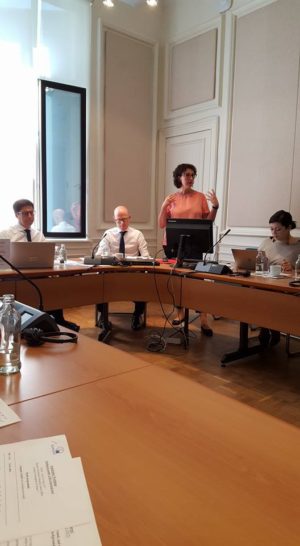
On May 16 Eurofound organized a stakeholder meeting on the topic ‘Building-up quality of life in the local area’. Dr. Ileana Rotaru from Nevo Parudimos and ERGO member presented the perspective of Social hubs in rural Europe: social inclusion and Roma integration.

Between 2017 and 2020 Eurofound will carry-out exploratory research on ways to build up quality of life in the local area, whether urban or rural. In particular, it seeks to investigate two questions:  a) what physical and social factors in the local area are of particular importance for people’s quality of life? and b) what can be learned from initiatives to enhance quality of life in the local area?

Our input to the meeting was that Roma communities cannot be forgotten when the ‘local dimensions’ of quality of life is targeted  in this project. We stressed the necessity of including Roma in different types of initiatives and policies aiming to improve quality of life.

Present at the meeting were Mr. Tadas Leonikas from Eurofund, Eurofound Research Manager Mr. Hans Dubois, different stakeholders from EU state members and municipalities and  European Commission representatives:  DG EMPL (Unit: Modernisation of Social Protection Systems), DG SANTE (Unit: Health determinants and inequality) and  from DG REGIO (Unit: Inclusive Growth, Urban and Territorial Development).
3rd National Meeting of Roma Forum Romania

3rd National Meeting of Roma Forum Romania

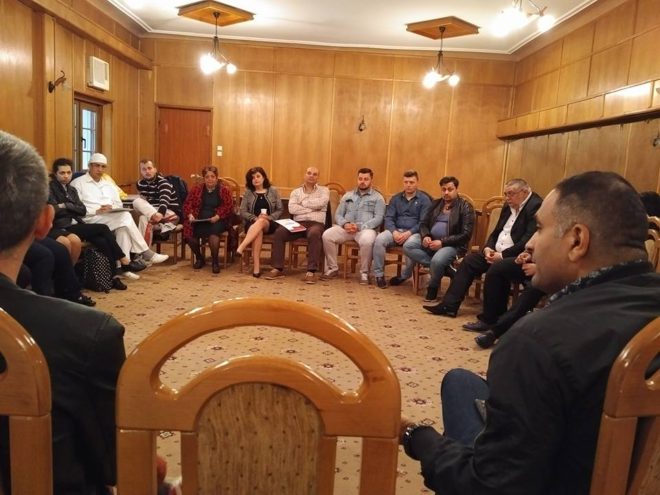
The National Meeting of Roma Forum organized by Nevo Parudimos, as a member of ERGO Network in partnership with Romani Criss, took place from 10-11 May in Bucharest.

The theme of the meeting was „The involvement of Roma NGOs for the Romanian Presidency of the EU in 2019”. More than 30 Roma NGOs participated to the meeting and over 60 people were present during the 2 days. In the same time, officials from the National Roma Agency, the National Roma Contact Point, the National Federations of LAGs, representatives of the Roma Education Fund, the Ministry of Employment and the Central European University gave presentations and talked about Roma issues in open and free discussions.

The main discussions focused on the list of several proposals for the Romanian Presidency of the European Union in 2019 in order to be formalized in the public agenda during the Romanian presidency. These proposals refer to the following important areas: school segregation, the mediation process for health and education and forced eviction of the Roma.

ERGO Network condemns murder of three Roma sisters in arson attack

ERGO Network condemns murder of three Roma sisters in arson attack

ERGO Network condemns in the strongest possible terms the murder of three Roma sisters aged four, eight and 20, who died in a fire after a Molotov cocktail was thrown at their camper van on the outskirts of Rome, Italy early Wednesday morning.  Such attack is as a heinous crime that is calling for an unbiased police investigation, and we’ll not rest until the perpetrators are brought to justice regardless their origin.

We would like to express deep condolences to the family and surviving children.

We appeal to the media and politicians to keep sensitivity in their coverage and in political responses to make sure they don’t fuel already existing antigypsyism in the society.

We repeat our call to the Italian municipal authorities, the Italian government and the European Commission to ensure that Roma families in Italy have a chance for equal citizenship and being offered decent housing conditions and facilities where their children grow up in a secure environment and can invest in a better future.

***

ERGO Networks joins the open letter of Graziano Halilovic that you can find attached.

Call: Monitoring of the implementation of National Roma Integration Strategies

Call: Monitoring of the implementation of National Roma Integration Strategies

Deadline: 19th May 2017

For the next three years the European Commission undertakes a series of activities to empower the Civil Society within the Member States through capacity building and a series of trainings in order to strengthen its involvement in the monitoring of National Roma Integration Strategies.

In this framework, ERGO Network together with its partners Central European University (CEU),  European Roma Rights Centre (ERRC), Fundacion Secretariado Gitano (FSG) and Roma Education Fund (REF) aim to involve 90 NGOs from 27 EU member states in monitoring the implementation of the National Roma Integration Strategies (NRIS) in the next two to three years.

Activities of the pilot project include:

  • Selection of NGOs through an open call;
  • Capacity building programme for the benefit of the selected NGOs;
  • Development of annual civil society monitoring reports by selected NGOs (one annual monitoring report per country);
  • Provision of assistance to selected NGOs, including quality control of draft monitoring reports and preparation of a synthesis report;
  • Organisation of a network of selected NGOs.

We encourage all our members and partners to apply for this important opportunity.

The call for NGOs is available at www.romacivilmonitor.eu.

Evaluating with your target group The potential of an inclusive approach to monitoring and evaluation

Evaluating with your target group
The potential of an inclusive approach to monitoring and evaluation

Despite the large and sustained focus of policy efforts to Roma inclusion, results remain limited. Thorough evaluation of programs and projects is crucial to identify reasons for weak performance and should ideally lead to stronger project design.
The current evaluation practice usually leaves out the perspective of the final beneficiaries: their opinions and experiences remain invisible. The experience of ERGO Network and its member organisations is that programme and project evaluations, if they are available at all, often lack depth, fail to address shortcomings and in many cases present an image that does not correspond to the reality of those the project or programme aimed to support. This represents a missed opportunity for achieving structural improvements in policy approaches to Roma inclusion.

Download link

`
Ana Rozanova – Page 57 – ERGO Network

By continuing to use the site, you agree to the use of cookies. more information

The cookie settings on this website are set to "allow cookies" to give you the best browsing experience possible. If you continue to use this website without changing your cookie settings or you click "Accept" below then you are consenting to this.

Close