ERGO Network is partner in Roma Civil Monitor project

ERGO Network is partner in Roma Civil Monitor project

During the next three years, ERGO Network together with Central European University’s Centre for Policy Studies, the European Roma Rights Centre, Roma Education Fund and Fundacion Secretariado Gitano will coordinate a large-scale project with the aim to strengthen the monitoring mechanisms of the implementation of national Roma integration strategies. The project “Roma Civil Monitor” is managed by the European Commission’s Directorate General for Justice and Consumers. Based on the applications received and the assessment of eligibility and selection criteria, close to 90 NGOs from 21 member states of the EU can be involved, including all member states with larger Roma communities.

The NGOs will be supported to develop their policy monitoring capacities and to prepare high-quality, comprehensive annual civil society monitoring reports focusing on different parts of the integration strategies.

In 2017, civil society monitoring will focus on structural preconditions for the effective implementation of national Roma integration strategies: governance, anti-discrimination and addressing antigypsyism. Findings of the assessment are expected to be channelled in the mid-term assessment of the EU Roma Framework. In 2018, the assessment will focus on sectoral policies in education, employment, health care and housing.

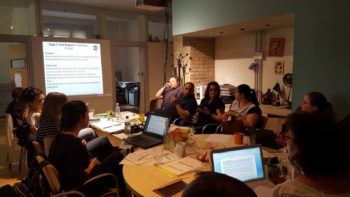
The first activity of the project is the organization of capacity building workshops. For 5 countries, Bulgaria, Czech Republic, Hungary, Romania and Slovakia, workshops will be organized in late June, early July. For other countries, workshops will be organized in September.

In order to broaden the coverage of the projects, involvement of further NGOs is foreseen from countries with few NGOs (e.g. France) or no NGOs (Poland, Finland, Cyprus, Denmark, Latvia, Luxembourg).

Updates on the project will be regularly shared on the project websitewww.romacivilmonitor.eu.
ERGO presents reference paper on Antigypsyism at CAHROM

ERGO Network presents Reference paper on Antigypsyism at the meeting of CAHROM

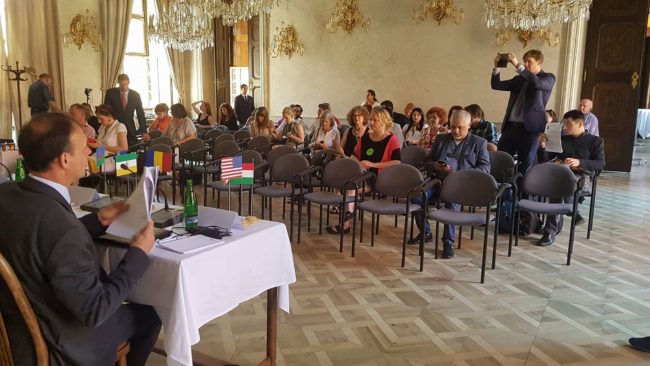
The 5th co-ordination meeting between international intergovernmental organisations organized by the AD HOC COMMITTEE OF EXPERTS ON ROMA AND TRAVELER ISSUES (CAHROM) in cooperation with the Governmental Office for Roma Affairs of the Czech Republic took place on 31 May in Prague. It was supported by ERGO member Slovo 21 and was organized during the International Roma Festival Khamoro.

Representatives of the Council of Europe, the Council of Europe Development Bank, the European Commission, the Fundamental Rights Agency, OSCE/ODIHR, UNDP, UNICEF, World Bank, representatives of national governments and relevant actors involved in the Roma issues participated in the meeting.

ERGO Director Jamen Gabriela Hrabanova presented the reference paper on antigypsyismand the “Roma Civil Monitor”, a project on shadow monitoring and capacity building run by Central European University together with the European Roma Rights Centre, Roma Education Fund, Fundacion Secretariado Gitano and ERGO Network.

The CAHROM took note of the reference paper and shared it with all CAHROM members. Jamen appealed to the government representatives to tackle systemic antigypsyism in their countries and to make a special effort to include combatting antigypsyism into their national strategies. This appeal was even more relevant as the CAHROM set up an international Task Force on Anti-Gypsyism under the Czech Chairmanship of the Committee of Ministers of the Council of Europe.

Leadership and initiatives in local communities

Leadership and initiatives in local communities- leadership program for young Roma and Roma women in Bosnia and Herzegovina

The Citizen’s Association for the Promotion of Education of Roma OTHARIN, ERGO Network member from Bosnia and Herzegovina, organized  from 1-4 June 2017 a workshop dedicated to building leadership programs and initiatives in Roma communities for young Roma, with a special focus on Roma women in the framework of the “Project young Roma and Roma for the rights and inclusion“.

The project is implemented and led by CARE International together with OTHARIN and other Roma NGOs from BIH and is funded by the EDHR instrument. The project aims for a better integration of Roma people in the society with a focus on the rights of Roma women and leadership skills.

The outcome of the workshop is a network of young Roma and Roma women who learnt new methods on how to initiate projects and on community planning. For the next 2 years of implementation OTHARIN together with its partners will help the trained young people to run several small actions in  Roma communities and strengthen their leadership skills and knowledge.


ERGO’s Annual working meeting and exchange visit in Hungary

ERGO’s Annual working meeting and exchange visit in Hungary

From 22-24 May our Hungarian members Autonomia Foundation and Pro Cserehat Association organized an exchange visit between the ERGO core members from Slovakia, Czech Republic, Hungary and Romania.

The first day of the visit was dedicated to discussing and exchanging views and practices from our common work conducted under the Annual Work Programme 2017 and to plan ahead. After the meeting, the ERGO members had the chance to visit and learn more about the work conducted by our Hungarian members in the rural areas of Borsod county.

The first visit was organized by Autonomia in the village of Tomor, where the local Roma coordinator László Siroki stressed the challenges that Roma communities are facing due to the reluctance of local authorities to cooperate with Roma.  As a good practice example, the local coordinator presented the social enterprise Romama, where several Roma women are employed in a restaurant in an area where 90% of Roma are in the Public Work Program.

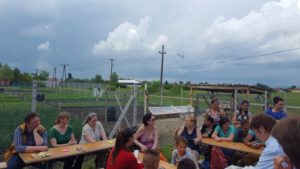
The second visit was organized by Pro Cserehat Association who presented their Pro Ratatouille project in Edelény.  This community gardening initiative targets disadvantaged communities. The community garden in Edeleny is run by 6 Roma families and proved to be a very successful project for the self-reliance and civic empowerment of Roma.

The meeting and the exchange visit brought up a lot of new information and many practices that the communities and our members can learn from, and was a starting point for new projects together.

Roma Advocacy and Research Center became a member of the National Rural Development Network of the Slovak Republic

Roma Advocacy and Research Center became a member of the National Rural Development Network of the Slovak Republic

On 24 May 2017 RAVS ERGO Network, member became an official member of the National Rural Development Network of the Slovak Republic (NSRF SR). NSRF SR associates the organizations and administrative bodies involved in rural development and the implementation of the PRV SR 2014-2020 in the sense of Art. 55 of Regulation (EU) No. 1305/2013 on support for rural development by the EPFRV and Art. 5 principles of partnership and multilevel governance of Regulation (EU) No. 1303/2013.

NSRF SR directly cooperates with the Ministry of Agriculture and rural development of the Slovak Republic (MPRV SR) and the European Network for Rural Development. Through this partnership Roma people will be involved more actively in the implementation of the programs under the Community Local Led Development in Slovakia.

Read more about RAVS activity in Slovak language here

`
Ana Rozanova – Page 56 – ERGO Network

By continuing to use the site, you agree to the use of cookies. more information

The cookie settings on this website are set to "allow cookies" to give you the best browsing experience possible. If you continue to use this website without changing your cookie settings or you click "Accept" below then you are consenting to this.

Close