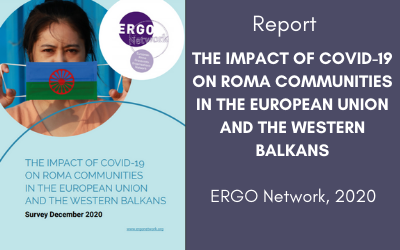
THE IMPACT OF COVID-19 ON ROMA COMMUNITIES IN THE EUROPEAN UNION AND THE WESTERN BALKANS

The Impact of Covid-19 on Roma Communities in the European Union and the Western Balkans

This survey was possible with the valuable contributions from ERGO members and partners from the European Union and Western Balkan countries and Turkey. We would like to thank in particular Roma Active Albania in Albania, Otharin in Bosnia and Herzegovina, expert Orhan Tahir in Belgium, Integro in Bulgaria, Slovo 21 and Life Together in Czechia,
Amrita OBK association in Hungary, Pavee Point in Ireland, Voice of Roma Ashkali and Egyptians in Kosovo*, RROMA in North Macedonia, Nevo Parudimos in Romania, Roma Forum in Serbia, Roma Advocacy and Research Centre in Slovakia and Zero Discrimination association in Turkey as well as Roma and Traveller communities in all the respective countries.
Download link

Input to the European Commission consultation on the Roadmap for a Council Recommendation for a Child Guarantee

Input to the European Commission consultation on the Roadmap for a Council Recommendation for a Child Guarantee

While the Roadmap identifies several groups of “children in need”, Roma children are not one of them. This is unacceptable, where the Fundamental Rights Agency found that every third Roma child (30%) lives in households where someone went to bed hungry at least once in the previous month, and only about half (53%) of young Roma children are enrolled in early childhood education and care programmes. Unless they are explicitly mentioned as target group and specific measures put in place to deal with very specific needs, experience shows that Roma children will once again be left behind.

Download link

ERGO Network response to the Annual Sustainable Growth Strategy 2021

ERGO Network response to the Annual Sustainable Growth Strategy 2021

While there is no explicit mention of the European Roma in this year’s Annual Sustainable Growth Strategy, ERGO Network welcomes that “people with a minority racial or ethnic background” are indicated as having been disproportionately hit by the coronavirus crisis (page 9). We further salute commitments to “address long-standing challenges that affect the fairness
in society … and rising inequalities” (page 3), and to “support those who have been hit hardest by the crisis, such as … vulnerable groups” (page 4). Other proposed measures have the potential of being positive for Roma communities, hinging on the right implementation: reducing inequalities, addressing labour market segmentation, increasing the inclusiveness of the education systems (particularly for disadvantaged groups), ensuring equal access to affordable, accessible, quality healthcare, childcare, and long term care, tackling the digital divide, reducing energy poverty, and ensuring a just and socially fair transition across green policy areas.

Download the response here

Explainer Annex: What are EU funds and how do they work

Explainer Annex: What are EU funds and how do they work

The budget of the European Union is decided for a period of 7 years (“programming period”), through an interinstitutional agreement called the Multiannual Financial Framework (MFF), which sets out the spending priorities of the EU budget during this time. It gives the maximum amounts (ceilings) for each broad category of expenditures (headings). The negotiations about the next programming period (2021-2027) are currently underway.
Cohesion Policy is the European Union’s strategy to promote and support the ‘overall harmonious development’ of its Member States and regions, by strengthening economic and social cohesion, and reducing economic, social and human rightsbased disparities in the level of development between regions. It is enshrined in the Treaty on the Functioning of the European
Union (Art. 174)

Download the Explainer Annex here

Toolkit: How to engage more effectively with ESF+ and ERDF

Toolkit: How to engage more effectively with ESF+ and ERDF

The purpose of the Toolkit is to support ERGO Network national members and other civil society organisations in ensuring specific EU funding for Roma inclusion during the 2021-2027 financial programming period. If you are not familiar with the main entities and processes of EU funding, you may wish to consult a brief Explainer in the Annex.

Download the toolkit here

`
Ana Rozanova – Page 47 – ERGO Network

By continuing to use the site, you agree to the use of cookies. more information

The cookie settings on this website are set to "allow cookies" to give you the best browsing experience possible. If you continue to use this website without changing your cookie settings or you click "Accept" below then you are consenting to this.

Close