EC releases European Care Package – What’s in it for Europe’s Roma?

European Commission releases the European Care Package – What’s in it for Europe’s Roma?

On 7 September 2021, the European Commission put forward the much-awaited European Care Strategy, aimed at ensuring quality, affordable, and accessible care services across the European Union, as well as at improving the situation for both care receivers and the people caring for them, professionally or informally.

The Strategy consists mainly of a Communication as well as two proposals for Council Recommendations, one on childcare (revising the Barcelona targets) and one on long-term care. It further includes a Staff Working Document, summarising the input received during the consultations carried out in preparation of the package.

ERGO Network has closely engaged with the preparation of the Strategy during 2022, with a view to raise awareness on the specific concerns of both Roma care givers and Roma care receivers. Among other advocacy efforts, we contributed to the call for evidence issued by the European Commission in April this year and have fed these messages also through other key lobbying opportunities. We have reviewed the proposed European Care Strategy in light of this input.

  • Read here our full analysis of the European Care Package!

Access to care throughout the life cycle is a fundamental right, and the European Care Strategy marks an important turning point in European social policy. ERGO Network welcomes that the Strategy is rooted in a rights-based approach, and includes commitments to improve quality, accessibility, affordability, and working conditions in care services, as well as to provide comprehensive support for informal and family carers.

The Roma are one of the most disadvantaged groups in Europe in what concerns their access to both childcare as well as to long-term care. While the Strategy pledges to improve access to early childhood education and care for Roma children, in synergy with the EU Roma Strategic Framework and the EU Anti-Racism Action Plan, the same consideration is not afforded to Roma adults needing long-term care, nor are Roma and other racialised carers sufficiently included.

Moreover, the fight against intersectional discrimination on all grounds (including antigypsyism, sexism, ageism, ableism, and stigma associated to living in poverty), is not mainstreamed in a comprehensive way through the package. This dimension should have been a core element of the Strategy, as leaving it out will perpetuate a key barrier to accessing and providing care.

ERGO Network expresses its hope that these gaps will be remedied through implementation, lest Europe’s Roma be left behind once more, and stands ready to support these efforts at both EU and national level.

For more information about our work on the European Care Strategy, please contact Amana Ferro (a.ferro@staging.ergonetwork.org), Senior Policy Adviser in the ERGO Network staff.
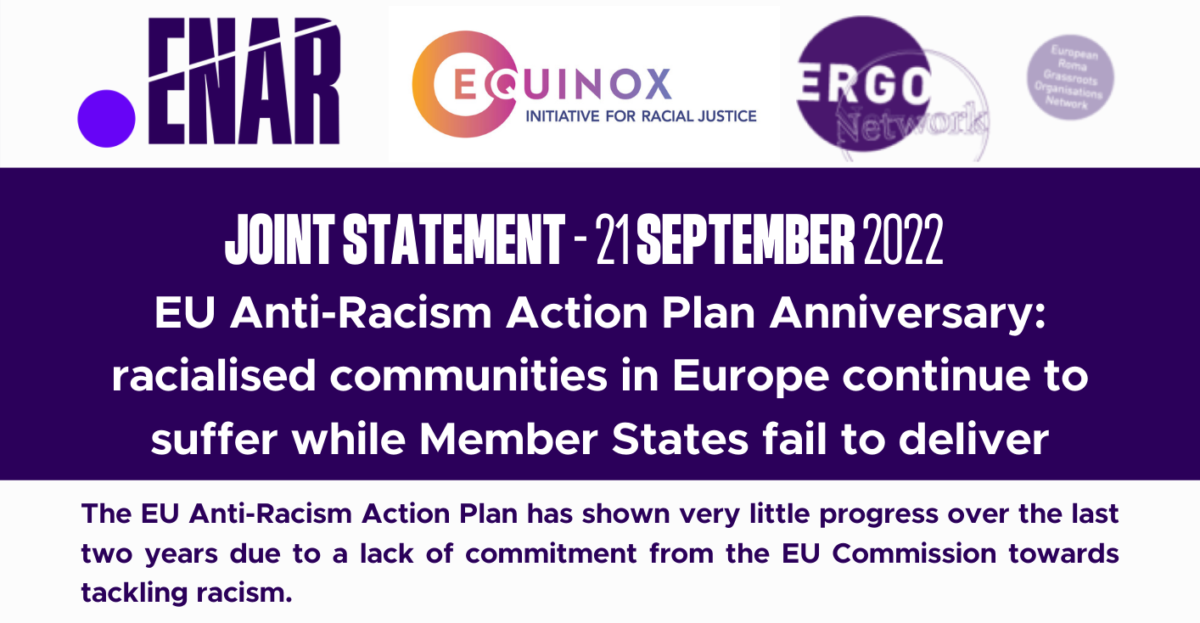
Joint Statement on EU Anti-Racism Action Plan Anniversary

On September 16 2020, European Commission President, Ursula von der Leyen delivered a speech with the pledge of effectively addressing racism in Europe. Through the EU Anti-Racism Action Plan (EU ARAP), the European Commission signaled its intention to seriously combat racism through a series of proposed measures. However, the negligible amount of progress made over the last two years reveals a lack of commitment and transparency leaving racialised communities far from the anti-racist Union von der Leyen promised.

Among the EU ARAP’s most ambitious objectives is the implementation of national action plans against racism (NAPAR) in all Member States. Unfortunately, the information shared by the Commission on the NAPAR implementation process has been scarce, while national development processes have not always been very transparent nor inclusive. As a result, civil society organisations have not been able to actively engage with the drafting process or support the implementation at the national level, yet have noted gaps between local, national, and EU entities including missing instructions and lack of communication across government levels (local, regional, etc.). Although these issues are problematic, it is the far-right ideologies spreading throughout the continent that are a larger threat to the NAPARs.

Recently, the French government renewed its attacks against a civil society organisation advocating against anti-Muslim hatred, citing a divergence in conceptions of diversity as its justification. In Sweden, 214 Swedish Democrat candidates who stood in the last election could be linked to right-wing extremism. In Italy, a politician with the far-right League sparked outrage after implying that the party would rid the streets of Roma people if it wins general elections later this month.

“There are many countries across the EU bloc with issues of institutional racism. Whether we speak about France, Sweden, or Italy, far-right ideology is rising and racism is being normalised to a whole new level. The EU Institutions must recognise this threat and act, or any initiative for racial equality will be dead in the water,” said ENAR Director (Policy, Advocacy, and Network Development), Ojeaku Nwabuzo.

The trend of rising far-right threats in Europe is only increasing, leaving racialised communities vulnerable to violence. In August, Alika Ogorchukwu, a black man, was beaten to death by a white Italian man in broad daylight. Despite the circumstances of the vicious attack, the police have refused to consider a racial motive to the crime. Meanwhile, the conflict in Ukraine has revealed another facet of European institutional racism in the double standards applied towards fleeing refugees.

“With the Russian war against Ukraine, Europe witnessed impressive solidarity towards the Ukrainian refugees. Unfortunately, ethnic minority groups such as the Roma Ukrainian refugees have been experiencing a lot of racism and rejection in the neighboring countries, in their efforts to secure a safe place for them and their families to date”, said Gabriela Hrabanova, Director of the ERGO Network.

“Racism is killing racialised people and it is only going to get worse. Without firm commitments, the hope for a true Union of Equality remains an empty promise. The European Commission must step up its efforts to remind Member States of our shared values, and deliver on the EU ARAP and NAPARs. The safety of racialised communities depends on their resolve,” concluded Ojeaku Nwabuzo.


Joint statement issued by:

  • The European Network Against Racism
  • Equinox Initiative for Racial Justice
  • ERGO Network

For more information or to arrange an interview, contact:  

Mobile: +32 (0)2 229 35 70 – Email: info@enar-eu.org – Web: www.enar–eu.org

Notes to editors:

  • The European Network Against Racism (ENAR aisbl) stands against racism and discrimination and advocates equality and solidarity for all in Europe. We connect local and national anti-racist NGOs throughout Europe and voice the concerns of ethnic and religious minorities in European and national policy debates.
  • On September 20 2021, ENAR and 40 civil society organisations across Europe shared recommendations last year for the EU Commission to prioritise over the period of 2021-2022. Available here.

Call for expert in project management

Roma equality, inclusion, and participation (EQUIP)

Calls for applications for expert to develop an ERGO manual on campaigning

Call for expert in project management

ERGO Network is contracting an expert to design a module on organizational and project management for national and local Roma civil society organisations. The module will be part of a capacity-building handbook, covering advocacy, campaigning and project management, that aims to support ERGO Network members and their national networks in delivering better work for the fight against antigypsyism on national level.

ERGO Network

ERGO Network (www.ergonetwork.org) brings together over 30 members from across Europe and supports organisations with a common perspective on Roma grassroots empowerment and equal citizenship to challenge stereotypes and combat stigmatization. We mobilize and connect organisations and individuals that share and express our values – active citizenship, shared responsibility, and passion – to strengthen and empower Roma civil society involvement in decision-making at local, national, and European levels and to address existing shortcomings of policies targeted at Roma.

Capacity-building on project management

As part of ERGO Network’s work programme “Roma Equality, Inclusion and Participation”, funded by the European Commission’s CERV programme, we are developing a series of capacity-building tools for our member organisations.

One of them is a toolkit on the key issues of advocacy, campaigning and project management, that are fundamental to all ERGO Network members. The module to be submitted should have 15 pages (designed). The handbook will be published online by  the end of 2022. Next year, a series of short online workshops will introduce the manual to ERGO Network members.

The module on project management should include guidelines, tips and templates for effective management. It will be complementary to a project management boardgame that is developed under a different project with ERGO Network members.

Role of the expert

We are searching for an expert in organizational and project management with experience in writing similar manuals.

Specifically, the expert is expected to:

  • Develop an outline of the module for discussion with the ERGO Network team
  • Write the module and incorporate feedback from the ERGO Network team. The deadline for finalizing the work is 15 November.

Profile:

  • Excellent knowledge of and experience in organizational and project management
  • Experience in working with Roma civil society organisations
  • Experience in writing handbooks and training manuals

Conditions

The development of the manual will be conducted from Mid-September to November 2022. A first draft must be ready by 31 October, with the final manual developed until 15 November.

Contract and budget:

The expert shall be paid for the execution of the services a fee of 1,500€, all taxes and VAT included.

Application procedure

Interested and qualified candidates should submit the following documents:

  • CV, highlighting past similar assignments
  • Proposed outline of the organizational and project management module

We will select the expert according to the principle “Value for money”. Please send your application to info@staging.ergonetwork.org by 30 September 2022, 23:59 CET.

For further questions, please contact Christine Sudbrock at c.sudbrock@staging.ergonetwork.org.

Call for an expert in campaigning

Roma equality, inclusion, and participation (EQUIP)

Call for applications for expert to develop an ERGO manual on campaigning

Call for expert in campaigning

ERGO Network is contracting an expert to design a module on campaigning for national and local Roma civil society organisations. The module will be part of a capacity-building handbook, covering advocacy, campaigning and project management, that aims to support ERGO Network members and their national networks in delivering better work for the fight against antigypsyism on national level.

ERGO Network

ERGO Network (www.ergonetwork.org) brings together over 30 members from across Europe and supports organisations with a common perspective on Roma grassroots empowerment and equal citizenship to challenge stereotypes and combat stigmatization. We mobilize and connect organisations and individuals that share and express our values – active citizenship, shared responsibility, and passion – to strengthen and empower Roma civil society involvement in decision-making at local, national, and European levels and to address existing shortcomings of policies targeted at Roma.

Capacity-building on campaigning

As part of ERGO Network’s work programme “Roma Equality, Inclusion and Participation”, funded by the European Commission’s CERV programme, we are developing a series of capacity-building tools for our member organisations.

One of them is a handbook on the key issues of advocacy, campaigning and project management, that are fundamental to all ERGO Network members. The module to be submitted should have 15 pages (designed). The handbook will be published online by  the end of 2022. Next year, a series of short online workshops will introduce the manual to ERGO Network members.

The module on campaigning should include guidelines and tips on how to design effective campaigns on Roma issues and particularly the fight against antigypsyism. It should be clearly targeted at national (pro-) Roma civil society organisations and take their struggles and interests into account.

Role of the expert

We are searching for an expert in campaigning to develop the campaigning module of the capacity-building handbook.

Specifically, the expert is expected to:

  • Develop an outline of the module for discussion with the ERGO Network team
  • Write the module and incorporate feedback from the ERGO Network team. The deadline for finalizing the work is 15 November.

Profile:

  • Excellent knowledge of campaigning and experience in civil society campaigns
  • Experience in working with Roma civil society organisations
  • Experience in writing handbooks and training manuals

Conditions

The development of the manual will be conducted from Mid-September to November. A first draft must be ready by 31 October, with the final manual developed until 15 November.

Contract and budget:

The expert shall be paid for the execution of the services a fee of 1,500€, all taxes and VAT included.

Application procedure

Interested and qualified candidates should submit the following documents:

  • CV, highlighting past similar assignments
  • Proposed outline of the campaigning module

We will select the expert according to the principle “Value for money”. Please send your application to info@staging.ergonetwork.org by 30 September 2022, 23:59 CET.

For further questions, please contact Christine Sudbrock at c.sudbrock@staging.ergonetwork.org.

Call for Graphic Designer to Design 2 ERGO Network Publications

Call for graphic designer to design 2 ERGO Network publications

ERGO Network is contracting a graphic designer to work with us from October – December 2022 on 2 publications:

  • Capacity-building manual for Roma civil society organisations

The text version will be ready on 15 November. The publication must be finalized by 15th December. The text version will have approximately 30 pages, split into 3 different “modules” on advocacy, campaigning and project management.

  • Report on Roma access to quality, inclusive and affordable health and long-term care

The text version will be ready in the second half of October. The publication must be finalized by 18th November. The text version will have between 30 and 40 pages.

The maximum total budget for the two publications is 4,500 €.

Profile:

  • Excellent portfolio of similar publications
  • Experience in working with civil society organisations
  • Availability from October to December to finalise both publications

Contract and budget:

The expert shall be paid for the design of the two publications a total fee of max 4,500€, all taxes and VAT included.

Application procedure

Interested and qualified candidates should submit the following documents:

  • Quote
  • Portfolio of past similar assignments

We will select the expert according to the principle “Value for money”. Please send your application to info@staging.ergonetwork.org by 30 September 2022, 23:59 CET.

For further questions, please contact Christine Sudbrock at c.sudbrock@staging.ergonetwork.org.


`
Ana Rozanova – Page 25 – ERGO Network

By continuing to use the site, you agree to the use of cookies. more information

The cookie settings on this website are set to "allow cookies" to give you the best browsing experience possible. If you continue to use this website without changing your cookie settings or you click "Accept" below then you are consenting to this.

Close