EU Award for Roma Integration in the Western Balkans and Turkey

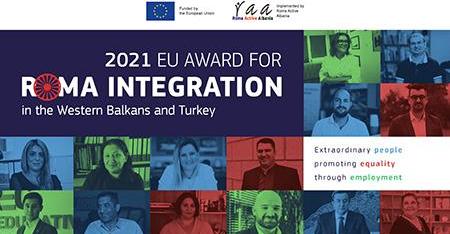
EU Award for Roma Integration in the Western Balkans and Turkey 

Extraordinary people promoting equality through employment

A highlight of the Romani Week 2021 was the only in-person event taking place in Brussels: The award ceremony for the 14 winners of the fourth edition of the “EU Award for Roma Integration in the Western Balkans and Turkey”! 

Launched in 2014, the  EU Award for Roma Integration in the Western Balkans and Turkey is organised by Roma Active Albania, member of ERGO Network, and funded by the European Union. It highlights the importance of Roma integration in the EU Enlargement process and shows the EU’s determination and commitment to improving the social inclusion of Roma people. With the Award, the EU recognises all efforts to empower Roma to reach their full potential as full members of the societies where they live and work. 

The 2021 edition invited nominations and self-applications for “Extraordinary people promoting equality through employment”. It recognises private and public initiatives that offer support, recognition and publicity to sustainable employment initiatives in Roma communities, especially among women, and that support positive role models and practical help.

Of the 67 applications submitted, 14 projects representing the Western Balkan partners and Turkey have been chosen for their outstanding contribution. The nominees often put themselves at risk by being role models and breaking established traditions. The winners include ERGO Network member Otaharin from Bosnia & Herzegovina, the Konak municipality from Turkey and the Roma Women Center Bibija from Serbia (full list of winners here). 

Adriatik Hasantari, Director of Roma Active Albania and Vice-Chair of ERGO Network, applauded all winners: “Your success in improving the economic situation of hundreds of Romani families proves that things can change when municipalities, companies, organisations and individuals are committed to and passionate about Roma inclusion. You are an inspiration to be followed by many”. 

Olivér Várhelyi, Commissioner for Neighbourhood and Enlargement, said: “Congratulations to all the winners for your contribution to such an important issue! You took courageous initiatives overcoming prejudices to promote Roma employment. With your diverse actions and your successful results, you show that progress on Roma employment is possible. I hope this Award will help expand your initiatives as role models for increasing Roma employment and for making our societies more equal and fair.”

The winners travelled to Brussels not only to been given their awards, but also to learn more about the EU’s role in Roma integration in the Western Balkans and Turkey and ERGO Network’s activities to empower Roma civil society and improve policy-making for Roma across Europe. During the next months, they will continue to share their experiences and learn together through a study visit to Spain and events organised in all partner countries of the Western Balkans and in Turkey. 

Find out more about the 14 winners and their achievements under the following links: 


Meeting with Cabinet of Commissioner Nicolas Schmit

ERGO Network delegation meets Cabinet of European Commissioner for Jobs and Social Rights Nicolas Schmit

On 5 November 2020, the European Roma Grassroots Organisations (ERGO) Network facilitated an online exchange meeting between its national members and Ms Anouk Faber and Mr Christoph Nerlich, members of the cabinet of European Commissioner for Jobs and Social Rights Nicolas Schmit (DG EMPL).

The objectives of the meeting were:

  • How to create positive synergies between the new EU Roma Strategic Framework and the European Green Deal, Next Generation EU, and the Multi-Annual Financial Framework 2021-2027?
  • How to ensure that the upcoming Action Plan of the European Pillar of Social Rights delivers on Roma inclusion, equality, and participation?
  • How can ERGO Network support your work and feed Roma perspectives from the grassroots level, also in light of the adapted European Semester?

During the meeting, ERGO Network Director Jamen Gabriela Hrabanova and Senior Policy Adviser Amana Ferro presented our work on social policy across a number of files which fall under the competence of DG Employment, such as the European Semester, the European Pillar of Social Rights, the Sustainable Development Goals, the Youth Guarantee, Child Guarantee, the MFF, the Covid-19 pandemic, as well as social economy and minimum income. They stressed the need to better integrate the EU Roma Strategic Framework in mainstream initiatives like the European GreenDeal and the recovery packages, and reaffirmed ERGO Network’s readiness and commitment to support the European Commission, as well as national Governments, in its efforts to promote Roma equality, inclusion, and participation.

Our members Katalin Nagy (Butterfly Development, HU), Pedro Aguilera (Federation of Roma Associations in Catalonia, ES), and Adriatik Hasantari (Roma Active Albania, AL) spoke about how the upcoming Social Economy Action Plan and the reinforced Youth Guarantee can be very useful tools to contribute towards reducing the gap between Roma and majority populations, as well as about the importance of including the Western Balkans and Enlargement and Neighbourhood Countries in the learning and exchanges about Roma inclusion in Europe.

Cabinet members Ms Faber and Mr Nerlich confirmed Commissioner Nicolas Schmit’s commitment to Roma rights and inclusion and exchanged with ERGO Network members and staff about the best ways to engage with the above-mentioned policy frameworks in order to ensure a strong Roma dimension in Europe’s social and economic development strategies, as well as drew the attention to the key role of EU Funds (including InvestEU and ReactEu) to support these processes. However, they cautioned, a lot lies in adequate implementation, and civil society organisations have a key role to play in promoting the partnership principle in both funds and policy making, to ensure that the right priorities are being chosen and that the funds reach the most in need, including disadvantaged Roma communities.

ERGO Network hopes that this meeting marked the beginning of a fruitful cooperation with the Cabinet of Commissioner Schmit, and will continue to engage very closely with DG Employment on these issues.

Find the full meeting of the report here.

For more information, please contact Senior Policy Adviser Amana Ferro in the ERGO Network Brussels Secretariat.

Dream to Grow – how to make Europe’s labour markets a place for all?

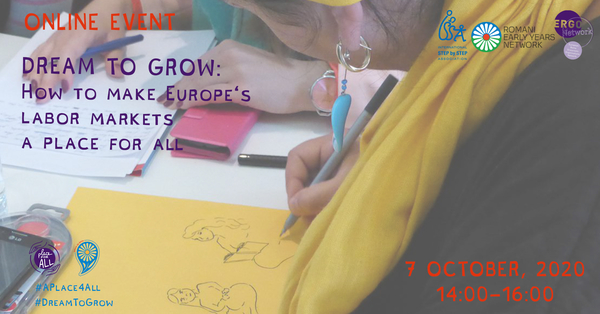
“Dream to Grow: How to make Europe’s labour markets a place for all”

ERGO Network together with the Romani Early Years Network (REYN) – an initiative of the International Step by Step Association (ISSA) – hosted a virtual human library on 7 October, where Roma professionals told the stories of their pathways to become who they are today, showing the difference that enabling, inclusive and diverse educational and working environments can make for society.

The human library took place online, where the participating “readers”, composed of practitioners and policymakers, academics, students and activists, could listen to the diverse and compelling stories of Enzo (Italy), Davie (Scotland), Tünde (Hungary), Milan (Croatia), Maria (Serbia), Ani (Bulgaria), Fatime (Belgium) and Manda (Romania). Four of them are Early Childhood Development practitioners working with national members of REYN, while the other four work in a variety of fields. All of them experienced antigypsyism in education, from wider society and in employment, but against all odds now have fulfilling jobs where they make a change for the children and adults they are working for.

The participants had the chance to read two of the books, and the human library experience was touching and captivating, each story denoting particular characteristics but a common dream – to grow.

The event was opened by Stanislav Daniel, co-chair of ERGO Network and Aljosa Rudas, Program Officer and REYN International Coordinator at ISSA , who introduced the concept and aim of the event and of the corresponding  campaigns of the two host organisations: A Place for All (ERGO Network) and Dream to Grow (REYN).

They highlighted the aim of the event: to raise awareness of the benefits of ensuring equality, inclusion and diversity in education and at work, and of the obstacles that Roma need to overcome to be able to find decent employment. Besides offering an inspiration for the readers, the human library was also a call to action to policy-makers and employers that more needs to be done to overthrow these obstacles and to ensure diversity and inclusion on Europe’s labour markets.

Brando Benifei, Member of the European Parliament in the Group of the Progressive Alliance of Socialists and Democrats, welcomed the continuous work of ERGO Network and REYN to shed light on this important topic, and explained the role that the updated European Youth Guarantee should play to ensure that those young people furthest from the labour market, including Roma, receive support to find decent employment.

Margareta Matache, Director at the FXB Center for Health and Human Rights’ Roma Program and Harvard instructor, spoke about the history of racism against Roma and how the majority society needs to change its perception of Roma in order to ensure discrimination on the labour market and in general society will end.

After these introductory remarks, the most awaited part of the event took place, the online human library. In smaller libraries, the human books told their stories of how they reached the place they are at right now, who and what supported them along the way and which challenges they met. Librarians from ERGO Network and REYN facilitated the dialogue between books and readers in four smaller groups, ensuring human interaction.

In the debriefing, participants were asked to “review” the books they have read. They described their experience in the libraries as “inspiring”, “powerful”, “eye-opening” and “brave” and said that stories of courageous people like these will help Roma children to dream again. Some readers also expressed the importance that the stories are also read by other people, which you can do on the websites of ERGO Network and REYN.

Also Anu Ritz, representing the European Commission Directorate – General for Justice and Consumers, where she works in the Non-discrimination and Roma coordination unit for the EU Platform for Diversity Charters, thanked the human books for sharing their stories, as far too often the real stories of Roma practitioners themselves are not listened to. She presented the current efforts made at EU level to increase diversity and promote inclusion in employment, also linking the event to the EU Roma Strategic Framework for Equality, Inclusion and Equality that was published the day prior to the event.

Stanislav Daniel and Alyosa Rudas closed the event by sharing their final reflections. Stanislav pointed out that the eight human books who presented their stories all succeeded despite a discriminatory system. Going forward, we need to work for a world where people can succeed thanks to the system, not despite it.

Alyosa highlighted that the human dimension presented in the human library is often not reflected in national or EU policies and strategies, and not always needs and views of the community are captured in policy documents. This is why listening to personal stories and creating opportunities for dialogue are so important.

Listening to the life stories of the books and how they overcame prejudice and discrimination in education and employment, and how they are making a change in our societies through their work could be a first step towards a more inclusive future.

Look back at videos from the event here.

Reinforced Youth Guarantee – will Roma youth be included?

The Council of the EU adopts a recommendation for more inclusive measures to boost youth employment by reinforcing the Youth Guarantee – Will Roma youth be included?!
On 30th of October, the Council of the European Union adopted by unanimity a Recommendation on ‘A Bridge to Jobs – Reinforcing the Youth Guarantee’.  The new scheme affirms the upcoming commitment of the EU Members States to set national schemes in order to help young people receive an offer of employment, education, traineeship or apprenticeship within a period of four months of becoming unemployed or leaving formal education. This initiative comes at an urgent time across the EU, during the COVID 19 pandemic, which brought high youth unemployment rates and increased the number of young people not in employment, education, or training (NEETs). Even before the crises Roma youth which as it shown in the last data issued by Fundamental Rights Agency 63% of Roma aged 16-24 were not employed, in education or training (55% of young Roma men and 72% of young Roma women

This is not a new initiative, it follows the EU Council Recommendation of 22 April 2013 on establishing a Youth Guarantee, which numerous studies and ERGO research showed that failed to reach its full potential nor to include the most disadvantaged groups, such as Roma youth.

What is new?

The new Recommendation is considering the concerns of youth organizations and tackles some of the gaps in its implementation, identified as well by ERGO Network. The Recommendation extends the age limit for targeted young people from 25 to up to 29 years old. The new Recommendation also clearly state that the Members States should create supportive measures at national, regional, and local level by providing clear guidelines such as:

  • mapping – identifying target groups, available services, skills needs and young people at risk of becoming a NEET
  • outreach – targeted information campaigns among young people and reaching out to NEETs
  • preparation – better profiling to match needs and responses, counselling, and guidance, and improving digital and other important skills
  • offer – employment incentives, quality and equity, and post-placement support

Now is the moment to make sure that the Member States include the voice of the most deprived in the implementation of the Youth Guarantee, and that they  take into account the situation of Roma youth. One of the main concerns when it comes to the Roma youth is the outreach offer and preparation in a time of pandemic, where many times the ones that need to be a priority are left out due to centuries of discrimination and low standards of education, which is the result of ongoing poverty cycles.

ERGO Network asks Member States to:

  • Invest in continued education (and training): enrolment in formal education or training programs leading to a recognized qualification, keeping in mind an individual approach.
  • Train employment officers and employers to fight antigypsyism: There is a need to train the employment offices as well as potential employers on historical and present antigypsyism, specially to counter the phenomenon during the recruitment process.
  • Improve cooperation between young Roma and labor offices: Governments should encourage a closer communication between labor offices and young Roma people and their civil society representatives, to increase the number of Roma youth engaged with activation programs
  • Hire Roma mediators as social workers/employees of the public employment services and local authorities with the main file and aim to assist Roma youngsters to access the initiatives under the Youth Guarantee, to ensure individual empowerment and ownership.
  • Take a holistic approach: Programs should be created to directly fight youth unemployment with an embraced holistic and multi-sectoral approach, in line with the Active Inclusion Recommendation. Efforts to support young people towards quality education and employment should be complemented by access to adequate income and services such as housing, transport etc
  • A more flexible and accessible registration process of public employment services, to ensure that no young person falls through the gaps and remains out of the social systems of their country – a situation young Roma often find themselves in
  • More partnerships with educational institutions and NGOs who can more easily reach out to Roma and other marginalized groups. This requires dedicated funding that will allow these partners to support the public employment services in the delivery of the Youth Guarantee, or to directly establish contacts with employers and support the skills development of young people.

It will now be up to the Member States to implement the Reinforced Youth Guarantee. We will continue the monitoring and advocating for young Roma people to have quality opportunities through this initiative, on equal footing with majority youth.

For additional information regarding our work on the Youth Guarantee and Youth Employment, please contact Policy Officer Carmen Tănasie in the ERGO Network staff (c.tanasie@staging.ergonetwork.org).

Dream to Grow

Dream to grow: How to make Europe’s labor markets a place for all

Co-hosted by: European Roma Grassroots Organizations Network (ERGO) and the Romani Early Years Network (REYN), an initiative of ISSA – the International Step by Step Association

October 7th, 14:00 – 16:00 CET

  • Find the agenda and catalogue of human books here.
  • Sign up here to receive access to the online event.

Although almost ten years have passed since the adoption of the EU Framework for National Roma Integration Strategies, Roma remain widely exposed to antigypsyism, poverty and social exclusion without opportunities to access proper education, employment, or training. They keep facing unequal treatment and inequalities in health, education, employment, and living conditions, a gap which has continued to widen following the outbreak of the COVID-19 pandemic.

63% of Roma aged 16-24 are not employed, in education or training (55% of young Roma men and 72% of young Roma women) and 40% of Roma report feeling discriminated at work! Even if they manage to secure employment, they often continue to face lower wages, precarious and atypical contracts, a lack of career options, and direct discrimination and harassment of employers and colleagues.

Eliminating such inequalities and promoting positive models of inclusion and diversity starting from the very beginning of life must be a priority not only for EU and national policy makers, but also for every person in Europe. Diversity does not only benefit minorities, but also impacts greatly on the quality of services offered and on society.

Acknowledging that it is fundamental to rewrite the current narrative about Roma and restore their dignity and pride, this event aspires to share inspiring stories highlighting Roma professionals’ different pathways to become who they are today and showing the difference that enabling, inclusive and diverse educational and working environments can make for society.

Why should you join this event:

  • Get inspired by real-life stories of Roma professionals who have succeeded to break the wall of prejudices and stereotypes and realized their dreams by participating in the online Human Library.
  • Learn about the advocacy efforts civil society organizations are doing to ensure equity, inclusion and diversity in education and at work.
  • Reflect together about the multilayered challenges and unequal treatment young Roma are facing in Europe and the long-term consequences of political inaction.
  • Benefit from lessons learned in implementing inclusive policies and practices and discover how to become part of the solution.

This event receives funding from the European Union. The information contained reflects only the author’s view; and the Commission is not responsible for any use that may be made of the information it contains.

This event is co-funded by the Open Society Foundations Early Childhood Program. The program has been providing continous support to the Romani Early Years Network initiative since its start.

`
Employment – Page 2 – ERGO Network

By continuing to use the site, you agree to the use of cookies. more information

The cookie settings on this website are set to "allow cookies" to give you the best browsing experience possible. If you continue to use this website without changing your cookie settings or you click "Accept" below then you are consenting to this.

Close