Successful 2nd EU Roma Week

Successful 2nd EU Roma Week

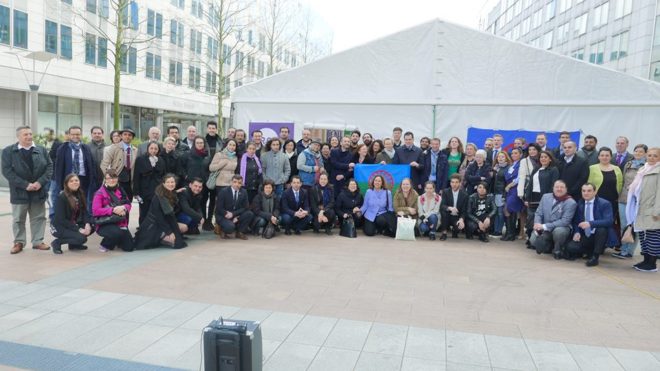
ERGO Network was one of the co-organisers of the 2nd EU Roma Week that was held from 27th to 3rd April 2017 in the European Parliament to mark the occasion of International Roma Day on 8th April.

Around 200 representatives of public institutions and civil society took part in a series of events dedicated to Roma integration in Europe.

The public institutions were represented by DG Justice, DG NEAR, the Fundamental Rights Agency and the European Parliament as well as the Contact Point for Roma and Sinti of OSCE/ODIHR. Civil society was represented by a number of young Roma activists and representatives of the European Roma Rights Centre, the Roma Initiatives Office of Open Society Foundations, ERGO Network, Ternype International Roma Youth Network, The German Central Council of Sini and Roma, the Spanish Fundacion Secredariado Gitano and many more, making the week a very useful space for all stakeholders of Roma integration to discuss their work.

A youth advocacy training led by ERGO Network, TernYpe, the German Council of Sinti and Roma and the German Documentation and Culture Centre for Sinti and Roma prepared 40 young Roma advocates to take part in all Roma week events and to advocate for their rights after their return to their home countries.  In three working groups focussing on antigypsyism, inclusion and political participation they discussed their experiences, learned about the institutional frameworks and agreed on the messages that they took forward in the debates in the European Parliament.

A workshop on strengthening diverse leadership, participation of Roma in public and political life organised by the Contact Point for Roma and Sinti of the OSCE/ODIHR invited participants to discuss diversity in mainstream political parties and decision-makings and draw comparisons between Europe and the US. The participants all agreed that the public narrative on Roma must change to combat antigypsyism, and that this effort must be led both by Roma and Non-Roma.

The European Commission’s Directorate General for the European Neighbourhood and Enlargement awarded the 2nd EU Roma Integration Award for the Western Balkans and Turkey to organisations supporting Roma children, youth and young adults.  3 members of ERGO Network, Otharin Bosnia, Rroma acedonia and Mladi Montengero were rewarded for their work.

The participants of the award ceremony also took part in a discussion on improving impact of EU funding and Roma integration policy in the enlargement region through partnership with Roma civil society.

The Greens/EFA in the European Parliament used the occasion of the EU Roma Week to launch their new publication “Countering Antigypsyism in Europe”, outlining achievements and failures of combating antigypsyism in the EU, outlining problems of segregation and the political dimension of antigypsyism, as well as pointing out the fight for recognition of Roma in public and civic life.

A very important discussion on the future of the EU Roma Framework took place in the event “Taking stock of the EU Roma Framework and National Roma Integration Strategies”, with a view to building a post-2020 strategic approach, which brought together all relevant stakeholders to provide input to the mid-term assessment of the Framework as a step for improving the remaining years and for shaping the next programming period.

Invited by the Greens and the S&D Group, the European Roma Rights Centre gave evidence on how strategic litigation can be used to challenge racism in court, especially when it comes to forced evictions and school segregation.

Soraya Post, one of two Roma MEPs in the European Parliament, invited Holocaust survivors to give testimonies of their life and their activism to raise more awareness of the Roma Holocaust and call for a Roma Holocaust Memorial Day.

Roma activists from the EU and enlargement countries finally met with Members of the European Parliament and representatives of the European Commission for a working breakfast to bring the voices and visions of Roma youth to decision-makers and discuss their concerns, challenges and realities. They highlighted how Roma youth have become strong agents of change for their communities and how political leaders across Europe can contribute to the fight against antigypsyism.

Such an intensive programme of debates and discussions cannot be successful without a good informal time, too. All participants and partners celebrated at the big Roma Week Party hosted by ERGO Network and danced to the music of two Roma bands.

We would like to thank all partners involved, and especially the European Parliament Anti-Racism and Diversity Intergroup who coordinated all events, for the common efforts and the good dialogue that will continue in the coming months.
ERGO Network has a new Director

ERGO Network has a new Director

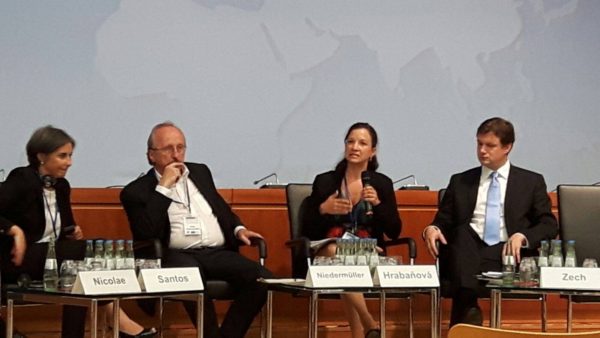
As of 1st April 2017, ERGO Network has a new executive director who will lead its secretariat and advocacy work in Brussels. Jamen Gabriela Hrabanova, former deputy director, has been appointed by ERGO’s board to tave over from our colleague and friend Ruus Dijksterhuis who said goodbye to ERGO after 14 years in its leadership.

Ruus Dijksterhuis has co-founded ERGO Network in 2003 and since then has been fundamental to its growing strength and outreach. She said good-bye to many members and close partners during the EU Roma Week 2017: “It is amazing to realise that ERGO has become a key player on European level thanks to the commitment of man people around. I believe we have built a unique organisation, being the only truly European Roma network. I am proud that many of the people from the first hour are still engaged to make the best out of our network.”

Ruus Dijksterhuis has been a great advocate for the participation of Roma as equal stakeholders in civic and political life and ERGO would not exist today without her hard work, passion and dedication for Roma rights.  We wish her all the best for the future.

Jamen Gabriela Hrabanova is not new to ERGO Network; she has been its advocacy and policy coordinator and later deputy director since 2011. She is a strong human rights activist with extensive experience in protection, promotion and advocacy of Roma rights and is a Roma herself.

She started her career as a consultant for non-profit organisations in Czech Republic and then joined the Governmental Office as Director of the Roma Office for the Council of Roma Minority Affairs, where she coordinated strategic and conceptual work related to Roma integration. She was strongly involved in the Czech Presidency of the European Union when the 10 Common Basic Principles for Roma Inclusion were adopted, and organised the first meeting of the EU Roma Platform. She is furthermore a member of the Advisory Panel to the Director of the Fundamental Rights Agency and a board member of RomMedia Foundation in Budapest.

Jamen Gabriela Hrabanova’s focus for the coming years will lie on strong capacity-building among Romani organisations in order to be more impactful in advocacy and to increase quality standards in accountability and transparency of (pro)Roma civil society. She aims to support the creation of coalitions and alliances to increase the voice of Roma in policy-making processes and to strengthen ERGO’s work to combat antigypsyism on all levels. Besides this, she states: “Within our network, my passion lies on creating a learning organisation that encourages sharing knowledge and experiences, creating ideas together and learning from each other. We will explore and build new potential especially among young Roma activists and strengthen our say in policy-making”.

For more information on ERGO Network, please follow us on www.ergonetwork.organd www.Romareact.org. The new director Jamen Gabriela Hrabanova can be contacted at g.hrabanova@staging.ergonetwork.org, +32 2 893 09 45.

ERGO co-organises the 2nd EU Roma Week from 27 March to 3 April 2017

ERGO co-organises the 2nd EU Roma Week from 27 March to 3 April 2017

The second EU Roma Week is a joint initiative of the European Commission and the European Parliament, together with civil society and international organisations.  Between 27 and 29 March, numerous Members of the European Parliament will host events on antigypsyism, political participation of Roma, funding for civil society, recognition of the Roma Holocaust and litigation to fight school segregation. An exhibition and reception in the European Parliament will close the week on 3rd April in Strasbourg.

The EU Roma Week aims to further the recognition of antigypsyism as the root-cause of the exclusion and marginalisation of Roma in Europe. The first step towards a new generation of more efficient policies and programmes that will make a real change for the Roma in Europe is to recognise antigypsyism as a specific form of racism in its various forms and to fight it at all levels of our societies. Without systematic and long-term efforts of public institutions to address antigypsyism, EU and governmental policies on Roma inclusion will remain without impact.

It furthermore aims to establish a Roma Holocaust Memorial Day to recognise the extermination of 500,000 Roma during World War II.  The Roma Week will also be an important step for the mid-term review of the EU Roma framework and the planning towards the Post 2020 process.

Already from tomorrow, Friday 24th March, a group of young Roma activists will take part in an advocacy training organised by ERGO Network, the youth organisation TernYpe, Central Council of German Sinti and Roma and the Dokumentations-und Kulturzentrum Deutscher Sinti und Roma, where young people will prepare their contributions to the Roma Week. Activists from enlargement countries will be present as well for a common programme with DG NEAR and to receive the Second EU Roma Integration Award for the Western Balkans and Turkey.

One of the highlights of the week will be a breakfast meeting between young people and MEPs in the morning of 29th March, organised by ERGO Network. ERGO further hosts a big Roma Week Party in Mundo B on 28th March and co-organises several other events.

Jamen Gabriela Hrabanova, deputy director of ERGO Network, states: “Civil Society took a very important role in preparing the Roma Week and in shaping the content of the discussions. This makes it a great space for dialogue between the European institutions and civil society. We are looking forward to the diverse events and to contributing to shaping the EU Roma agenda together.”

Hosting MEPs: Soraya Post, Brando Benifei, Bodil Ceballos, Damian Draghici, Cornelia Ernst, Fredrick Federley, Marina Albiol Guzmán, Benedek Javor, Barbara Lochbihler, Peter Niedermuller, Tania González Peñas, Terry Reintke, Barbara Spinelli and Tomáš Zdechovský.

Co–organising civil society organisations and institutions: ERGO Network, Fundacion Secretariado Gitanos, ternYpe, Central Council of German Sinti and Roma, European Roma Rights Centre, European Network against Racism, OSEPI, OSCE/ODIHR, Fundamental Rights Agency.

Follow the event on twitter: #EURomaweek

Contact: Christine Sudbrock (c.sudbrock@staging.ergonetwork.org, +32 486 046 940).

Download the full programme here

Download the press release here


Roma Forum Romania

Roma Forum Romania

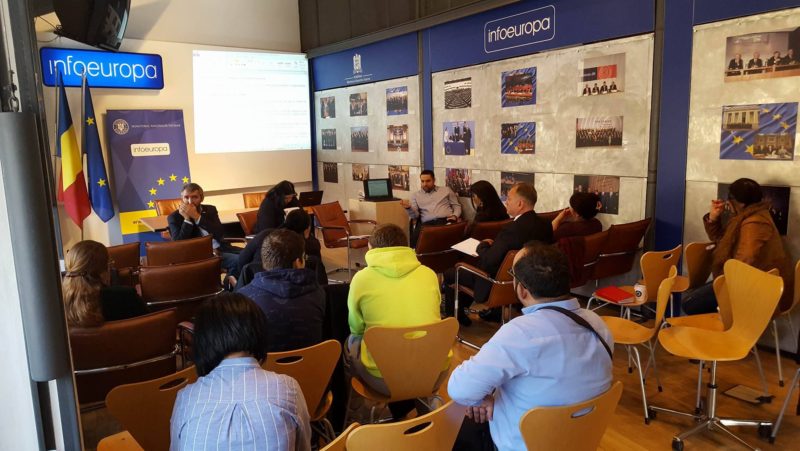
The Second National Meeting of Roma Forum in Romania took place on 18 November 2016 at the InfoEurope Center in Bucharest, organized by Nevo Parudimos, as member of ERGO Network, in partnership with Romani Criss.

The meeting focused on issues of Roma communities in order to increase the capacity-building of Roma grassroots organizations who are members in the Roma Forum, especially in the area of monitoring and advocacy work, together with experienced NGOs such as RomaniCriss and Sastipen;

The discussions focused on the list of proposals for the Romanian Presidency of the European Union in 2019 in order to be formalized in the public agenda during the Romanian presidency. These proposals refer to the following areas: school segregation, the mediation process for health and education and the forced eviction of the Roma.

Marian Mandache (Romani Criss), as an invited speaker of the 1st session, proposed ways of addressing the Roma issues to the future Romanian Government from 2017: bilateral meetings on the main social and economic fields that address Roma, such as sectorial meetings with public ministry representatives to include in their public agenda the Roma issues.

The Roma Forum had about 20 participants of Roma organizations from Romania and some new ones expressed their willingness to join.

As an ERGO member, Nevo Parudimos expresses its commitment to sustain the Roma Forum activities and to develop the capacity of Roma NGOs by exchanging information, solutions and models in order to overcome certain issues.

Also representatives of public authorities, namely the National Roma Agency and Mr. Alexandru Potor from the National Federation of LAGs, participated in the meeting.

A new united Europe for people

A new united Europe for people

ERGO Network is one of 177 European and national civil society organizations and trade unions to sign a common statement calling for a new direction for the European Union.

The statement is directed to the 27 EU leaders who are going to meet for an informal Summit in Bratislava on the 16th of September, where the leaders are supposed to address the growing gap between the citizens and the EU in the wake of the UK referendum.

The common statement has been adopted to show a common position demanding leaders to fight back against populism, social inequalities, climate changes etc.

For more information read the full statement and see a full list of signatories.

`
General – Page 41 – ERGO Network

By continuing to use the site, you agree to the use of cookies. more information

The cookie settings on this website are set to "allow cookies" to give you the best browsing experience possible. If you continue to use this website without changing your cookie settings or you click "Accept" below then you are consenting to this.

Close