Joint recommendations for the European Care Strategy

Joint recommendations for the European Care Strategy regarding migrant care providers and service users

Together with other human rights organisations, ERGO endorsed Joint recommendations for the European Care Strategy regarding migrant care providers and service users.

This document sets out some joint recommendations for the inclusion of migrants in the forthcoming European Care Strategy and accompanying Council recommendations, both as workers and providers of care as well as care service users.

With a view to supporting the full inclusion of people who are non-nationals in every part of the strategy, the document is organised around key aspects that the strategy is expected to address, namely: access to care, affordability, sustainability, quality of care, workforce, and gender aspects of care.

 Contributors and endorsement

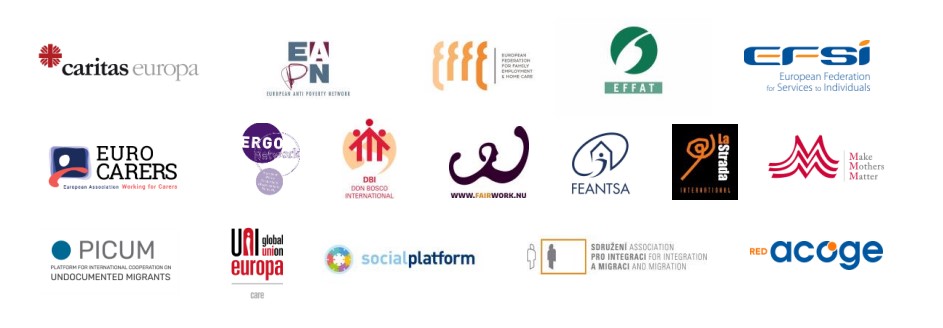
  • Caritas Europa
  • EAPN – European Anti-Poverty Network
  • EFFE – European Federation for Family, Employment & Home Care
  • EFFAT – European Federation of Food Agriculture and Tourism Trade Unions
  • EFSI – European Federation for Services to Individuals
  • Eurocarers
  • ERGO – European Roma Grassroots Organisations Network
  • Don Bosco International
  • FairWork (the Netherlands)
  • FEANTSA – European Federation of National Organisations Working with the Homeless
  • La Strada International
  • Make Mothers Matter
  • PICUM – Platform for International Cooperation on Undocumented Migrants
  • UNI Europa – UNICARE
  • SIMI (Czech Republic)
  • Social Platform and Red Acoge (Spain)

General principles and key messages

  • People who have non-EU nationality living in the EU must be fully considered and included in every part of the EU’s care strategy.
  • The availability, accessibility, affordability and quality of health, social and long-term care, as well as early childhood education and care, are essential for all, and especially those who, as non-nationals with various statuses living in the EU, may face particular barriers in accessing care, intersectional discrimination, marginalisation and in-work poverty.
  • The COVID-19 pandemic both reinforced the essential role of the care sector and exacerbated the precarity of migrant carers. Appropriate and effective measures are urgently needed.
  • The forthcoming European Care Strategy should:
    • Recognise the essential role and contributions of both intra-EU mobile workers and non-EU migrant workers, including undocumented workers, in providing care in the European Union.
    • Recognise that in many cases this care is being provided undeclared or under-declared, in exploitative conditions, impacting on the rights and well-being of workers and their families. This also impacts on care service users, and contributes to unfair and unsustainable social protection systems. Decent work should be integral to definitions and priorities around sustainable and quality care systems.
    • Commit and set concrete actions to promote decent work for all care workers, regardless of their migration or residence status, including through targeted measures.
    • Commit and set concrete actions to ensure that all people living in the EU have access to quality services on the basis of need, regardless of their migration or residence status.
    • Recognise and support informal carers, including young carers, regardless of their migration or residence status.
    • Meaningfully involve representatives of care workers, including migrant carers- as well as those in need of care – in the development, monitoring and evaluation of care policy-making and reform, and encourage member states to do likewise.
    • Encourage member states to evaluate the impacts of policies – in particular in the areas of employment, education, health and migration – on people in need of care, families, care workers and informal and formal care service provision, including through gender impact assessments.
    • Encourage the use of both EU and national funds, in particular ESF+ and the Child Guarantee national action plans, to improve access, affordability and quality of care services for marginalised and disadvantaged people and families, including mobile EU and non-EU migrants.
  • It is important for the European Care Strategy to address both the differences and overlap between care and non-care services needed by, and provided to, people with care needs in their homes. The strategy needs to recognise the different professional and skills profiles of care workers. This should reflect the types of care that require professional qualifications, as well as the reality that in many home care arrangements, people are providing a combination of care and housework-related personal household services.

Download the joint recommendations

Letters to EU and United Nations in support of Ukraine Roma

Letters to EU and United Nations in support of Ukraine Roma

To bring the attention of the international bodies to the dire situation of Ukrainian Roma refugees, ERGO Network has reached out to European Union and United Nations.

Letters were sent to

Letter to the European Union

President Ursula von der Leyen,  President of the European Council Charles Michel and High Representative of the European Union for Foreign Affairs and Security Policy Josep Borrell Fontelles

Letter to the United Nations

High Commissioner for Human Rights Michelle Bachelet

calling on their respective institutions to do their utmost to ensure that in the current war the border and other affected Member States do not further discriminate against Roma and other racialized and vulnerable minorities.

Joint Statement “End the war against Ukraine!” #StandWithUkraine

Together with the letters ERGO Network has sent Joint Statement “End the war against Ukraine!” #StandWithUkraine, signed by Members of the European Parliament, International and national organisations and individuals. The current number of signatures of this letter is over 400.

Please consider joining us by signing this Joint Statement. To do so follow this link.

For more information about ERGO Network’s advocacy in support of Ukrainian Roma and other vulnerable communities, please don’t hesitate to contact our Senior Policy Officer Isabela Mihalache at i.mihalache@staging.ergonetwork.org

Joint Briefing for United Nations Committee on the Rights of Persons with Disabilities

Joint Briefing for United Nations Committee on the Rights of Persons with Disabilities regarding the review of the implementation of the CRPD by the EU

Together with other human rights organisations, ERGO endorsed a Joint Briefing to inform the UN Committee on the Rights of Persons with Disabilities about issues of inequality and intersectional discrimination faced by persons with disabilities with intersectional identities in the European Union (EU). Its objective is to inform the adoption of the List of issues prior to reporting on the EU.

The endorsing organisations are alarmed by the rate of discrimination faced by persons with disabilities in all their diversity in Europe. The EU has not taken enough measures to address equality and non-discrimination in its legislation and policies, and in particular to address intersectional and multiple forms of discrimination.

In particular, the EU is yet to:

  • Adopt legislation and policies to prevent and combat discrimination on all grounds and in all areas of life
  • Adopt legislation and policies to prevent and combat hate speech and hate crime, including based on disability and other grounds
  • Ensure that Equality Bodies are protected by standards that among others, harmonise the mandate of equality bodies so that they can adequately and efficiently combat disability-based discrimination and support victims of unequal treatment
  • Adopt intersectional policies and targeted measures against intersectional discrimination

The organisations recommend that the CRPD Committee request information on those issues and pay particular attention to the diversity of persons with disabilities in its List of issues prior to report and Concluding observations.

Download the joint report

 Contributors and endorsement

  • AGE Platform Europe
  • Equinox Initiative for Racial Justice
  • Eurochild
  • The European Disability Forum (EDF)
  • The European Network Against Racism (ENAR)
  • The European Network of Equality Bodies (Equinet)
  • The European Roma Grassroots Organisations (ERGO)
  • The European Youth Forum
  • Hope and Homes for Children
  • ILGA-Europe
  • Lumos
  • Transgender Europe (TGEU)

Council Conclusions on Racism and Antisemitism

Council conclusions on racism and antisemitism: European Union (EU) the Member States must commit to fighting structural racism and ensure equality for all people living in the EU

The European Network against Racism, Equinox Initiative for Racial Justice, the European Roma Grassroots Organisations Network (ERGO) and the Forum of European Muslim Youth and Student Organisations (FEMYSO) support the initiative proposed by the French Presidency to have Council Conclusions on Racism and Antisemitism adopted by the Council of the EU.

We believe Council Conclusions are an important step forward which will show the support and commitment of Member States to the EU Anti-Racism Action Plan (EU ARAP), adopted in September 2020. The EU Commission has constantly referenced the EU ARAP to affirm its commitment to addressing racial injustice in response to anti-racism protests in Europe and the Black Lives Matter movement.

The EU ARAP was a landmark document as for the first time the EU officially recognised institutional forms of discrimination. Civil society has raised concerns for many years about how deeply structural racism is embedded in European society and how it is having a significant impact on the lives of many people in Europe, especially during this unprecedented health crisis. Civil society organisations and human rights advocates have also warned that denying the existence of systemic racism poses an increased threat to the rule of law and fundamental rights.

Therefore, it is important that the Council Conclusions also recognise structural and institutional racism and build on the important work done by the European Commission and civil society.

For the next meeting on Fundamental Rights of the Council of the EU (FREMP), we call on Member States to support and include the following recommendations in the Council Conclusions:

To Member States:

- Recognise structural and institutional forms of racism which stem from many European Member States’ historical role in discriminating against racialised people., in the past and present.

- Ensure that all forms of racism (including antisemitism, antigypsyism, islamophobia, afrophobia/anti-black racism, anti-Asian racism, anti-migrant racism, discrimination against indigenous people, etc.) and their manifestations are mentioned and addressed through an intersectional approach with equal attention and refrain from creating hierarchy between groups affected by racism, which only further reinforce inequalities.

- Collect equality data disaggregated by race and ethnicity as a major tool to understand racial inequalities and assess progress of policies as per recently published in the European Commission’s guidance note on the collection and use of equality data based on racial or ethnic origin.

- Carry out equality impact assessments of legislation and policies in Member States, with an intersectional approach.

- Adopt or improve National Action Plans against Racism following the Common Guiding Principles adopted by the European Commission’s NAPAR subgroup.

- Address the structural obstacles that prevent hate crime and hate speech reporting and access to rights and remedy, such as tackling lack of accountability of law enforcement in case of re-victimisation, police violence, criminalisation and suspicion of migrants and racialised people based on racial prejudices and denial of basic rights

- Use existing budget allocations to explore and adopt structural reforms for law enforcement and the criminal justice system to address existing institutionalised racism and to encourage a move away from criminalisation of certain communities.

To the European Commission:

- Strengthen the work and position of the EU anti-racism Coordinator and for the implementation of the EU ARAP, including by ensuring coherence between equality issues and having Commissioners directly supervising anti-racism work.

- Provide more resources to mainstream racial equality across all policy areas and in the different Directorates-General, including by carrying out equality impact assessment of policies and legislation, with an intersectional approach.

- Monitor the situation of anti-racist human rights defenders and ensure support, including by strengthening the chapters on civic space and fundamental rights in the European Commission’s Rule of Law report.

- Ensure that all forms of racism are treated equally and centered under the mandate of the anti-racism coordinator, ensuring that coordinators on antisemitism and anti-Muslim hatred are working in close collaboration.

The full document can be found here: Council Conclusions

For more information about this, please don’t hesitate to contact our Senior Policy Officer Isabela Mihalache at i.mihalache@staging.ergonetwork.org

Open Letter calling for meaningful debate on and written responses to European Citizens’ Panel recommendations

Open Letter calling for meaningful debate on and written responses to European Citizens’ Panel recommendations

Dear members of the Executive Board,

The Conference on the Future of Europe (hereafter: the Conference) is at a crossroads: either it will turn into an ugly interinstitutional battle happening largely behind closed doors, feeding cynicism about EU and the oft-declared ‘Europe of citizens’, or it will fully embrace the potential of meaningful and publicly accountable engagement with Europe’s citizens and residents. In order to increase our chances of the Conference going down the second road, we call on you to ensure that the recommendations coming out of the European Citizens’ Panels are all seriously and publicly debated and responded to in writing by the Conference Plenary and its Working Groups.

While the process of European Citizens’ Panels designed and implemented for the purpose of the Conference is very far from perfect, and while their output is not and should not be the exclusive input for the work of the Conference Plenary[1], the way this output is dealt with will be a crucial indicator for the success of the Conference[2]. If you invite 800 citizens from all across Europe to dedicate more than three weekends of their time to come up with recommendations for the future of the European Union, the least you owe them and the wider European public is a public debate followed by a clear, reasoned and detailed answer on each of their specific recommendations.

An important task of the Conference Plenary is to debate the recommendations coming out of the European Citizens’ Panels[3]. However, in order to ensure that this debate is meaningful and accountable, connected to the outcomes of the Citizens’ Panels, it should be followed by the adoption of a resolution in which the Conference Plenary responds concretely and in detail to each of the recommendations. In the absence of such a document, many citizens are likely to feel misled, as they will not see how their recommendations had a serious chance of being heard and making a difference. Even if the Conference Plenary disagrees with certain recommendations, it is of crucial importance to communicate and justify such opposition explicitly, publicly and in writing.

The Working Groups are the appropriate place to debate recommendations in detail and to prepare the final position of the Conference Plenary on citizens’ recommendations. In order to fulfil this role, Working Groups should be given the adequate resources and working structures, and their meetings should be live-streamed[4].

Considering the powers the EU institutions invested in you as Executive Board, as defined by the Joint Declaration, we count on you to adjust the Conference’s Rules of Procedure and the Working Groups Terms of Reference to accommodate our urgent requests for meaningful, publicly accessible Working Group and Conference Plenary debate on, and clear, detailed and reasoned written responses to, the European Citizens’ Panel recommendations.

We are looking forward to hearing back from you.

Sincerely,

List of civil society organisations co-signing this letter:

Alliance4Europe
Allianz für WERTEorientierte Demokratie (AllWeDo)
Alpe Adria Green
Another Europe
Asociación Musulmana por los Derechos Humanos
Balkan Civil Society Development Network (BCSDN)
Bulgarian Center for Not-for-Profit Law
Citizens for Europe
Citizens Take Over Europe
CIVICO Europa
Civil Society Development Foundation, Romania
Civil Society Europe
Culture Action Europe
Danubiana Network
Debating Europe
Democracy International
ENAR – European Network Against Racism
Equinox Initiative for Racial Justice
ERGO network
ETUC – European Trade Union Confederation
Eumans – citizens for democracy and sustainability
Europe for Scotland
European Alternatives
European Center for Not-for-profit Law Stichting (ECNL)
European Civic Forum
European Democracy Lab
European Environmental Bureau
European Federation of National Organisations Working with the Homeless
European House
European Movement Italy
European Network on Religion & Belief
Fix The Status Quo
Fórum dos Cidadãos
Friends of the European Republic
Gong
Greek Forum of Migrants
IGO – Interessenvertretung Gemeinnütziger Organisationen
ILGA-Europe
INITIATIVE FOR DEVELOPMENT AND COOPERATION
Institute of Public Affairs
Ligue de l’enseignement
Mehr Demokratie e.V.
Music Theatre International
National Network for Civil Society Germany (BBE)
OGA Ireland – Open Government Association Ireland
Politics for Tomorrow / nextlearning e. V.
Pulse of Europe
Regional Roma Educational Youth Association – RROMA
Social Platform
Society for Sustainable Living/STUŽ
SOLIDAR
Stand Up for Europe
Take a Break from Brexit
TGEU
The ECI Campaign
The Good Lobby
The Wheel
Unconditional Basic Income Europe
Understanding Europe

This letter is sent to Executive Board members on Thursday, 20 January 2022, with a total of 58 co-signatories. If your organisation still wants to support this letter and remain updated, including about possible future actions, please fill out this form.

Footnotes:
[1] In this context, we want to mention and recognise the work done by the Civil Society Convention on the Future of Europe in bringing civil society actors together and developing common proposals for the Conference Plenary to debate and consider.
[2] We note that our call for written replies to recommendations from the European Citizens’ Panels does not preclude the Conference Plenary additionally developing written responses to recommendations from National Citizens’ Panels, from the Civil Society Convention on the Future of Europe and/or from other sources, as collected on the Digital Platform.
[3] See articles 5 and 17 of the Rules of Procedure of the Conference on the Future of Europe.
[4] Up until now, only one Working Group meeting was ever live-streamed, the ‘EU in the world’ Working Group meeting taking place on 17 December at 11:00 CET (find the recording here).

`
General – Page 21 – ERGO Network

By continuing to use the site, you agree to the use of cookies. more information

The cookie settings on this website are set to "allow cookies" to give you the best browsing experience possible. If you continue to use this website without changing your cookie settings or you click "Accept" below then you are consenting to this.

Close