European Semester – ERGO response to the country reports

European Semester: European Commission releases Winter Package
What’s in it for Europe’s Roma?

On 26 February 2020, the European Commission published the so-called Winter Package, comprising the 28 Country Reports 2020 (including the United Kingdom), and the usual Communication on Country Reports, in the framework of the 2020 European Semester.

The European Roma Grassroots Organisations (ERGO) Network warmly welcomes the explicit mention of the European Roma in the Communication on the Country Reports, which states “Equal access to high-quality education and training from an early age is also essential to promote equality of opportunities and to foster inclusion, including of underrepresented groups such as Roma…”. However, we are disappointed that the Roma are mentioned exclusively under education and training. There are no references to the fact that Roma people in Europe face poverty and social exclusion at rates of over 80% in most Member States, that their employment, health, housing and other indicators are extremely low compared to the majority of the population, and that antigypsyism and discrimination continue to be rampant.

This approach is mirrored by the very vast majority of the individual Country Reports included in the Package, according to the review performed by the ERGO Network and its national members. Read below the Key Messages derived from this analysis and access the full report here:

  1. Only 6 Country Reports explicitly refer to the Roma, despite most of them across Europe experiencing severe discrimination, marginalisation and segregation, poverty, poor living conditions, and very low employment, education, and health outcomes.
  1. The National Roma Integration Strategies are not given enough prominence and support in the vast majority of Country Reports, evidencing a lack of effective integration of the EU Roma Framework in the European Semester and its processes.
  1. The national approach to Roma rights and inclusion continues to be piecemeal in most countries, while a comprehensive, integrated policy response, rooted in realities across all social areas and equally tackling antigypsyism, is lacking.
  1. The approach to Roma communities is consistent with an unfortunate lack of prioritizing of issues related to ethnic minorities and discrimination throughout the Country Reports.
  1. Civil society organisations are only rarely mentioned as key partners in the design, implementation, and monitoring of public policies, thus weakening the effectiveness of interventions, as well as undermining ownership and democratic decision-making processes.

For more information about ERGO Network’s work on EU social inclusion and employment policy (European Semester, Europe 2020, European Pillar of Social Rights, Sustainable Development Goals etc), please contact Senior Policy Adviser Amana Ferro.


ERGO Network meets new EU Commissioners

ERGO Network meets European Commissioner for Equality Helena Dalli, and is part of the Social Platform delegation to meet Executive Vice Presidents Frans Timmermans (cabinet) and Valdis Dombrovskis

In the first months of 2020, ERGO Network took the opportunity to get to know three of the new EU Commissioners who are essential for our work towards fostering social inclusion of Roma and combatting antigypsyism and to convey our key messages.

On 28 January 2020, a delegation of 14 ERGO Network member organisations met with the new European Commissioner for Equality Helena Dalli, to commemorate the Holocaust Remembrance Day, as well as to discuss about the challenges faced by Roma civil society organisations in fighting antigypsyism and advocating for Roma rights and inclusion, and a meaningful and participatory post-2020 Roma Strategy. “Roma people have been living in Europe for more than 700 years and have massively contributed to the richness of the European heritage. Yet, for centuries, European societies have turned a blind eye to racism and widespread discrimination of Roma people. We have to change that”, committed Commissioner Dalli. Topics discussed included:

  • combating antigypsyism as horizontal and stand-alone priority, in all its forms and manifestations, including through strong legislative measures;
  • a comprehensive, binding, EU Strategy for Roma inclusion that includes enlargement countries on equal footing, with concrete minimum standards, ambitious targets, and common monitoring at the EU level;
  • capacity-building, support and channels for Roma civil society to meaningfully engage in the design, implementation, and monitoring of public policies that affect them;
  • prioritising Roma inclusion in the next MFF programming period, ensuring that Roma communities are involved in the delivery of European funds at the national and local level.

On 19 February, the ERGO Network was part of the Social Platform delegation to meet with the cabinet of European Commission Executive Vice-President Frans Timmermans, to put forward the Roma rights perspective in discussions about how to put social inclusion at the heart of the Sustainable Development Goals and the European Green Deal in post-2020.

On 25 February, the ERGO Network was part of the Social Platform delegation to meet again with European Commissioner for Equality Helena Dalli. We reiterated the importance of Roma-related indicators and data, the need for a specific investment priority on Roma, the importance of diversity, especially of including LGBTQIA+ Roma in the next EU Roma Framework, and the need to work together with civil society.

On 6 March, the ERGO Network was part of the Social Platform delegation to meet with European Commission Executive Vice-President Valdis Dombrovskis, in charge of an Economy that Works for People. We stressed the importance of ambitious targets, common indicators, and a strong EU monitoring process for the post-2020 Roma Integration Strategies, and for poverty reduction and social objectives in general.
Intersecting Realities

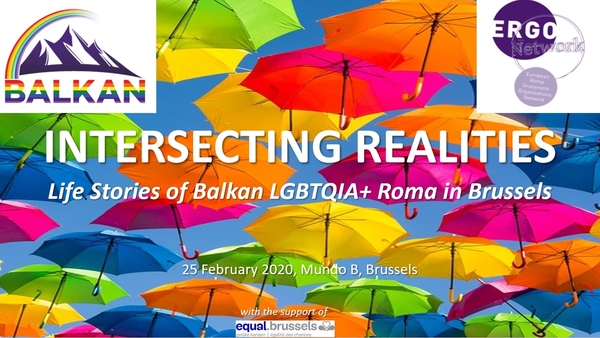
On 25 February 2020, ERGO Network together with Balkan LGBTQIA vzw organized an inspiring and mind-opening event in Mundo B, Brussels: the photo exhibition and conference ‘Intersecting Realities: Life stories of Balkan LGBTQIA+ Roma in Brussels’.

During the event, the book ‘My Story’ was launched, which features eight life stories about the experiences of LGBTQIA+ migrants from the Balkan countries, many of them Roma. The stories and portraits of the books were displayed in an exhibition, and some of the individuals portrayed in the book shared their powerful stories of racism, discrimination, but also love and support with the audience. The event was opened by ERGO Network Director Jamen Gabriela Hrabanova and Danny Jacqmot, Attaché of Equal.Brussels, which kindly funded the book project and the launch event.

The personal testimonies of Djenk Ejupi (North Macedonia) and Gerard Epure (Romania) were followed by a moderated debate on discrimination at the intersection of origin, ethnicity, gender and sexual orientation.

Lilly Dragoeva from the NGO Bilitis Bulgaria, Deszo Mate from Eötvös Loránd University, Hungary, Biser Alekov of Balkan LGBTQIA, Brussels, Isabela Mihalache of ERGO Network, Brussels and Szabolcs Schmidt of the European Commission, Directorate-General for Justice and Consumers, Unit on Non-Discrimination and Roma Coordination explained the concept of intersectionality, gave examples from different EU Member States, and discussed the European Commission’s efforts to tackle intersectional discrimination.

The event was a unique opportunity to bring the focus on a target group that has always remained in the shadow of the majority, considering their voice has not been heard so far.

If you are interested in obtaining a copy of the book, please Biser Alekov at  Biseralekov@gmail.com

Activities of Slovo 21

Meeting with representatives from NGO Centrum Inkluze within the CLLD

On 6 March Slovo 21 organized a meeting with 3 representatives from the NGO Centrum Inkluze in Suchdol nad Odrou with the aim to share information within the Local Action Group Opavsko. The NGO Centrum Inkluze is based in Budišov nad Budišovkou, where a high number of Roma live. Slovo 21 shared information on grant opportunities such as “Small Leader” within the LAG Opavsko and on other grants focused on education, culture and environment. During the meeting we agreed on future steps to build a Community Centre in Budišov nad Budišovkou, which would be used for educational and cultural programmes not only for Roma but also for the majority. Our next steps include cooperation with Roma women from this locality led by one of the representative.

Cooperation in Náchod

Slovo 21 works closely with NGO Roma Community Centre Náchod. For many years our Roma women’s group Manushe together with representatives from the NGO Roma Community Centre implement activities within the project “Jileha”. Now we are focusing on  empowering Roma girls with the aim to reduce early pregnancy and, as a consequence of this, early school dropout. We now made contact with the Local Action Group Stolové Hory, of which Nachod is a part. Through this contact we will cooperate with the Roma Community Centre in the field of education.

 On 3 March we met with the Member of Parliament and mayor of Náchod city. We agreed on long term cooperation and solved issues concerning Roma pupils in elementary schools. Náchod city will also support cultural and sport activities organized by local Roma. All mentioned activities will be financed from the budget of Náchod city and from the projects of Slovo 21.

For 18 years already Slovo 21 supports activities of the local Roma Women’s group Manushe, which has a great impact on activating the local community. One of the result is the visit of Roma Community Centre by Minister of Labour and Social Affairs, Jana Maláčová.

RIISE Coordination Meeting

RIISE Coordination Meeting

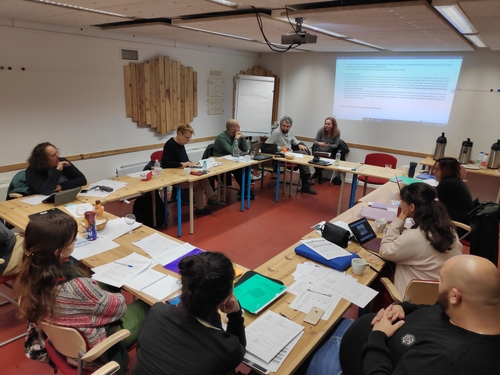
Several ERGO Network members and also new partners met in February for our annual ‘Roma Included in Social Europe’ (RIISE) coordination meeting.

ERGO Network is implementing a four-year work programme funded by the EaSI Programme of the European Commission’s DG Employment in order to support the social inclusion and poverty reduction of Roma in EU member states and provide a bridge between the grassroots and the EU level concerning Roma-related policies and funding programmes.

An important part of the work programme is implemented on national level in the ‘Big 5’, the EU member states with the highest Roma population. With the financial support of the European Commission through the RIISE work programme, ERGO Network members coordinate national Roma civil society coalitions, support Roma activists to engage in and benefit from Community-Led Local Development (CLLD), conduct research and inform Roma activists about relevant EU developments.

During the coordination meeting held in Brussels, representatives of the ERGO Network members Integro Association (Bulgaria), Nevo Parudimos (Romania), Slovo 21 (Czech Republic), Autonomia Foundation and Pro Cseherat (Hungary) as well as our partners RomanoNet (Czech Republic) and Idetartozunk (Hungary) came together for two days to discuss their work.

Among other things they shared updates on the development of national Roma Inclusion Strategies and Operational Programs and strategized together how best to influence them. They learned more about how to engage in the EU’s European Semester process and discussed common work on Social Economy. The partners will work together closely during the year and meet again in November.

`
Christine Sudbrock – Page 18 – ERGO Network

By continuing to use the site, you agree to the use of cookies. more information

The cookie settings on this website are set to "allow cookies" to give you the best browsing experience possible. If you continue to use this website without changing your cookie settings or you click "Accept" below then you are consenting to this.

Close