ERGO partner in Solidi project – Solidarity in Diversity

Solidi Project

ERGO Network is a partner in a new exciting academic project called the European Training Network “Solidarity in Diversity” (SOLiDi), providing a Roma perspective to the programme.

Over the last decade, liberal democracies in Europe have been shaken to their core by the rise of national populisms. This puts strong pressure on all forms of solidarity, especially as they cross ethnic-cultural boundaries. The increasingly successful capture of the notion of solidarity by radical right, anti-liberal democratic forces is testimony to this. The challenge for European democracies is to identify the conditions under which solidarities in diversity can be nurtured.

To address this urgent challenge, the European Training Network “Solidarity in Diversity” (SOLiDi) develops a training and research program that is focused on how to generate solidarities across cultural boundaries, taking the proximity of citizens with different ethnic-cultural backgrounds in specific places and the practices they engage in as starting point. Building on the strengths of the interculturalist paradigm, SOLiDi will contribute with an intersectional understanding of how place-based solidarity practices are shaped by and can work around entrenched social inequalities and unequal power relations.

To that end, SOLiDi brings together 10 academic partners from sociology, geography and educational science and 23 non-academic partners – one of them ERGO Network – in an international, interdisciplinary and inter-sectoral training network for 15 Early Stage Researchers (ESRs). The research and training will prepare a cohort of highly-skilled professionals who are well-versed in a range of different approaches to generate solidarity in diversity and are able to apply these in different geographical, policy and organisational contexts.

SOLiDi has 3 main objectives:

  • to combine knowledge from sociology, geography and social pedagogy to extend our knowledge on how solidarities can be generated across cultural boundaries
  • to articulate public pedagogies and organizational and policy strategies that support diversity
  • to promote social innovation by facilitating the translation of academic insights into skills to promote and to analyse societal change through training in research methods and ethics

SOLiDi will train doctoral researchers both in the state of the art on sociological, geographical and educationalist insights on solidarity in diversity, place-based practices, interculturalism and intersectionality as well as in analytical and transferable skills on public pedagogies and organizational and policy strategies. In this way, the SOLiDi consortium aims to articulate a new, academically grounded and practice and policy-oriented vision on solidarity in diversity. SOLiDi will provide an alternative to the prevailing pessimism around living in diversity and train a cohort of professionals well equipped to bridge the gap between academic knowledge and professional interventions on living in diversity

For more information please visit the Solidi website

(Post-)Pandemic Life Together

(Post-)Pandemic Life Together

This spring arrived accompanied by many challenges for our work. Instead of shrinking back, we battened down the hatches and continued supporting people with fewer opportunities.

During March, one of our localities became an epicentre of a special mutation of the corona virus. Many families, Roma and non-Roma, found themselves in the middle of danger of contagion. Together with other local NGOs and volunteers we distributed FFP2 respirators and masks and discussed the situation with adults and children.

Keeping the seriousness of the pandemic situation in mind, we tried hard to preserve the quality and quantity of our services and activities that we offer to local people in need. Instead of cancelling our events and appointments, we equipped our teams with protective aid or searched for alternative ways of helping the community. The arrival of spring allowed us to hold workshops outdoors, other activities took place one-to-one.

Every ten years, a Census is carried out in the Czech Republic to obtain information about the population that is not easily accessible. This May, another nation-wide census took place. As the attendance is obligatory under penalty of a fine, our street workers helped 131 households to fulfill this legal duty.

While maintaining the quality of our street work, counselling and other social services, we are also mindful of human rights aspect of our work. This spring became a milestone for women who suffered – and still suffer – from forced sterilisation. At the beginning of May, after many years of struggle, the Chamber of Deputies passed a bill on compensation for the female victims.

Since Czech schools implemented distance learning, children needed extra support to cope with online lessons. We restored our „outdoor school“ and offered assistance with homework or learning on-spot. For families that were not endowed with digital devices, we arranged computers and laptops as a gift in cooperation with the Česko.digital initiative.

To celebrate the International children’s day, all teams prepared special activities for the children and young people they work with. Almost hundred children from Liscina, a neighbourhood once flooded, gathered for fun outdoor activities and received sweet rewards. Other events related to the International children’s day and the end of the school year will take place all over the localities we work in. Preparations for our traditional summer camp are already under way as well.

Project Market “New solutions to old problems”

Project Market – “New solutions to old problems – exchange of new type of approaches in the field of Roma integration”

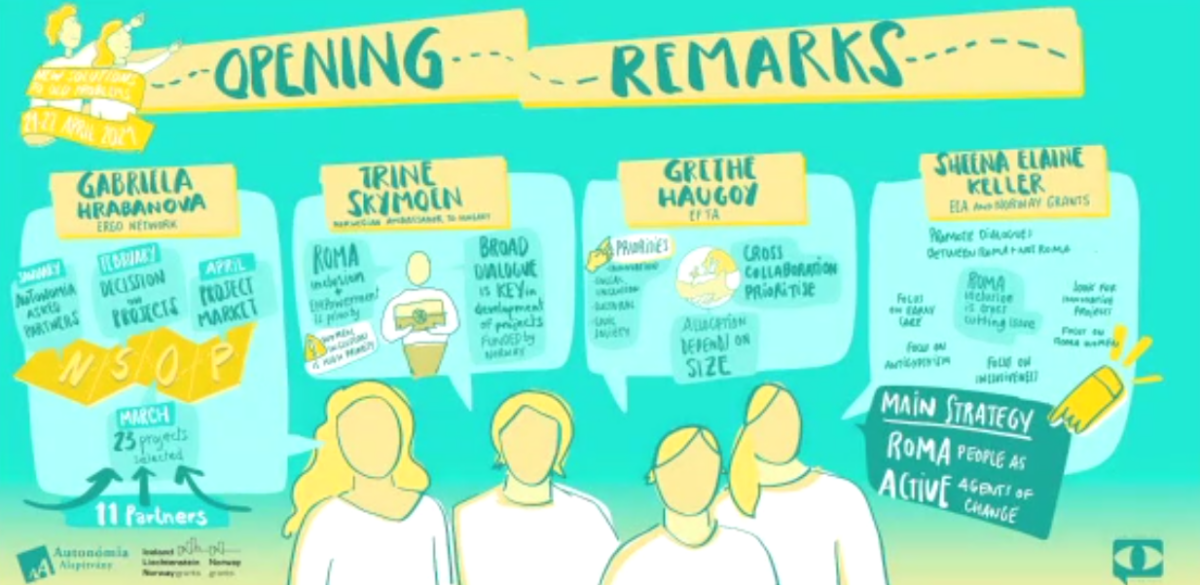
On 21-22 April 2021 the partners in the project “New solutions to old problems – exchange of new type of approaches in the field of Roma integration” gathered online for the “Project Market”, where they shared their best practices of Roma inclusion and empowerment projects and “bid” on each other’s projects to implement similar initiatives in their own communities.

The event showed the great wealth of experience of Roma civil society and the impact that bottom-up approaches to Roma inclusion, empowerment and fighting antigypsyism can have.

For the event, all partners had to identify up to 3 local good practices from their own or their partners’ work on Roma inclusion and empowerment. These good practices were presented in the ‘Project Market’ to other consortium partners so everyone could select someone else’s good practice that fits to their own community needs.

Projects that were ”won” at the ”auction” will need to be adapted to different contexts, planned in detail with the community and will then be kicked off. The ‘project owner’ who proposed this project will act as a coach during the entire period. The good practices will include for example supporting companies to recruit Roma employees, a mothers’ center, a volunteering program with elderly homes and a motivational re-training project for unemployed Roma. All partners are rooted in local Roma communities so they can easily reach out to and involve their target group.

The meetings also gathered guests from numerous International Organisations, embassies and and partner civil society organisations, among them the EEA and Norway Grants, EU Justice and Consumers, the Embassy of Norway, Tom Lantos Institute, ERSTE Foundation, Zentralrat Deutscher Sinti und Roma, Hildegard Lagrenne Stiftung.

“New solutions to old problems – exchange of new type of approaches in the field of Roma integration” is funded by Iceland, Liechtenstein and Norway through the EEA and Norway Grants Fund for Regional Cooperation.

DG JUST widens dialogue with civil society

DG JUST widens dialogue with Roma civil society and anti-racism civil society organisations

In its intention to ensure a greater transparency and inclusion of wider Roma and pro-Roma civil society organisations at national level in implementing the EU Roma Roma Framework on  equality, inclusion and participation, the European Commission launched a call for expression of interest to NGOs in supporting the work at European Union level and their readiness to participate in consultation processes. All CSOs who expressed their interest will be informed regularly about important policy developments. Moreover, according to the experience and knowledge of the organisations, based on the information provided in the expression of interest, the Commission services will determine the list of CSOs and/or alliances of CSOs who will be invited to contribute to consultation processes, in particular on the monitoring of the implementation of the Roma policies at EU level. All expressions of interest by the 22 June 2021 will be carefully reviewed based on outreach capacity, work topics, expertise, size and type of CSO as well as the following criteria:

  •  independent status and legal registration in the EU, featuring a democratic decision-making mechanism as well as a mission and values aligned with those of the European Commission;
  •  proven expertise of at least 3 years in one or more of the following: policy, research, advocacy work concerning Roma equality, inclusion and participation, as well as legitimacy of the CSO’s representations (community ties, accountability to beneficiaries and/or members);
  •   respect for pluralism of opinion, tolerance and personal integrity of the representatives is mandatory;
  •   good working knowledge of English as this is the working language of CSO consultation meetings; and
  •   demonstrated ability to engage in constructive dialogue with other governmental and/or non-governmental organizations is highly valued.

In addition, the applicants have to be registered in the EU Transparency registry, proving their legal constitution, including proof of grant of legal personality, evidence of internal rules procedure, audited financial statement for the last 2 years or any other official document demonstrating the annual income; annual activity reports for the last 2 years or any other published reports or research as evidence of Roma-relevant work; and CV(s) of the CSO representative(s).

For the above mentioned call more information can be found  here.

A similar call has been launched for anti-racism civil society organisations or the implementation of the EU Anti-racism action plan with a small difference in that there is no minimum limit on the years of proven expertise in the case of antiracism CSOs and that in their case they should have worked on at least one or more of the following: policy, research, advocacy work concerning racial and ethnic equality and anti-racism; and in at least one or more of the following thematic areas: racial justice, equality, reparations and decolonisation, anti-migrant racism.

More information about the anti-racism CSO call can be found here.

Different than in the case of Roma organisations, antiracism CSOs fear that this mechanism could restrict access of more radical NGOs, including pro-Muslim associations which have been banned or accused of inciting to hatred, for being vocal against Islamophobia, particularly in France, under the leadership of President Emmanuel Macron. With a growing victimization of human rights defenders and NGOs, EU institutions should ensure depolitization of antiracism civil society work and build further trust and cooperation with antiracism NGOs.

For more information about ERGO Network’s work on anti racism contact Isabela Mihalache , Senior Policy Adviser in the ERGO Network Brussels team.

Fighting antigypsyism as a precondition to achieve equality for Roma

Regional Conference: Fighting antigypsyism as a precondition to achieve equality for Roma

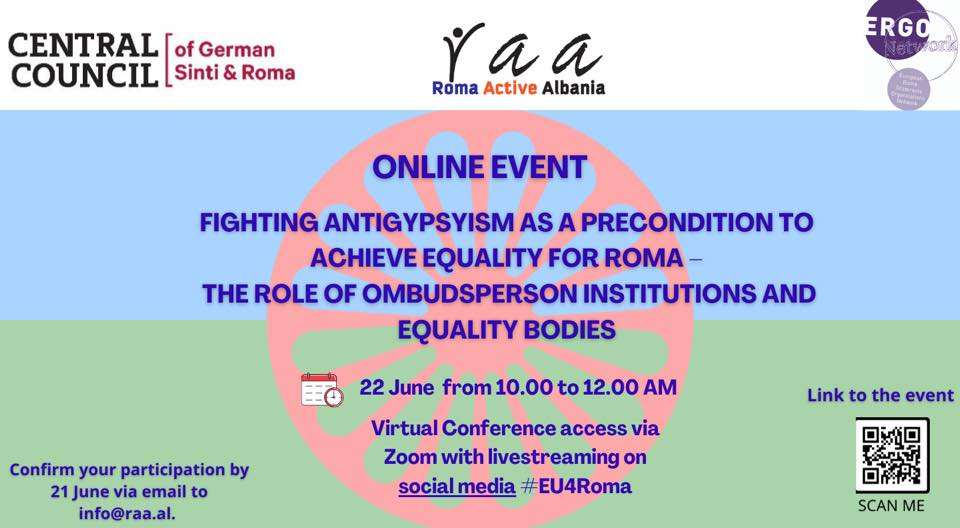
On 22 June, ERGO Network together with the Central Council for German Sinti and Roma, the Roma Active Albania and Equinet co-organised the Regional Conference: Fighting Antigypsyism as a Precondition to Achieve Equality for Roma – The Role of Ombudsperson Institutions and Equality Bodies. The Conference brought together equality bodies, national human rights institutions and civil society organisations from Western Balkan countries, European Commission Directorate-General for Neighbourhood and Enlargement Negotiations and the Ministry of Foreign Affairs Germany. Participants discussed on the role of equality bodies and ombudsperson institutions in the design, implementation, monitoring and evaluation of national Roma strategic frameworks to tackle antigypsyism based on the principles of non-discrimination and equality set out in the EU Treaties, reaffirmed in the EU Charter of Fundamental Rights, the Racial Equality Directive 2000/43/EC and the Council Framework Decision 2008/913/JHA on combating certain forms and expressions of racism and xenophobia by means of criminal law.

Some of the conclusions highlighted inter alia that equality bodies and ombudsperson institutions:

  • have a mandate to deal with discrimination using civil and administrative law and most of them have a mandate to deal with hate speech using their general mandate for promotion of equality and fighting discrimination or broadly interpreting their mandate to tackle harassment.
  • should also have a mandate to start own-initiative cases and use strategic litigation as an effective means to reach an impact that goes beyond the individual case.
  • even in the absence of an explicit legal mandate to cover certain issues related to antigypsyism (such as hate crimes, for instance), can gather information, commission or conduct studies to reveal the extent and manifestations of antigypsyism
  • can contribute with independent reports in the implementation of national Roma strategic frameworks.
  • should raise awareness about antigypsyism and widely communicate positive, values-based messages; use their powers to advise governments and other policymakers so that policies and legislation contributes to challenging antigypsyism; use their powers to work with duty bearers, such as employers and service providers, to spread good equality practices
  • should ensure close and structured cooperation with civil society. Equality bodies should enter into a constructive dialogue with pro-Roma civil society that should include mutual education where each party shares their unique knowledge and expertise
  • work closely with Roma and involve them in their activities – as trainers and trainees, as valued partners and as employees of the equality body and ombudsperson institution.

The conference also emphasized the need for equality bodies and ombudsperson institutions to be provided with the necessary human and financial resources, powers and independence to conduct their work effectively. Participants saw this regional conference between equality bodies, the EU and civil society as an important step in building a closer and structured cooperation in fighting structural antigypsyism.

For more information about ERGO Network’s work on anti racism contact Isabela Mihalache , Senior Policy Adviser in the ERGO Network Brussels team.


`
Ana Rozanova – Page 41 – ERGO Network

By continuing to use the site, you agree to the use of cookies. more information

The cookie settings on this website are set to "allow cookies" to give you the best browsing experience possible. If you continue to use this website without changing your cookie settings or you click "Accept" below then you are consenting to this.

Close