ERGO Network is contracting a Web Designer to improve ERGOnetwork.org website
Are you a creative and talented Web Designer looking for an exciting opportunity to transform a plain-text website into a visually stunning and highly functional online platform? If so, we want to hear from you!
Position Overview:
We are seeking a Web Designer with a passion for aesthetics and a keen eye for detail to elevate our website to the next level. In this role, you will be responsible for turning our text-based web pages into engaging, user-friendly, and aesthetically pleasing digital experiences. Your creative touch will be essential in designing maps with interactive links, crafting icons for various content types, and making our website visually appealing by incorporating images, boxes, colours, and more.
Key Responsibilities:
Collaborate with the Communications Officer to understand project requirements and objectives.
Transform plain-text web content into visually appealing, user-friendly designs.
Create interactive maps with clickable links to streamline data access and enhance user experience.
Design custom icons and graphics to represent different types of content effectively.
Incorporate images, graphics, and multimedia elements to make the content engaging.
Utilize colour theory and typography to enhance the website’s visual appeal.
Ensure responsive design for seamless viewing on various devices.
Utilise the industry trends and best practices to improve our website’s design.
Qualifications:
Proven experience as a Web Designer or in a similar role.
Proficiency in graphic design software, such as Adobe Creative Suite.
Strong knowledge of HTML, CSS, and web design principles.
Excellent understanding of user experience (UX) and user interface (UI) design.
Ability to communicate with the team, understand and clarify the tasks.
Attention to detail and a strong creative flair.
Problem-solving skills to overcome design challenges.
Strong portfolio showcasing your web design projects.
Conditions:
The Web designer will be paid 3,000-4,000 euros for the website. We will select the candidate based on the principle of “value for money”.
If you are interested in this task, please submit your resume and a link to your portfolio showcasing your web design projects to info@staging.ergonetwork.orgby 15 September 2023. In your cover letter, tell us why you’re the perfect fit for this role and share your vision for improving our website.
ERGO Network is an equal opportunity employer. We encourage candidates of all backgrounds to apply.
Call for graphic designer to design ERGO Network publication
ERGO Network is contracting a graphic designer to design our “Guidelines to Counter Antigypsyism”
We have recently developed a toolkit for national and local civil society organisations on countering antigypsyism online and offline, full of information and practical tips about documenting and reporting incidents, counter speech and safety.
As a word document, the text has 26 pages – including many lists and different paragraphs. We expect it to be a colourful publication with many info boxes and graphics. It will mostly be shared digitally, but we are also planning to print it.
If you are interested in working with us on this during the month of September, please send us a quote and a portfolio of past similar assignments.
Profile:
Excellent portfolio of similar publications
Experience in working with civil society organisations
Availability in September to finalise the publications
We will select the designer according to the principle “Value for money”. Please send your application to info@staging.ergonetwork.orgby 31 August 2023, 23:59 CET.
European Commission releases Spring Package 2023 – What’s in it for Europe’s Roma?
On 24 May 2023, the European Commission published the so-called Spring Package, comprising the 27 Country Reports, 27 Country-Specific Recommendations, and the accompanying Communication on the Spring Package, in the framework of the 2023 European Semester. ERGO
Network and its national members have reviewed the Package, to see to which extent it explicitly mentions Roma rights and inclusion, ethnic minorities, discrimination, and racism, as well as to assess whether national civil society was involved in the drafting of the Country Reports.
The Communication on the Spring Package mentions the Roma once, in the context of improving their labour market participation – nothing on health, housing, education, poverty.
7 Country Reports include references to the Roma (BG, CZ, GR, HU, IE, RO, SK) in 2023, the same number as in 2022, but still insufficient as Roma live in 26 EU Member States.
Only one Preamble to Country-Specific Recommendations (HU) mentions the Roma, a step down from 2022, when Hungary received an actual Recommendation on Roma inclusion.
Ethnic minorities, discrimination, and racism are absent from all documents, with only discrimination mentioned in passing in the Country Reports for Belgium and Slovakia.
Civil society organisations were poorly associated to the drafting of the Country Reports, and the Spring Package references to their role are few and vague (4 Country Reports, no CSR).
Overall, while our members welcome references to Roma communities in some countries, they lament that most of the Spring Package 2023 doesn’t explicitly mention them, whereas the Roma are present in all Member States except Malta, and experience rates of poverty and social exclusion of over 80% in all of them except the Czech Republic. This situation was exacerbated by the aftermath of the Covid-19 pandemic, the war in Ukraine, and the rising cost of living and energy price spikes. As the Package itself highlights these very challenges, it would have warranted more attention paid to one of Europe’s most left-behind communities.
The recurrent focus on supporting just transitions and mitigating the consequences for vulnerable groups is very positive, however it is our members’ experience that, unless the Roma are explicitly named as key target beneficiaries of support measures, mainstream initiatives andbroad national and EU funds end up not reaching them. Europe’s Roma must be specifically prioritised in the EU’s Recovery Package and associated funds, if the EU is serious about delivering on its commitments for Roma equality, inclusion, and participation by 2030.
Our members equally express disappointment that issues of discrimination and antigypsyism are not present in the Package, while these phenomena have increased in recent years. The fact that the country analyses and recommendations do not seek to establish explicit synergies with the EU and national Roma Frameworks, and with the National Action Plans against Racism, is considered a tremendous missed opportunity.
Finally, they deplore the lack of recognition and support given to civil society organisations in the documents, given that most of them are not only on the frontlines, providing essential support to communities in need, but they equally possess the knowledge, expertise, and direct links to beneficiaries which are needed to inform the design of public policies and ensure both ownership and effectiveness of interventions.
For more information about ERGO Network’s work on the European Semester and associated frameworks (European Pillar of Social Rights, Sustainable Development Goals etc), please contact Senior Policy Adviser Amana Ferro.
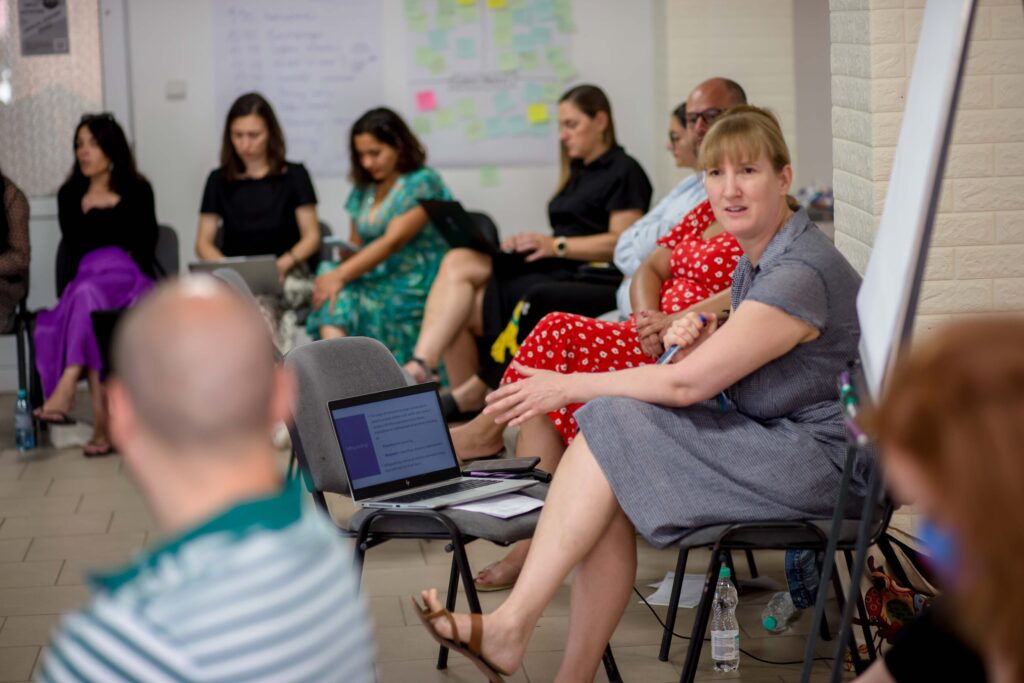
We have successfully held our General Assembly from June 25 to June 28, 2023. The event took place in the picturesque location of La Padure, not far from the town of Resita in Romania, hosted by our member Nevo Parudimos and it offered a serene setting for productive discussions and collaborative efforts.
Monday 26 June: Updates and Sharing Among ERGO Network Members
The first day of the General Assembly was filled with lively discussions, updates, and the exchange of ideas among the ERGO Network members.
The day began with the registration, followed by a warm welcome from the Board, including Soraya Post, Daniel Grebeldinger, and ERGO Network Director Gabriela Hrabaňová.
Gabriela Hrabaňová provided an insightful framing of the General Assembly, setting the context for the discussions and activities to come.
As we had many new faces during this General Assembly we continued with an exchange session where we all could introduce ourselves, and share our hopes, fears and commitments, facilitated by Martina Horváthová and Ana Rozanova.
The focus then shifted to sharing the latest grassroots and national-level activities. Members had the opportunity to discuss their organisations’ biggest successes, challenges, and projects of which they were proud.
Following the enriching discussions, attendees enjoyed lunch together, fostering further networking and connection among participants.
In the afternoon session, ERGO Network policy work took centre stage. Isabela Mihalache provided updates on the EU Roma Strategic Framework up to 2030, Roma Civil Monitoring, and the work of the Anti-Racism Coalition. Amana Ferro and Carmen Tănasie presented on combating Roma poverty and social exclusion.
Afte this the statutory items and voting took place. Attendees were reminded of the General Assembly’s statutory role and voting procedures. The Internal Governance Handbook was reviewed, and topics for voting were presented, including the approval of the end of the mandate for founding members and the consideration of new membership applications.
We are now happy to reveal that our Network grew bigger. Our associate member Jaw Dikh Foundation from Poland was approved as a full member, and three new associate members joined us: Roma Women Platfrom ROMNI from Moldova, Sastipen from Romania and Roma Women Dendropotamos, Greece.
The day concluded with a sense of accomplishment and unity, followed by a BBQ dinner accompanied by live music and warm and relaxed atmosphere.
Tuesday, June 27: Building the New ERGO Network – Strengthening Leadership
The second day of the General Assembly focused on shaping the future of the ERGO Network by enhancing leadership and strategic planning.
The day began with a warm welcome by a framing session and check-in led by Christine Sudbrock and continued with the presentation of two projects. Ana Rozanova shed light on the Decade “Fighting against Antigypsyism,” while Dejan Markovic discussed the power of Romani women for change in the Western Balkans and Turkey.
After this (and a short coffee break) Christine Sudbrock delved into the topic of safeguarding policies. Participants gained valuable insights into the importance of such policies and how to develop them within their organisations.
Martina Horváthová facilitated an interactive discussion on the Membership Strategy, inviting members to contribute their thoughts and ideas.
The afternoon session explored ways to strengthen the ERGO Network
by fostering collaboration and initiating new projects. An open space format was adopted to encourage participants to create cooperative initiatives and explore potential areas of collaboration, and we have several concrete ideas to implement in the coming year.
After a brief coffee break, attendees had the opportunity to visit a housing project in Resita organised by Nevo Parudimos. This visit provided firsthand exposure to a successful initiative aimed at improving housing conditions for Roma communities, showcasing the tangible impact of dedicated efforts.
The day concluded with a closing dinner, where participants gathered to reflect on the General Assembly and provide valuable feedback.
Concluding remarks
As the General Assembly came to a close, participants departed with a sense of renewed energy, strengthened partnerships, and a shared commitment to continue the vital work of promoting the rights and empowerment of Roma communities.
The ERGO Network General Assembly 2023 served as a significant milestone in strengthening collaboration, empowering change, and charting the course for a more inclusive and equitable future. The event showcased the collective dedication and determination of ERGO Network members to overcome challenges, share successes, and create lasting impact.
Through engaging discussions, policy updates, and the exploration of new projects, we departed with a renewed sense of purpose and motivation to drive positive change in communities and for the Secretariat to support our members in their work.
The ERGO Network remains steadfast in its commitment to advocating for the rights of Roma communities, combating antigypsyism, and fostering social inclusion. With the outcomes and momentum generated during this General Assembly, the organisation is poised to further amplify its impact, expand its network, and promote meaningful change for Roma communities across Europe.
As the General Assembly concluded, the ERGO Network looks forward to the continued collaboration, collective efforts, and achievements that lie ahead.
On 18 April 2023, the European Union put forward two Council Recommendations, one on improving the provision of digital skills in education and training, and one on key enabling factors for successful digital education and training. Both Recommendations are part of the European Year of Skills and the ambitious Digital Education Action Plan, articulating a vision of high-quality, inclusive and accessible digital education in Europe and aiming to support the adaptation of the education and training systems of Member States to the digital age.
ERGO Network has consistently advocated for more and better digital inclusion for Europe’s Roma, so that they don’t end up being the losers of the digital transition. As such we were delighted to see that the Roma are mentioned in both Council Recommendations. Roma children and learners are not provided, from a very early age, with the same learning opportunities as their majority peers, as the vicious circles of poverty and antigypsyism act as powerful barriers in accessing both digital skills, as well as education and training through digital means. Subsequently, they have lower attendance and completion rates, which in turn lead to higher poverty rates and poor labour market integration and social participation.
In the Council Recommendation on improving the provision of digital skills in education and training, the Roma are explicitly referenced in the Explanatory Memorandum, which highlights that having a Roma background (alongside gender, socio-economic and migrant background) strongly correlates with poorer digital skills outcomes. While this is a welcome mention, it is a pity that the document stops short of pointing out why that correlation exists and tackling intersectional discrimination. In fact, there is only one reference to discrimination in the whole document, still in the Explanatory Memorandum, and it is only a brief reference to the right to non-discrimination in Article 21 of the Charter of Fundamental Rights of the European Union, which this Council Recommendation is in line with.
We are further pleased to notice several references to racial or ethnic origin and minority background in the document. The Union of Equality and its role in supporting the most marginalised communities is highlighted, including – in a footnote – its 5 key initiatives adopted thus far, including the EU Roma Strategic Framework for Equality, Inclusion and Participation, and the EU Anti-Racism Action Plan. Additionally, the Recommendation supports a gender equality approach, inclusive supporting girls with a minority racial or ethnic background.
The Council Recommendation on the key enabling factors for successful digital education and training also contains one reference to Europe’s Roma, who are named among other disadvantaged learners (such as those with low skills, experiencing poverty, or of migrant background) who have less access to computers at home and start using digital devices later in life. Aside this reference, the document – similarly to the other Council Recommendation – includes the same pro-forma references to the Union of Equality and its composing initiatives (including the EU Roma Framework and the Anti-Racism Action Plan) and to Article 21 on anti-discrimination of the Charter of Fundamental Rights. A clear commitment to tackling discrimination and racism, and in particular antigypsyism in order to curb the digital divide and guarantee equal and inclusive access, is missing from both texts.
ERGO Network warmly welcomes these references, because experience has shown time and time again that the Roma and other racialised communities must be explicitly included in mainstream policy documents and objectives, or generalised approaches will see them left behind. Dealing with Roma access to education exclusively under the EU Roma Strategic Framework leads to siloing of issues, rather than comprehensive solutions that tackle challenges (and their roots!), focusing on both prevention and resolution.
To ensure that every Roma child gets a good start in life, we must guarantee equal access to quality and inclusive digital education and training, including digital skills. We hope that European Commission efforts to curb the digital divide and to ensure access to quality and inclusive education, including digital education, for all will explicitly include a focus on Roma learners, as some of the most disadvantaged learners in Europe.
For more information about our work on Roma digital inclusion, please contact Amana Ferro (a.ferro@staging.ergonetwork.org), Senior Policy Adviser with the ERGO Network staff team.
[1] The umbrella term “Roma” encompasses diverse groups, including Roma, Sinti, Kale, Romanichels, Boyash/Rudari, Ashkali, Egyptians, Yenish, Dom, Lom, Rom and Abdal, as well as Traveller populations (gens du voyage, Gypsies, Camminanti, etc.), in accordance with terminology used by the European Commission.