Voluntary work with and for Roma communities

Voluntary work with and for Roma communities

Romanian ERGO member Nevo Parudimos Association has more than 5 years of experience in volunteering projects. The organisation has hosted more than 30 volunteers and sent more than 15 volunteers to different European countries.in the last years.

A big part of our work is based on local or international volunteers. Our projects promote volunteering at local level as a tool to promote inclusion.  Our project “For a kid smile”, which involved 2500 Roma and non-Roma local volunteers, was a finalist in the Erste Stiftung Roma integration projects award, being considered a good practice in the field.

Currently we are hosting 15 volunteers from across Europe and are searching to recruit five more coming from EU countries, Macedonia and Turkey for our ongoing projects:

  • Volunteering and Education for Civic Involvement
  • Volunteering for a smile
  • V for Volunteering
  • Yes to volunteering

The main activities of our international volunteers are: non-formal education and prevention of school dropout in schools from poor neighborhoods of Resita; promotion of volunteering and civic involvement; learning foreign languages and promoting interculturality, tolerance and understanding among young people or activities to increase the involvement of young people in decision-making.

You can find more information here.

In November 2018 our association opened the Nevo Parudimos Youth Center, a place that is coordinated together with EVS volunteers. The main goal of the center is the development of social, cultural and artistic activities with and for disadvantaged youth (with a focus on Roma youth) in Resita Citi (80.000 inhabitants). The youth center offers  volunteers opportunity for self-development and creates a safe space for EVS volunteers to learn and practice non – formal education methods for their professional development.

Looking back at the EU Roma Week 2019

Looking back at the EU Roma Week 2019

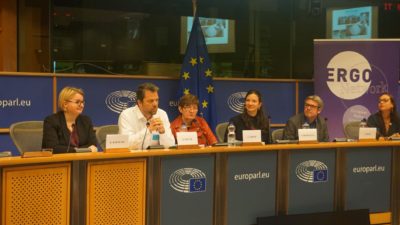
From 18-21 March 2019, the fourth EU Roma Week took place in Brussels, jointly organised by several Members of the European Parliament, the EU Commission, the UN Human Rights Office in Brussels and civil society organisations. The Roma Week offered a framework for a series of events discussing Roma-related policies and giving the spotlight to the fight against antigypsyism. ERGO Network played a leading role in a number of events held during the week.
The Roma Week would not make any sense without the active involvement of Roma activists from across Europe. Therefore, together with the Central Council of German Sinti and Roma, the Documentation and Cultural Centre and ternYpe International Roma Youth Network, ERGO Network invited a group of youth activists to prepare for the week in the Roma Youth Advocacy Training. Moreover, ERGO Network coordinated the participation of the most important Roma civil society activists in Europe under the umbrella of the ‘Alliance against Antigypsyism’ together with the Central Council of German Sinti and Roma.

Before the start of events in the European Parliament, ERGO members from the project Joint Initiative to Empower Roma Civil Society in the Western Balkans and Turkey attended the conference Roma Inclusion in the Western Balkans: The Forward Look, Policy v Reality, Where the new World Bank report “Breaking the Cycle of Roma Exclusion in the Western Balkans” was launched.

The first event in the European Parliament was the crucial Reality Check: Evaluating the EU Framework for National Roma Integration Strategies, where results of the Roma Civil Monitor were discussed. ERGO Network’s advocacy and research coordinator Jelena Jovanovic highlighted good practices and shortcomings of measures combatting antigypsyism, and several civil society representatives gave an overview of their national monitoring reports.

On Tuesday evening, two award ceremonies celebrated individuals for their contribution to Roma inclusion: The European Civil Rights Prize for Sinti and Roma was awarded to the Slovak President Andrej Kiska, and 14 inspiring women activists received the EU Award for Roma Integration in the Western Balkans and Turkey under the theme ‘Unknown Heroes’. As a surprise during the Western Balkans award event, Soraya Post MEP received an award too, for her outstanding support to the fight against antigypsyism in the European Parliament.
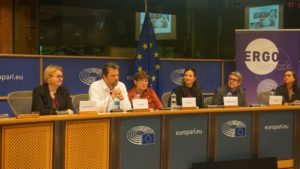
On Wednesday, ERGO Network together with Cornelia Ernst MEP brought the UN’s Sustainable Development Goals as a tool to support the fight against antigypsyism to the agenda. The panel discussion was held together with Global Call to Action against Poverty (GCAP), Sozialfabrik and Soraya Post MEP. The panellists discussed recommendations to civil society on how to use the 2030 Agenda, brought by ERGO Network in the new paper ‘Roma Included’.

The flagship event of the week was the conference ‘Creating trust through uncovering and recognising the truth: Advancing recognition and remedy for antigypsyism’, jointly hosted by Soraya Post MEP, the Central Council for German Sinti and Roma, Fundacion Secretariado Gitano (FSG), UN Human Rights Office in Europe, the Open Society European Policy Institute and ERGO Network. The stock-taking conference focussed on discussing the state-of-play and efforts to advance the fight against antigypsyism through truth, recognition, remedy, trust and reconciliation processes. It also gave voice to several survivors of acts of antigypsyism who shared their stories and highlighted the urgency to act against antigypsyism.

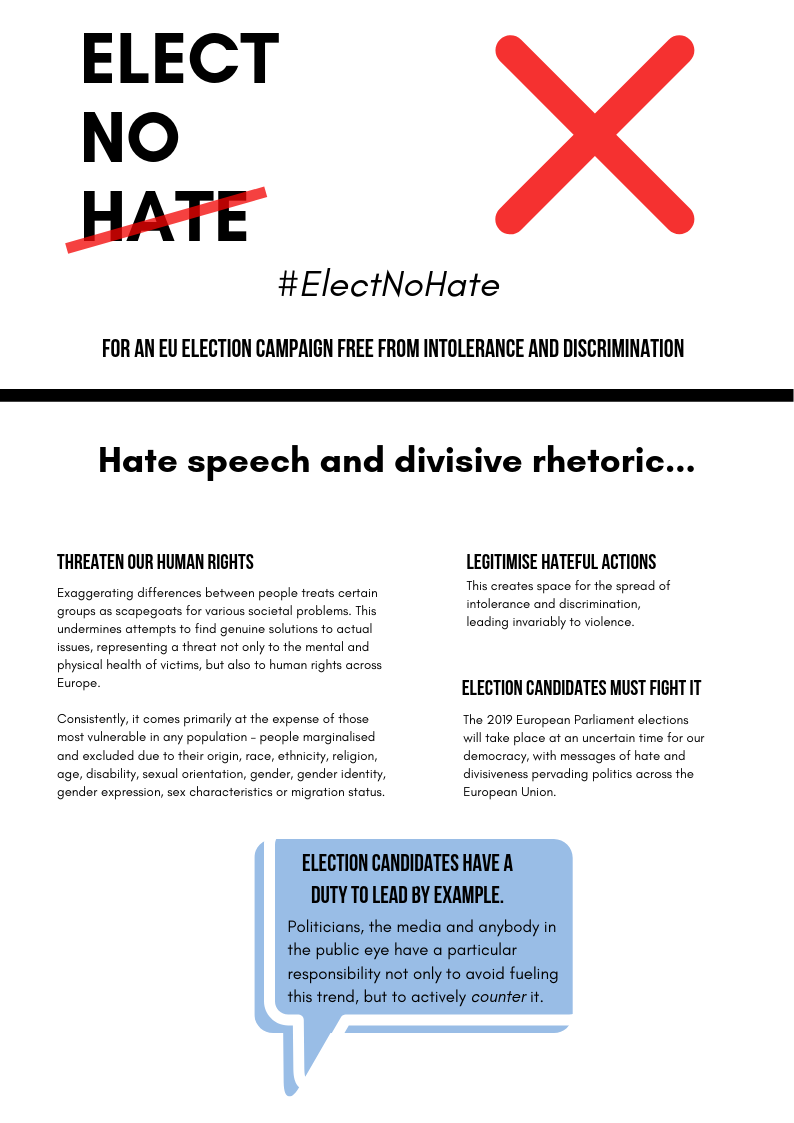
Members of the European Parliament from different political groups signed a pledge affirming that they will continue to work to achieve non-racist EU elections, an effective Post-2020 EU Roma Framework and a continuation of the fight against antigypsyism in the new legislative period. The undersigned MEPs pledged to create a European society in which Roma can access and enjoy their rights set in our Treaties, in which Roma can fulfil their true potential, in which dehumanisation of Roma is stopped, a healthy European society free from racism, such as antigypsyism – a Europe that we can be proud of.

Now it is time to let actions follow the words and spirit of cooperation conveyed during the week. We ask all participating institutions to fulfil the promises made during the Roma Week and work together for an effective EU Roma Framework and an increased fight against antigypsyism.

Credits photo on top: © European Union 2019 – EP/Didier BAUWERAERTS

Roma demand to be included in the SDGs

Roma demand to be included in the SDGs

At the heart of the EU Roma Week 2019, which brought over 100 European activists and stakeholders to Brussels, policy-makers and civil society met for the first public debate on Roma and the UN Sustainable Development Goals. The debate was co-hosted by Cornelia Ernst, MEP of the Left Party, and the European Roma Grassroots Organisations (ERGO) Network together with Soraya Post MEP, Global Call to Action Against Poverty (GCAP) and Sozialfabrik.

The debate was opened by Cornelia Ernst MEP who stated that “the global development agenda can and should be an important lever for fighting antigypsyism and racism”, calling to mind that the EU Roma Framework “has failed because it did not include the Roma community”. ERGO Network Director Gabriela Hrabanova stressed that “the 17 Sustainable Development Goals and the promise of governments to leave no one behind provide crucial opportunities for advancing the rights of Roma in Europe”.

Stefan Meyer of Fresno Consulting presented the discussion paper ‘Roma included’, which was launched by ERGO Network with the event, and brought to the table recommendations for civil society on how to engage with the 2030 Agenda.

Reacting to the presentation, Henriett Dinók from Romaversitas highlighted the challenges for Roma organisations to keep track with new programmes and principles: “We here who have access to information on the SDGs, have to collect it, share it and use it to advocate! Then the SDG fora will serve as a platform for us to shape the narrative and to raise our demands.”


Paul Divakar, Chairperson of the Asia Dalit Right Forum, brought the global perspective to the panel and pointed out that the SDGs must be designed in a way that they also serve those who are excluded in their societies, across the globe. “If we are not named in the indicators, if there are no data, what do we do? That´s why need to fight for our rights together.”

On behalf of the European Commission, Katarina Ivanković Knežević, Director for Employment, Social affairs and Inclusion in DG Employment, stressed the potential of the SDGs to address questions of the inclusion and discrimination of Roma, and better take into account intersectionalities of gender and disability. Gesa Boeckermann (Policy Officer, Non-discrimination and Roma coordination Unit, DG Justice and Consumers)  highlighted that not only are the SDGs an important roof for policies related to Roma but that in reverse, by achieving Roma inclusion, the EU could also make an important step in its commitment to reach the Sustainable Development Goals.

Romeo Franz MEP (Greens/EFA) closed the debate by underlining that (pro)Roma activists need to use the 2030 Agenda for supporting their fight against antigypsyism, as this racism is the main reason for the social exclusion of Roma across Europe.

Watch a record of the discussion here:

Roma Included: Can the 2030 Agenda and the Sustainable Development Goals contribute to combatting antigypsyism? Co-hosted by Cornelia Ernst MEP and Soraya Post MEP, the European Roma Grassroots Organisations (ERGO) Network, Global Call to Action Against Poverty (GCAP) and Sozialfabrik on 20 March 2019

EU Roma Week 2019

From 18-21 March 2019, the fourth EU Roma Week in the European Parliament will take place, with the active involvement of ERGO Network, its members and civil society partners.  The Roma Week consists of a series of events discussing  the current and future EU Roma rights agenda, hosted by Members of the European Parliament.

It will be preceeded by a Roma Youth Advocacy Training, bringing together over 30 young people to prepare their inputs to the week and learn more about EU advocacy. This five days lasting seminar is organized by ternYpe International Roma Youth Network, ERGO Network, Phiren Amenca and the Documentation and Cultural Centre & Central Council of German Sinti and Roma.

Additionally, civil society representatives will attend a meeting of the Alliance against Antigypsyism.

ERGO Network will be actively participating in the events in the European Parliament. Besides co-organising the panel debate ‘Roma Included: Can the Agenda 2030 and the Sustainable Development Goals contribute to combatting antigypsyism’, ERGO and its members will participate in discussions on the current and future EU Roma Framework and on creating truth and reconciliation commissions.

For more information, please contact info@staging.ergonetwork.org

`
Christine Sudbrock – Page 27 – ERGO Network

By continuing to use the site, you agree to the use of cookies. more information

The cookie settings on this website are set to "allow cookies" to give you the best browsing experience possible. If you continue to use this website without changing your cookie settings or you click "Accept" below then you are consenting to this.

Close