Quality Standards for the Youth Guarantee- #RomaYouth as focus

Quality Standards for the Youth Guarantee- #RomaYouth as focus

The European Youth Guarantee so far failed to provide quality offers to marginalized groups, including #RomaYouth.

Together with other civil society organizations, ERGO Network has contributed to a set of Quality Standards for the Youth Guarantee proposed by the European Youth Forum.

The recommendation paper is aimed to contribute to the communication issued by the European Commission and debated in the European Parliament and Council “Youth Employment Support: a bridge to jobs for the next generation” which will be adopted later this year.

ERGO stands for several standards to be included in the new strategy and make sure that Roma youth are not overlooked in the implementation process. Please read the publication here.

Overdue action against racism by the European Union

PRESS STATEMENT

 Overdue action against racism by the European Union

Brussels 23 September 2020: The European Coalition of Roma and pro-Roma organisations welcomes the adoption of an Action Plan against Racism by the European Commission, providing a framework to address structural racism in the EU, including antigypsyism.  

The Action Plan recognizes the structural dimension of racism and the specific forms of racism affecting different racialised groups in Europe, including Roma. As such, it could become a key tool to support measures against antigypsyism as outlined in the upcoming Framework for Roma equality and inclusion, including in connection with National Action Plans against Racism to be implemented in all EU Member States. It also provides a more comprehensive approach to all forms of racism in Europe and could help to better address structural and intersectional forms of discrimination affecting Roma people. 

Michael Privot from the European Network against Racism: “The fact the action plan recognises the reality of structural racism and provides a comprehensive approach to racism is a major step forward. The plan is also an important tool to build solidarity across racialised groups in the fight against structural racism. We now expect national governments to develop national action plans against racism that are closely connected to Roma inclusion strategies.”

“It is timely that Europe learns from its many failures in protecting the most vulnerable within our societies, including the Roma and Travellers, who remain amongst the most discriminated-against groups in Europe. They continue to suffer from unequal access to services in all areas of life, segregation in education and housing, forced evictions, criminalisation of nomadism, destruction of property and halting sites, police violence, hate speech and bias crimes due to structural and systemic antigypsyism”, stated Gabriela Hrabanova from the ERGO Network.

Isidro Rodríguez, Director of Fundación Secretariado Gitano, explains that: “This EU anti racism plan should be the keystone in mitigating the high rates of poverty and marginalisation of Roma triggered by rooted discrimination. For its implementation, it is essential to have Roma and civil society engaged in each Member State“.

“We are highly concerned with the damaging impact Covid-19 has had on Roma and Travellers communities and the increasing antigypsyist political discourse and police violence in the member states. With this action plan, the EU should set up stricter funding conditionalities and indicators that guarantee fundamental rights protection”, the European Roma and Travellers Forum stated.

Adriatik Hasantari, Director of Roma Active Albania underlined: “We expect that the Enlargement and Neighbourhood countries closely follow this action plan and develop national action plans to combat racism against Roma and protect fundamental rights more effectively.”

“OSEPI welcomes this ambitious initiative from the Commission to combat structural racism across Europe. The action plan includes important steps to provide institutional support for the longstanding work of civil society organisations, along with forthcoming legislation, funding and political commitment to the fight for racial justice. Together with the upcoming EU Framework on Roma equality and inclusion, the action plan could lead the way forward to fight anti-Roma prejudice and all forms of racism, strengthen the equality bodies, and implement equal treatment in the EU member states.” Heather Grabbe, Director of Open Society European Policy Institute.

Despite a number of positive legislative and policy developments in the past decade, many gaps and challenges remain in improving the application of the EU antidiscrimination law and adoption of relevant and useful policies regarding Roma and Travellers throughout EU Member States and Enlargement countries, such as the deeply rooted structural and institutionalised discrimination, the lack of adequate disaggregated data, underreporting of discrimination, lack of trust in authorities, low awareness of rights, a lack of means to access justice and a general lack of political will at national level. At EU level, mechanisms such as infringement proceedings to sanction governments against pervasive discrimination and segregation of Roma children in education have failed to correct the situation.

As Roma and pro-Roma NGOs, we look forward to the adoption of National Action Plans against racism by all EU Member States, Enlargement and Neighbourhood countries in order to effectively address racism against all racialised groups, including by legally recognising various forms of targeted racism, such as antigypsyism, antisemitism, islamophobia and afrophobia.

We also expect that direct links of the Commission Action Plan with all major EU policy developments in the area of equality, non-discrimination and social inclusion of Roma and Travellers are made. Notably, it should be linked to the upcoming Strategic Framework for Roma Equality, Inclusion and Participation, and the recently adopted European Parliament resolution on the implementation of National Roma Integration Strategies, demanding a legislative act for Roma. It is equally important that the situation of Roma in the Enlargement and Neighbourhood countries is not overlooked in the implementation of the Action Plan.

As we witness that changes in the laws and policies are not sufficient to improve the situation on the ground concretely and effectively, we call on the Commission to use a further reaching and more extensive approach and tools to address deep-rooted stereotypes, negative prejudices and antigypsyism against Roma and Travellers in order to enable a more adequate response from state actors, institutions and citizens at large. This would also require a more inclusive and non paternalistic approach by the Commission and its public servants towards civil society in its daily workings and consultation approaches.

Finally, we welcome the promise by the Commission to review its hiring and staffing policies to increase diversity within. We hope that this will lead to a fairer and more adequate representation of ethnic minorities, including Roma, in EU institutions.

Members signatories:

European Roma Grassroots Organisations Network (ERGO Network)

European Network against Racism (ENAR)

European Roma Information Office (ERIO)

European Roma and Travellers Forum (ERTF)

Roma Active Albania (RAA)

Phiren Amenca International Network

Fundación Secretariado Gitano (FSG)

Roma Entrepreneurship Development Initiative (REDI)

Central Council of German Sinti and Roma

Open Society European Policy Institute (OSEPI)

For further information, contact:

Jamen Gabriela Hrabanova, ERGO Network: g.hrabanova@staging.ergonetwork.org, Tel: +32(0)489 97 47 53

Launch meeting: New solutions to old problems

Launch meeting: New solutions to old problems – exchange of new type of approaches in the field of Roma integration 

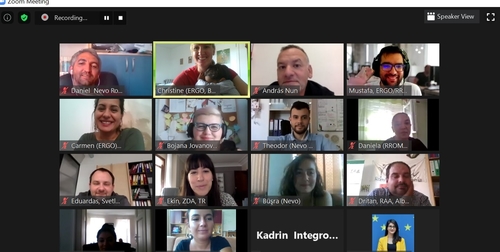
On 17-18 September 2020, the project team gathered online for the launch meeting of the project New solutions to old problems – exchange of new type of approaches in the field of Roma integration.

The objectives of the meeting were:

  • To learn more about the expectations and roles of partners
  • To introduce the Project Market and prepare for the selection of good practices
  • To discuss capacity-building needs of the partners to support developing the training and coaching activities
  • To introduce the common advocacy objectives of the project and start reflecting about national advocacy for better bottom-up funding
  • To get to know the EEA/Norway grants and its expectations towards our project
  • To publicly launch the project

The meeting started with a short recap of the aim of the project and the different work packages and continued with presenting the roles and expectations of partners, an introduction of the EEA/Norway grants & Fund Operator and their expectations towards our project.

We also had an introduction of the Project Market and Peer to Peer partnerships and of good practices in general (What makes a good practice? What are our criteria? What do the partners already have in mind?)

The first day of the launching meeting also targeted the capacity-building side of the project, so we had an introduction to the work package – communication & presentation training, learning academies, individual coaching, transparency criteria, project management toolkit.

On Friday 18th September we met to discuss the advocacy work package  – funding research, national advocacy meetings, European meetings.

Also, we shared national funding situations and related national advocacy objectives and partners ( what are we working on already, who are our national partners, what are our aims?)

We also had an introduction to communication work package – project website, information sessions, social media campaigns, story-telling, project video, crowdfunding. In this session we discussed the communication requirements for partners and brainstorming on ideas to promote the project.

We also tackled the risk management: What can go wrong in the project and how can we deal with possible challenges.

The  launching meeting ended with a short evaluation and suggestions for improving future meetings.

The project “New solutions to old problems – exchange of new type of approaches in the field of Roma integration” is funded by Iceland, Liechtenstein and Norway through the EEA and Norway Grants Fund for Regional Cooperation.

European Parliament adopts first-ever Resolution proposing a Roma EU legislation to combat antigypsyism and social exclusion of Roma

PRESS STATEMENT – ALLIANCE AGAINST ANTIGYPSYISM

European Parliament adopts first-ever Resolution proposing a Roma EU legislation to combat antigypsyism and social exclusion of Roma

Brussels 21 September 2020: The Alliance against Antigypsyism welcomes the adoption by the European Parliament of a resolution on the implementation of National Roma Integration Strategies initiated by MEP Romeo Franz (Greens/EFA) demanding for a legislative act for Roma equality, inclusion and participation and for combating antigypsyism, focusing on “fighting against poverty and antigypsyism, improving living and health conditions and combining targeted and mainstream approaches”.

The proposed legislative act intends to include, among other things, a plan to eliminate housing, health, employment and education inequalities, specific objectives to protect and improve the inclusion of Roma people, including those facing multiple discrimination and concrete measures to combat discrimination and segregation both in EU Member States and Enlargement Countries.

ERGO Network Director Gabriela Hrabaňová called the proposal for a Roma Directive “an important recognition of the systematic failure by the EU and governments to address the structural and systemic antigypsyism Roma are facing across the EU and Western Balkans” and a “turning point in the EU’s approach towards Roma”.

”After the recognition of the Holocaust of 500,000 Sinti and Roma in Nazi-occupied Europe by the European Parliament in 2015, with the resolution now adopted, this Parliament shows once again its determination to condemn and fight the threatening antigypsyism in Europe.”, says Romani Rose, chairman of the Central Council of German Sinti and Roma.

Michael Privot, Director of the European Network Against Racism (ENAR), adds that “The resolution and the new EU action plan against racism are different steps on the road towards more equality for all. We now need EU member states to adopt concrete measures and plans against racism, including antigypsyism, at national level.” .

Inter alia, the Resolution:

  • calls for the recognition of antigypsyism as a specific form of racism against Roma, equal access to justice and equality before the law;
  • highlights the need for systematic collection of robust ethnic and gender disaggregated data to inform needs and context analysis, help in setting targets and impact indicators;
  • urges Member States to adopt a holistic approach across all policy areas, to place the education of Romani children high on governments’ agendas and put an end to segregation;
  • calls on the Commission to fulfil its commitment to adopt an action plan to implement the European Pillar of Social Rights and to incorporate Romani inclusion as an indicator in the Social Scoreboard;
  • urges the Commission and the Member States to ensure access to decent jobs, fair wages and working conditions for Romani people and to guarantee that social protection systems and social services are adequate, accessible and used by all potential beneficiaries, and include universal health coverage without discrimination, as well as minimum income schemes and pension rights;
  • calls on the Member States to adopt urgent measures to address the lack of water, adequate sanitation, electricity and needed infrastructure in poor Romani communities in the light of the Covid-29 crisis;
  • calls on the Member States to fully include Romani settlements in disinfection measures, to prohibit the cancellation of basic utility services during the pandemic, to consider subsidizing consumption costs for the most vulnerable and those who have lost incomes, or freezing payments until the end of the recovery plan period, to provide financial support for lone parents/single mothers for childcare, rent payments and other household expenses to alleviate the financial hardship, especially in light of the job losses;
  • stresses the need to give priority to a gender perspective and gender-sensitive policies and fight violence (including human trafficking);
  • calls on mobilising funding for Romani equality, inclusion and participation under the Multi-Annual Financial Framework 2021-2027 and EU Recovery Plan and to adjust the existing mainstream financial mechanisms and make them flexible for blended use of funds in Romani communities by enabling access to information, outreach, capacity building and delivery of technical assistance;
  • demands equal participation of Roma in all domains of public life, political participation, and the language, arts, culture and history by making Romani participation a binding common quality standard for the future framework and National Inclusion Strategies;
  • calls for an inclusive mechanism to ensure the equal participation of Roma and pro-Roma civil society organisations, experts and community members from all levels, taking into account a gender perspective in the policy debate and decision-making.


For further information, contact:

ERGO Network: Jamen Gabriela Hrabanova, Executive Director, g.hrabanova@staging.ergonetwork.org – Tel: +32(0)2 893 10 49

Central Council of German Sinti and Roma: Jonathan Mack, Policy Officer, jonathan.mack@sintiundroma.de – Tel: +49 (0) 6221 981101

Notes to the editor:

  1. The ‘Alliance against Antigypsyism’ is a coalition of organisations across Europe that promote equality of rights for Roma and combat antigypsyism on institutional and societal level. The aim of the Alliance is to advance understanding of antigypsyism as a specific form of racism, and to strengthen the political will and institutional mechanisms in order to tackle antigypsyism in Europe. The Alliance is coordinated by the European Roma Grassroots Organisations (ERGO) Network, the European Network against Racism (ENAR) and the Central Council of German Sinti and Roma.
  1. Link to the adopted Resolution: https://www.europarl.europa.eu/doceo/document/A-9-2020-0147_EN.html


ERGO meets EC desk officers

ERGO members meet European Commission desk officers

On 10 September 2020, the European Roma Grassroots Organisations (ERGO) Network facilitated an online exchange meeting between its national members in 5 key countries (Bulgaria, Czech Republic, Hungary, Romania, Slovakia) and their counterparts in the country desks of DG Employment, Social Affairs and Inclusion (DG EMPL) and DG Regional and Urban Policy (DG REGIO).

The meeting served as a space to update each other on the preparation of National Roma Integration Strategies in the specific countries, as well as on Roma participation in the process of designing measures to target Roma under the European Funds. The participants also discussed the possibility to introduce Roma indicators in the funds, connecting them better with the Roma strategies. Finally, in view of the upcoming European Semester Country Reports 2021, the European Commission urged ERGO Network members to feed Roma realities and proposals, in particular with a view to the pandemic and recovery.

ERGO Network director Gabriela Hrabanova pointed out that the exchange was very timely, as we are now living a crucial moment where dots need to be connected to ensure that Roma rights and inclusion are delivered on. She stressed the importance of having a Roma-specific indicator, to ensure that the impact of measures and funds on Roma communities can be measured, and lessons learned. Investment is also needed in civil society, to build capacity and strong coalitions in order to effectively put forward the voice of the Roma. She reminded that ERGO Network is also actively monitoring the European Semester and wishes to see better alignment between these processes and the EU Roma Strategic Framework.

ERGO Network members expressed their concerns regarding the situation in their countries. For Bulgaria, Liliya Makaveeva and Kadrin Hasanov from Integro Association, stressed that civil society organisations were not involved in the consultation processes for the elaboration of the post-2020 National Roma Integration Strategy. The situation was better when it came to the working groups for most Operational Programmes, where civil society is present and can put forward proposals – even if those are not always taken into account. It is equally important to ensure that the Roma feature prominently in the upcoming Country Reports 2021.

In Czech Republic, Michal Miko from RomanoNet, Jelena Silajdžić from Slovo 21, and Nikola Taragoš from Romodrom agreed that they felt that their country was on the right path to have a good Strategy with positive measures, although there is always room for improvement. For the first time, Roma NGOs and the Roma Council are able to negotiate with different ministries to achieve good quality Operational Programmes, and hopefully deliver real inclusion for the Roma in the Czech Republic.

For Hungary, András Nun from Autonómia Foundation and Melinda Kassai from Butterfly Development informed that, unfortunately, civil society is not being involved in any process, and drafts have not been shared. The state of democracy in Hungary is dire, and civil society is systematically disempowered and kept out. There are no open calls, funding is allocated behind closed doors, without competition, participation, or transparency. A few well connected actors receive all the opportunities.

For Romania, Florin Botonogu from the Policy Center for Roma and Minorities and Daniel Grebeldinger from Nevo Parudimos indicated that the next national Strategy looks like a good document on paper, and – very importantly – has budgetary allocations attached. Civil society has been very involved in the drafting process, this was the closest cooperation in the history of the national Strategy. Both organisations have closely followed both this process, as well as the consultations around EU funds, which was however a much poorer engagement process. It was very difficult to ensure the delivery of Community-Led Local Development (CLLD) during the pandemic, as .community participation was not feasible in online meetings.

For Slovakia, Zuzana Havírová from the Roma Advocacy and Research Center shared that the country now had a new Head of the Plenipotentiary Officer for Roma Communities, which means that the process for the preparation of the Strategy was much more open to Roma people and the civil society organisations working with them than previously. This is a very encouraging step, however more can be done to improve participation, ownership, and transparency.  

Konstantinos Niafas, from the Romanian desk in DG REGIO, noted the process of regionalisation currently taking place in Romania, which means that some of the EU Funds will be channelled through regional Operational Programmes in the next programming period. While the negotiation processes for the planning of the period 2021-2027 are ongoing, there is a parallel open channel to discuss the recovery and resilience funds, a process which is still being designed. The Commission is hoping to receive the National Recovery Plans from Member States by October – this is a process coordinated by the Secretariat General of the European Commission, together with DG ECFIN. However, he stated, a lot of coordination was needed, with all these processes taking place at the same time, so such exchange meetings are welcome.

Ştefan Păduraru, working in the Romanian desk in DG EMPL, also noted that addressing the needs of disadvantaged communities, including Roma, was an important priority for the European Commission in the ongoing negotiations on the next programming period. As these negotiations are not finalised, however, it would be difficult to comment on specific future interventions. Grassroots organisations such as the ERGO Network members are encouraged to proactively contribute to this process through, for example, the consultation process undertaken by the Romanian authorities on the draft Operational Programmes.

Pavel Tychtl, working for the Czech Republic desk in DG EMPL, highlighted that sensitive, intelligent solutions needed to be found at both EU and national level to collect disaggregated information on Roma without infringing data privacy. This would enable having a concrete and specific indicator, which would allow all parties to evaluate the impact of the measures. It is important to keep in place the explicit, but not exclusive, principle when designing specific Roma targeted measures. Regarding civil society engagement in the Czech Republic, the overall feeling is that there is good cooperation, relevant actors work together. Even where voices are diverse, the message is strengthened. Information from the ground is incredibly appreciated and valuable, and national meetings are also open to civil society actors.

Andor Ürmös, from DG REGIO, stressed that the debate on a Roma-specific indicator was a very important one, as such as indicator would help improve Roma participation in the big Programmes. However, he expressed concern that such an indicator, if used improperly, might lead to segregation, and that social and economic inclusion of the Roma would be seen as a separate side-process.

After the opening plenary, participants split into breakout rooms according to countries, in order to be able to exchange bilaterally more in detail about specific national concerns. Some of these bilateral discussions during the meeting have led to the setting up of more such follow-up meetings, so that the two sides can keep each other involved.

Once participants reconvened once more in the main virtual room, Jamen Gabriela Hrabaňová, ERGO Network Director, ended the meeting by reassuring desk officers that ERGO Network national members and staff stand committed, willing, and able to provide all necessary input and feedback from their work directly at grassroots level, to make sure that the voice of the Roma is being heard.

`
Christine Sudbrock – Page 13 – ERGO Network

By continuing to use the site, you agree to the use of cookies. more information

The cookie settings on this website are set to "allow cookies" to give you the best browsing experience possible. If you continue to use this website without changing your cookie settings or you click "Accept" below then you are consenting to this.

Close